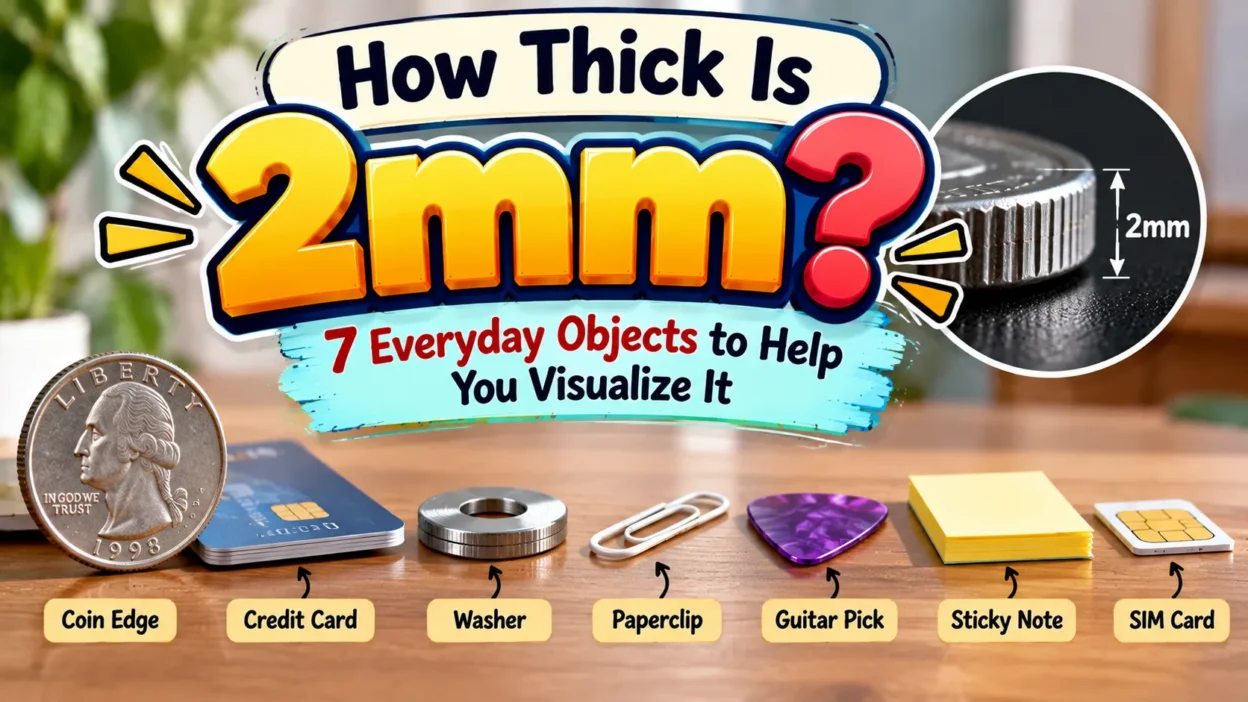
Have you ever wondered how thick 2mm really is? This tiny measurement appears in everyday objects, including coins, plastic cards, paper products, and small hardware components. Although two millimeters may sound insignificant, understanding this thickness can help when comparing materials, choosing products, or working on a DIY project.
Two millimeters equals 0.2 centimeters, approximately 0.079 inches, or about 1/13 of an inch. It is thin enough to fit into a small gap but thick enough to feel when compared with a sheet of ordinary paper. In this guide, you will discover what 2mm looks like, compare it with familiar objects, and learn how to measure this thickness accurately.
📏 How Thick Is 2mm in Inches and Centimeters?
Two millimeters is a small measurement in the metric system. It is commonly used to describe the thickness of materials, the diameter of small components, and the dimensions of everyday products.
Here are the main conversions for 2mm:
| Measurement Unit | Equivalent |
|---|---|
| Millimeters | 2 mm |
| Centimeters | 0.2 cm |
| Meters | 0.002 m |
| Inches | 0.0787 in |
| Fraction of an inch | About 5/64 inch |
| Micrometers | 2,000 µm |
The easiest conversion to remember is that 2mm is approximately 0.08 inches. It is also one-fifth of a centimeter.
Because this measurement is so small, comparing it with familiar objects is often easier than trying to picture it from numbers alone.
👀 What Does 2mm Look Like in Real Life?
Two millimeters is thinner than many common household objects, but it is not as tiny as a single sheet of paper. Imagine a small gap between two surfaces that is just wide enough for a thin plastic piece or a small metal component.
If you hold a ruler with millimeter markings, the distance between two neighboring millimeter lines represents 1mm. Two consecutive millimeters give you the full thickness of 2mm.
This is a useful visual reference when checking product dimensions, comparing materials, or deciding whether something will fit into a narrow space. Keep in mind that thickness, width, and diameter describe different dimensions, even when the measurements use the same unit.
🪙 1. About the Thickness of Two Credit Cards
A standard bank card is typically around 0.76mm thick, although cards can vary. Two cards stacked together measure approximately 1.52mm, which is thinner than 2mm.
Three standard cards stacked together would measure around 2.28mm, making that stack a little thicker than 2mm.
This comparison helps you visualize how small the measurement is. If you imagine a stack of two cards and add a little more thickness, you are approaching 2mm.
Actual card thickness varies, so use this comparison only as a rough estimate.
📄 2. Much Thicker Than a Sheet of Printer Paper
Ordinary office paper is often around 0.1mm thick, although paper weight and composition affect its actual thickness.
At that approximate thickness, 2mm is equivalent to about 20 sheets of paper stacked together.
Imagine placing a small pile of printer paper on a desk. The pile would need to contain roughly 20 typical sheets to reach a thickness of around 2mm.
This comparison is useful because paper is easy to find at home or in an office. However, heavier cardstock and specialty paper can be considerably thicker than ordinary printer paper.
🪙 3. Similar to the Thickness of Some Small Coins
Coins can help you visualize a few millimeters, but their thickness varies by currency and denomination. Some coins are close to 2mm thick, while others are noticeably thinner or thicker.
If you have coins available, place one on a flat surface and examine its edge. Comparing several coins can help you develop a better sense of small measurements.
Do not assume every coin is exactly 2mm thick. For an accurate comparison, check the official specifications of the particular coin rather than relying on its appearance.
📏 4. About the Width of Two Millimeter Marks on a Ruler
A ruler with millimeter markings provides one of the most reliable ways to picture this measurement. Each small division represents 1mm, so two divisions represent 2mm.
Look at the smallest markings between the centimeter numbers. The distance covering two of those one-millimeter divisions is the same as the measurement you are trying to visualize.
This approach works well for school projects, crafts, and quick household comparisons. It also avoids the uncertainty that comes with estimating the dimensions of unrelated objects.
🧵 5. Similar to Some Thin Cords or Wires
Certain thin cords, wires, and craft materials have a diameter close to 2mm. However, their sizes vary by material, construction, and intended use.
For example, a small decorative cord may be sold in a 2mm diameter, while electrical wires and metal components use their own size specifications. In these cases, the stated measurement may refer to the conductor, the outer insulation, or the entire product.
This distinction matters when buying replacement parts or planning a craft project. Always check whether the listed dimension refers to the complete object’s diameter or only one of its components.
🧱 6. Comparable to a Very Thin Layer of Material
Two millimeters can describe the thickness of a thin sheet, coating, gasket, or flexible material. Whether a particular product measures 2mm depends on its design and manufacturer.
Imagine a thin rubber sheet placed between two flat surfaces. A 2mm layer would create a small but noticeable gap between them.
This comparison is helpful for DIY work, repairs, and product selection. If the material needs to fit into a specific opening, check the actual thickness rather than relying on a visual estimate.
🔩 7. A Small but Noticeable Thickness in Hardware
Small washers, gaskets, spacers, and other hardware components may have dimensions measured in millimeters. A 2mm thickness can be important when a component needs to fit properly or maintain a particular spacing.
For instance, a spacer that is 2mm thick creates a gap of that size between two surfaces when installed as intended. A difference of even one millimeter may matter in precision assemblies.
When selecting hardware, remember that thickness is not the same as the inner diameter, outer diameter, or overall width of a part. Review all listed dimensions before purchasing.
📊 How Does 2mm Compare With Other Small Measurements?
Comparing 2mm with nearby measurements helps you understand its size and use it more confidently.
| Measurement | Equivalent | Comparison With 2mm |
|---|---|---|
| 0.5 mm | Half a millimeter | One-quarter as thick |
| 1 mm | One millimeter | Half as thick |
| 2 mm | Two millimeters | The full measurement |
| 3 mm | Three millimeters | 1.5 times as thick |
| 5 mm | Five millimeters | 2.5 times as thick |
| 10 mm | One centimeter | Five times as thick |
| 20 mm | Two centimeters | Ten times as thick |
The table shows that a difference of just one millimeter is significant when comparing measurements this small. For example, a 3mm sheet is 50% thicker than a 2mm sheet.
This is why it is important to check the stated thickness when buying materials, tools, or replacement components.
🔢 How to Convert 2mm to Inches
Inches are commonly used for product specifications in the United States. Converting millimeters into inches makes it easier to compare items listed in different measurement systems.
One inch equals exactly 25.4 millimeters. To convert 2mm into inches, divide two by 25.4.
2 ÷ 25.4 = 0.07874 inches
Therefore, 2mm equals approximately 0.079 inches.
As a fraction, this is close to 5/64 of an inch. This conversion can be useful when reading tool specifications or comparing small materials sold using imperial measurements.
📐 How to Convert 2mm to Centimeters
Centimeters are another metric unit used to measure length and thickness. Since one centimeter equals 10 millimeters, converting 2mm is straightforward.
Divide the millimeter measurement by 10:
2 ÷ 10 = 0.2 centimeters
Therefore, 2mm equals exactly 0.2cm.
This conversion is helpful when product dimensions are listed in centimeters instead of millimeters. Remember that 2mm is less than one centimeter, because one centimeter contains five times that measurement.
🛠️ Where Is a 2mm Thickness Useful?
A thickness of 2mm can be important in many everyday products and practical projects. It may seem small, but it can affect whether a material fits, bends, covers a surface, or works as intended.
Common applications include:
- Crafts: Measuring thin sheets, decorative materials, and small accessories.
- Home repairs: Checking the thickness of gaskets, spacers, or flexible strips.
- Product selection: Comparing plastic, rubber, or metal sheets.
- DIY projects: Planning small gaps between surfaces.
- Hardware: Checking the thickness of washers and other components.
- Design work: Understanding the dimensions of thin panels or decorative pieces.
- Model making: Selecting materials for small-scale structures.
Before buying any material, check the product description carefully. A measurement may describe thickness, width, diameter, or another dimension, and these terms are not interchangeable.
📏 How Can You Measure 2mm at Home?
Because 2mm is so small, estimating it by sight can be difficult. Fortunately, a few simple tools can help you check the measurement.
Use a metric ruler: Find the millimeter markings and identify the distance between two consecutive one-millimeter intervals.
Use a digital caliper: A caliper is useful for measuring the thickness of small objects more precisely. Check the tool’s stated accuracy and use it according to its instructions.
Use a micrometer: For measurements requiring greater precision, a suitable micrometer can measure small thicknesses. Choose the instrument appropriate for the object and level of accuracy needed.
Compare stacked paper: Approximately 20 sheets of ordinary printer paper may be close to 2mm in total thickness, but paper type and weight can change the result.
For a quick visual estimate, a ruler is often enough. If the dimension affects a repair, fit, or safety requirement, use a measuring instrument rather than relying on paper or visual comparisons.
⚠️ Common Mistakes When Visualizing 2mm
Small measurements can be easy to misjudge, especially when comparing objects with different shapes or materials. Avoid these common errors:
- Confusing millimeters with centimeters: Two millimeters equals 0.2cm, not 2cm.
- Assuming all cards have the same thickness: Card materials and designs vary.
- Mixing up diameter and thickness: A cord’s diameter is not necessarily the thickness of a flat sheet.
- Relying only on eyesight: A difference of one millimeter can be difficult to see.
- Assuming approximate comparisons are exact: Paper, coins, and wires come in different sizes.
- Ignoring measurement tolerance: Manufactured products may vary slightly from their nominal dimensions.
For accurate work, check the product specifications and measure the relevant dimension directly.
❓ Frequently Asked Questions About 2mm
Is 2mm thick or thin?
Two millimeters is considered a small thickness for many everyday materials. It is thicker than a single sheet of ordinary printer paper but still thin compared with most solid household objects.
How thick is 2mm in inches?
Two millimeters equals approximately 0.079 inches, which is close to 5/64 of an inch.
How many centimeters is 2mm?
Two millimeters equals exactly 0.2 centimeters.
Is 2mm the same as 1/8 inch?
No. One-eighth of an inch equals 3.175mm, so it is noticeably thicker than 2mm.
How many sheets of paper make 2mm?
If ordinary printer paper is approximately 0.1mm thick, around 20 sheets stacked together would measure about 2mm. The exact number depends on the paper’s thickness.
Is 2mm thicker than a credit card?
A typical bank card is around 0.76mm thick, so a single card is thinner than 2mm. Three such cards stacked together would measure approximately 2.28mm.
Can I measure 2mm with a regular ruler?
Yes, if the ruler has millimeter markings. A digital caliper or micrometer is a better choice when you need a more precise measurement.
What everyday objects are about 2mm thick?
Some small coins, thin craft materials, cords, and hardware components may measure close to 2mm in a particular dimension. Their actual sizes vary, so check specifications when accuracy matters.
✅ Conclusion
Two millimeters is a very small measurement equal to 0.2 centimeters, approximately 0.079 inches, or about 5/64 of an inch. It is thicker than a single sheet of ordinary printer paper but thinner than many common household objects.
To picture this size, imagine two millimeter divisions on a ruler or approximately 20 sheets of ordinary paper stacked together. These comparisons can help you understand the measurement when choosing materials or planning a DIY project.
For an accurate result, use a metric ruler, digital caliper, or suitable micrometer. Everyday comparisons are helpful for visualization, but direct measurement is the best way to confirm a precise thickness.

Colton Mercer is a writer and contributor at TechMeasurez, covering measurements, dimensions, size guides, conversions, comparisons, and practical online tools. His work focuses on turning everyday measurement questions into clear, easy-to-follow information. Through TechMeasurez, Colton aims to make useful facts, guides, and digital resources simple for everyone to understand.