
A 100-inch TV is an impressive display designed to create a big-screen viewing experience at home. Whether you’re planning a home theater, upgrading your living room, or checking whether a large television will fit on your wall, understanding its dimensions is essential before making a purchase.
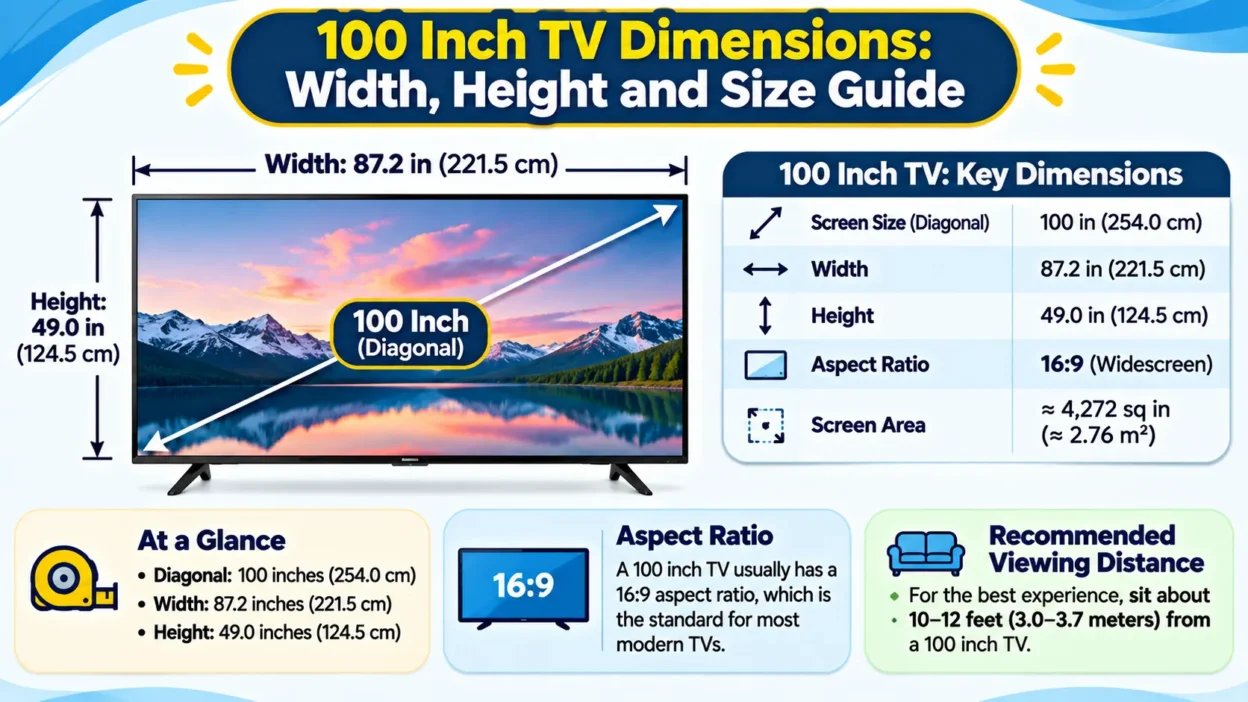
A standard 100-inch television with a 16:9 aspect ratio has a screen approximately 87.2 inches wide and 49.0 inches high. In centimeters, that is about 221.4 cm wide and 124.5 cm high. The screen’s diagonal measurement is 100 inches, equal to 254 centimeters.
These measurements describe the screen itself, not necessarily the complete television body. Bezels, frames, stands, and model-specific designs can make the actual TV slightly larger.
In this guide, you’ll discover 100-inch TV dimensions in inches and centimeters, understand screen size versus actual TV size, compare it with other popular television sizes, and learn how much wall space and viewing distance you may need.
📏 What Are the Dimensions of a 100 Inch TV?
A typical 100-inch television uses a 16:9 aspect ratio, which is the standard widescreen format used by most modern TVs.
Its screen measures approximately:
| Measurement | Inches | Centimeters |
|---|---|---|
| Screen diagonal | 100 in | 254 cm |
| Screen width | 87.2 in | 221.4 cm |
| Screen height | 49.0 in | 124.5 cm |
This means the visible screen is approximately 7 feet 3 inches wide and just over 4 feet tall.
The diagonal measurement is taken from one corner of the screen to the opposite corner. It does not represent the television’s width or height.
Actual television dimensions vary between manufacturers and models. Some televisions have very thin bezels, while others include wider frames or different cabinet designs. Always check the manufacturer’s product specifications before choosing a wall mount or TV cabinet.
📐 100 Inch TV Dimensions in Inches, Feet, and Centimeters
If you’re planning to install a 100-inch television, converting its measurements into different units can help you determine whether it will fit your available space.
Here are the approximate screen dimensions:
| Measurement | Inches | Feet | Centimeters |
|---|---|---|---|
| Width | 87.2 in | 7.27 ft | 221.4 cm |
| Height | 49.0 in | 4.08 ft | 124.5 cm |
| Diagonal | 100 in | 8.33 ft | 254 cm |
For a quick reference, remember that a 100-inch TV has a screen approximately 221 cm wide and 125 cm tall.
If you’re measuring a wall in feet, allow more than seven feet of horizontal space. You should also leave additional room around the television for installation, ventilation, cables, and access to connections.
🔍 Why Is a 100 Inch TV Measured Diagonally?
Television screen sizes are measured diagonally rather than horizontally or vertically.
This measurement starts at one corner of the visible display and extends to the opposite corner. For a 100-inch television, that diagonal distance is exactly 100 inches, or 254 centimeters.
The diagonal measurement provides a consistent way to describe screen size even when televisions have different aspect ratios.
For example, two televisions may both have 100-inch diagonal screens but different widths and heights if their aspect ratios are different.
Most modern televisions use a 16:9 widescreen format, which is why the approximate dimensions are 87.2 × 49 inches.
Remember that the screen diagonal and the complete TV body’s dimensions are not necessarily identical.
🖥️ How Big Is a 100 Inch TV Compared to a Wall?
A 100-inch television takes up a substantial amount of wall space. Its screen is approximately 87.2 inches wide, which is more than seven feet across.
Before installing one, measure the available wall area carefully.
Consider the following:
- The television’s actual outside width and height.
- The wall mount’s position and installation requirements.
- Space for electrical outlets and cables.
- Ventilation around the television.
- Nearby shelves, cabinets, and furniture.
- Comfortable viewing height.
A wall that measures exactly 87 inches wide would not be sufficient for a screen that is approximately 87.2 inches wide. The television’s frame would make the required space even larger.
For a more comfortable installation, allow additional clearance beyond the manufacturer’s complete TV dimensions.
🏠 How Much Room Do You Need for a 100 Inch TV?
A large television needs a suitable room layout. Although the screen itself is approximately 87.2 inches wide, the viewing area and furniture arrangement also matter.
A spacious living room or dedicated home theater is generally more suitable than a small room.
Before purchasing a 100-inch TV, consider the distance between the screen and your seating area. You should also think about where speakers, cabinets, and other equipment will be placed.
A practical installation plan should include:
Wall space: Make sure the wall can accommodate the complete television body and mounting hardware.
Viewing distance: Choose a seating position that provides a comfortable viewing experience.
Furniture: Check that your sofa, chairs, and entertainment cabinet do not obstruct the screen.
Lighting: Avoid strong reflections from windows and bright lights.
Installation: Make sure the wall and mounting system are suitable for the television’s weight.
Large televisions can be heavy and difficult to handle. Professional installation may be advisable, particularly for wall mounting.
📺 100 Inch TV Compared With Other TV Sizes
Comparing a 100-inch television with other common screen sizes helps you understand how much larger it is.
The following dimensions are approximate and assume a standard 16:9 aspect ratio.
| TV size | Screen width | Screen height |
|---|---|---|
| 55 inches | 47.9 in | 27.0 in |
| 65 inches | 56.7 in | 31.9 in |
| 75 inches | 65.4 in | 36.8 in |
| 85 inches | 74.0 in | 41.6 in |
| 98 inches | 85.4 in | 48.0 in |
| 100 inches | 87.2 in | 49.0 in |
| 110 inches | 95.9 in | 53.9 in |
A 100-inch TV is considerably wider and taller than a 65-inch or 75-inch television.
The difference is especially noticeable when comparing screen area. A 100-inch 16:9 display has more than twice the screen area of a 65-inch 16:9 display.
This is why a 100-inch television can create a much more immersive viewing experience, particularly for movies, sports, and large-screen gaming.
📏 How Much Bigger Is a 100 Inch TV Than an 85 Inch TV?
An 85-inch television with a 16:9 aspect ratio has an approximate screen width of 74 inches and a height of 41.6 inches.
A 100-inch TV measures approximately 87.2 inches wide and 49 inches high.
The difference is:
| Measurement | Difference |
|---|---|
| Width | 13.1 inches |
| Height | 7.4 inches |
| Diagonal | 15 inches |
Although the diagonal difference is 15 inches, the increase in screen area is much greater than the diagonal numbers might suggest.
A 100-inch television has approximately 38% more screen area than an 85-inch television with the same aspect ratio.
This is an important consideration when deciding whether the larger screen is worth the additional cost and space.
🪑 What Size TV Stand Do You Need for a 100 Inch TV?
A 100-inch television requires a strong and appropriately sized TV stand if you plan to place it on furniture rather than mount it on a wall.
The screen itself is approximately 87.2 inches wide, but the complete television may be wider depending on its frame and construction.
Your stand should meet the manufacturer’s requirements for weight capacity, support points, and placement.
Before buying furniture, check:
- The complete TV width, including its frame.
- The distance between the television’s feet, if it uses a stand.
- The television’s total weight.
- The stand’s maximum supported weight.
- The depth required by the TV’s base.
- Space for cables and connected devices.
A stand that is narrower than the television may be suitable only if the manufacturer specifically permits that arrangement and the mounting feet are fully supported.
Never assume that an ordinary cabinet can safely hold a 100-inch television. Use furniture designed for large-screen displays.
📍 What Is the Best Viewing Distance for a 100 Inch TV?
Viewing distance is important because sitting too close or too far away can affect your viewing experience.
For a 100-inch 16:9 television, the ideal distance depends on screen resolution, personal preference, and how immersive you want the picture to feel.
Here are some useful approximate viewing distances:
| Viewing preference | Distance |
|---|---|
| Very immersive viewing | Around 8.3 feet |
| Comfortable cinematic viewing | Around 10–12 feet |
| More relaxed viewing | Around 12–14 feet |
These are practical starting points rather than strict requirements. People have different preferences, and room layout can influence the best seating position.
If you mainly watch high-resolution movies and television shows, you may enjoy sitting closer than someone who prefers a more traditional viewing experience.
The best approach is to test different seating positions before finalizing your room layout.
🔩 Can You Wall Mount a 100 Inch TV?
Yes, many 100-inch televisions can be wall-mounted, but the correct mounting hardware and installation method are essential.
A television of this size can be heavy, so you must check the manufacturer’s mounting requirements before purchasing a bracket.
Important things to verify include:
VESA compatibility: Check the television’s VESA mounting pattern and make sure the bracket supports it.
Weight rating: The wall mount must be rated for the complete weight of the television.
Wall construction: The mounting system must be secured to an appropriate structural support. The correct installation method depends on the wall material.
Mounting clearance: Ensure the television has enough room for cables, ventilation, and any connections on the back.
Professional installation: Because of its size and weight, professional installation is worth considering.
Do not choose a wall mount based only on screen size. Confirm that it is compatible with the exact television model.
⚖️ How Much Does a 100 Inch TV Weigh?
The weight of a 100-inch television varies depending on its technology, frame, internal components, and stand design.
A large LED or QLED television may weigh considerably more than a smaller model. Some large-screen televisions are also supplied with different stand and mounting configurations.
There is no single accurate weight that applies to every 100-inch TV.
Before purchasing a wall mount or TV cabinet, check the manufacturer’s specifications for:
- Weight without the stand.
- Weight with the stand.
- Complete outside dimensions.
- VESA mounting pattern.
- Recommended installation requirements.
These details help you select compatible furniture and mounting equipment.
❓ Frequently Asked Questions About 100 Inch TV Dimensions
How wide is a 100-inch TV?
A standard 100-inch television with a 16:9 aspect ratio has a screen width of approximately 87.2 inches, or 221.4 centimeters. The complete TV body may be slightly wider.
How tall is a 100-inch TV?
The screen height is approximately 49 inches, equivalent to 124.5 centimeters. The actual television body may be slightly taller because of its frame and design.
How many centimeters is a 100-inch TV?
A 100-inch diagonal screen measures exactly 254 centimeters. For a standard 16:9 display, the screen is approximately 221.4 cm wide and 124.5 cm high.
Is a 100-inch TV really 8 feet wide?
Not quite. Its screen width is approximately 7.27 feet. The diagonal measures 8.33 feet, which is a different measurement.
How much wall space does a 100-inch TV need?
The screen itself is approximately 87.2 inches wide and 49 inches high. You should allow additional space for the complete TV frame, mounting hardware, cables, and ventilation.
Is a 100-inch TV bigger than a 98-inch TV?
Yes. Both generally use a 16:9 aspect ratio, but a 100-inch screen is approximately 1.7 inches wider and 1 inch taller than a 98-inch screen.
How far away should you sit from a 100-inch TV?
A viewing distance of approximately 8 to 12 feet is a useful starting point for many viewers. Your preferred distance depends on resolution, room size, and personal comfort.
Can a 100-inch TV fit in a normal living room?
It can fit in a spacious living room, but you should measure your wall, available floor space, and seating distance before buying. The room must also accommodate safe installation and suitable furniture.
🎯 Final Thoughts on 100 Inch TV Dimensions
A standard 100-inch television with a 16:9 aspect ratio has a screen approximately 87.2 inches wide and 49 inches high. In metric measurements, that is about 221.4 cm wide and 124.5 cm high. Its diagonal screen measurement is 254 centimeters.
This is a very large display, so planning its installation requires more attention than choosing a smaller television. Measure your wall, check the complete TV dimensions, consider the viewing distance, and make sure your stand or wall mount is suitable for the model.
Most importantly, remember that advertised screen size refers to the diagonal measurement rather than the television’s width. Checking the manufacturer’s specifications before purchasing will help you avoid fitting and installation problems.

Colton Mercer is a writer and contributor at TechMeasurez, covering measurements, dimensions, size guides, conversions, comparisons, and practical online tools. His work focuses on turning everyday measurement questions into clear, easy-to-follow information. Through TechMeasurez, Colton aims to make useful facts, guides, and digital resources simple for everyone to understand.