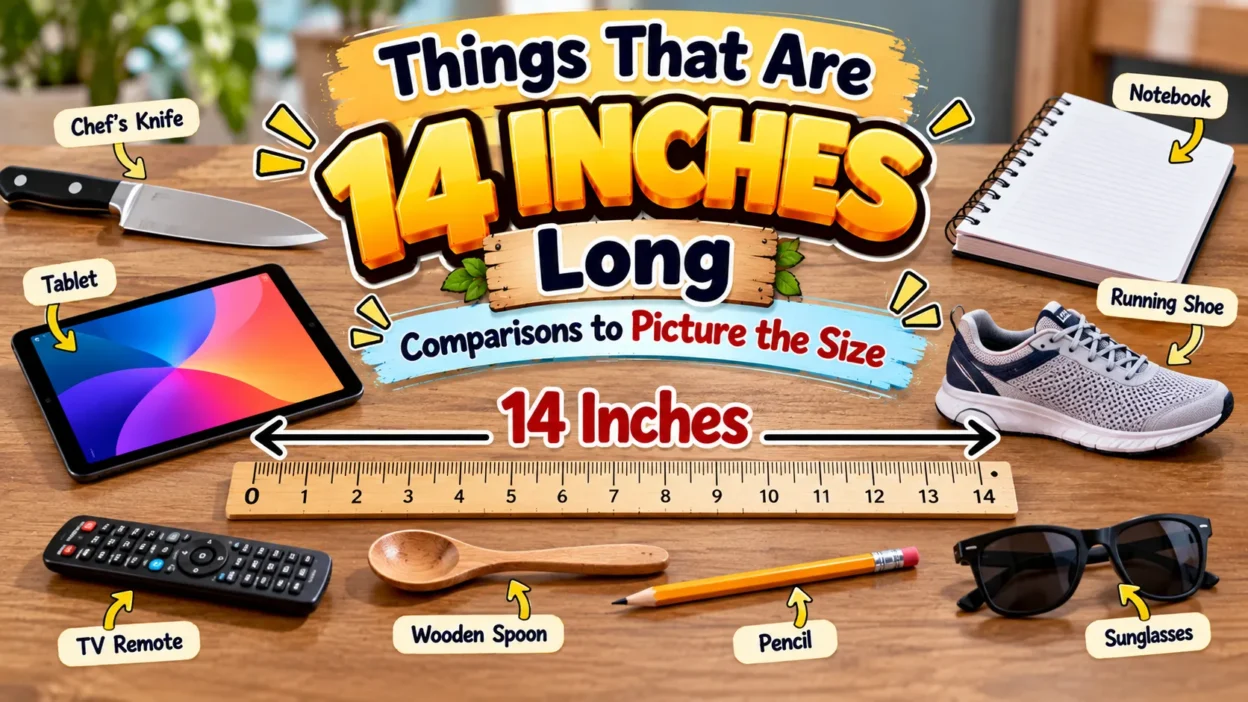
Have you ever wondered what 14 inches looks like in real life? This measurement might seem difficult to imagine without a measuring tape, but you probably encounter objects close to this size every day. From a laptop screen and a large pizza to a sheet of legal paper, several familiar items can help you visualize 14 inches.
14 inches equals 1 foot 2 inches, 35.56 centimeters, or 0.3556 meters. It is slightly longer than a standard 12-inch ruler, making it a useful measurement to picture when comparing everyday objects.
In this guide, you will discover 15 things that are approximately 14 inches long or wide, learn how to visualize the measurement, and find practical examples you can use at home, school, or work.
📏 How Big Is 14 Inches?
Fourteen inches is a little longer than one foot. Since one foot contains 12 inches, adding another 2 inches gives you a total of 14 inches.
Here are the most useful conversions:
- In feet and inches: 1 foot 2 inches
- In centimeters: 35.56 cm
- In meters: 0.3556 m
- In millimeters: 355.6 mm
- In yards: Approximately 0.389 yards
Imagine holding a standard 12-inch ruler and adding 2 more inches to its end. That combined length represents 14 inches.
This comparison makes the measurement easier to understand because most people have seen a standard ruler or measuring tape. You can also picture the distance between the ends of a 14-inch pizza or the longer edge of a US legal-size sheet of paper.
Keep in mind that an object’s advertised size may refer to its diameter, screen diagonal, width, or total length. These measurements are not interchangeable, so it helps to check exactly what is being measured.
💻 1. A 14-Inch Laptop Screen
A 14-inch laptop is one of the easiest ways to picture this measurement, especially if you use a computer regularly. Many laptop models are sold with screens advertised as 14 inches.
However, there is an important detail: a laptop’s screen size is measured diagonally, not horizontally across the display. The visible screen measures 14 inches from one corner to the opposite corner.
The laptop itself is usually wider than 14 inches because its body includes the screen frame, hinges, and other components. Its height also depends on the screen’s aspect ratio and the design of the computer.
For example, a laptop with a 14-inch display may have a body width of roughly 12 to 13 inches, although actual dimensions vary by model.
If you have a laptop at home, check its specifications to see whether it has a 14-inch screen. You can use it as a visual reference for the diagonal measurement, but do not assume that the entire laptop is exactly 14 inches long.
This example is particularly useful when shopping for a computer bag, desk accessories, or a protective laptop sleeve. Always compare the laptop’s actual body dimensions with the product’s measurements before purchasing a case.
🍕 2. A 14-Inch Pizza
A 14-inch pizza is another familiar way to understand this measurement. Many pizza restaurants offer pizzas with a diameter of 14 inches, although sizes differ between restaurants.
The diameter is the straight-line distance across the pizza through its center. Therefore, a pizza advertised as 14 inches wide measures 14 inches from one outer edge to the opposite edge.
That is equivalent to 35.56 centimeters across.
A pizza of this size can look considerably larger than a personal pizza, especially when placed on a dinner table. Its actual serving capacity depends on the crust, toppings, and how the pizza is sliced.
For example, a restaurant might cut a 14-inch pizza into eight slices, while another might offer ten or twelve slices. The number of slices does not change the pizza’s diameter.
If you want to picture 14 inches without using a ruler, imagine a large round pizza on a table. The distance across its center provides a convenient visual reference.
Remember that a pizza’s stated size generally describes its diameter, not its circumference. The circumference is the distance around the outside edge and is much longer than 14 inches.
📄 3. A Sheet of US Legal-Size Paper
A sheet of US legal-size paper has a long edge measuring exactly 14 inches. This makes it one of the most practical and accurate everyday examples of the measurement.
Legal-size paper measures 8.5 inches wide by 14 inches long. In metric units, its dimensions are approximately 21.59 by 35.56 centimeters.
If you place a sheet of legal paper on a desk and measure its longer side, you will get 14 inches. This is a reliable reference because legal paper follows a standardized size in the United States.
Legal-size paper is commonly used for contracts, legal documents, forms, and certain business records. It is longer than standard US letter-size paper, which measures 8.5 by 11 inches.
The difference is easy to see when the two sheets are placed side by side. Legal paper extends 3 inches beyond the long edge of letter-size paper.
This example is especially helpful for students, office workers, and anyone who handles printed documents. If you have legal paper available, its long edge gives you a straightforward way to visualize the exact length.
Just remember that other countries use different paper-size standards, so a generic sheet of office paper may not measure 14 inches along either side.
🍳 4. A 14-Inch Skillet or Frying Pan
Some large skillets and frying pans are sold in 14-inch sizes. These pans can help you picture the measurement because their broad, round cooking surfaces are easy to compare with a ruler or measuring tape.
In most cases, the advertised pan size refers to the approximate diameter across the top, rather than the length of the handle or the flat cooking base. A pan with a 14-inch diameter measures about 35.56 centimeters across its opening.
This does not mean every part of the pan is 14 inches wide. The base may be narrower, the sides may slope inward, and the handle adds extra length to the complete item.
Large skillets are useful for cooking family-sized meals, preparing multiple ingredients, or making dishes that need plenty of surface area. Their actual capacity depends on the pan’s depth and shape.
If you already own a frying pan, measure from one outer rim to the opposite rim to determine its diameter. You might discover that it is smaller or larger than 14 inches.
A 14-inch skillet is a helpful visual comparison, but it is not as universally available as a standard ruler or legal-size paper. Always check the manufacturer’s listed dimensions if exact sizing matters.
🪴 5. A 14-Inch Plant Pot
A large plant pot with a 14-inch diameter can provide another useful comparison. Garden centers and online stores sell containers in a variety of sizes, including pots around 14 inches wide.
If a pot is described as 14 inches in diameter, that measurement generally refers to the width across the top opening. It does not necessarily describe the pot’s height or its width at the bottom.
For instance, a tapered pot may measure 14 inches across the top but become noticeably narrower near its base. A tall planter can also have a height quite different from its diameter.
A container of this size may be suitable for certain houseplants, patio plants, or small shrubs, depending on the plant’s root system and growing requirements. The appropriate pot size is determined by the plant rather than the measurement alone.
To picture 14 inches, imagine a round container sitting on a garden bench. The distance from one side of its top opening to the other represents the approximate measurement.
This example is particularly useful for gardeners who need to plan shelf space, arrange containers on a patio, or compare the size of different planters.
Because pot dimensions are not always standardized, check whether a seller lists the top diameter, bottom diameter, or height before making a purchase.
🚗 6. The Diameter of Some Car Steering Wheels
Some car steering wheels measure approximately 14 inches in diameter, although the exact size varies according to the vehicle and steering-wheel design.
To understand this comparison, picture the circular steering wheel in a car. The diameter is the straight-line distance from one side of the wheel to the opposite side, passing through its center.
A steering wheel measuring 14 inches across would be approximately 35.56 centimeters in diameter.
However, not every steering wheel is this size. Some are larger or smaller, and the measurement can vary depending on the make, model, and type of vehicle.
The wheel’s outer rim also has thickness, so the diameter is usually measured across the outside edges rather than across the inner opening.
If you are curious about the size of your own steering wheel, use a measuring tape to measure straight across its center. Avoid following the curve of the wheel, because that would measure a different distance.
This comparison can make the measurement easier to imagine, but it should not be used to choose a replacement steering wheel without checking vehicle compatibility and the manufacturer’s specifications.
🖥️ 7. Some Computer Monitors Measured Diagonally
A computer monitor with a 14-inch display is another possible reference for the measurement. Portable monitors and compact displays are available in this size range, although many traditional desktop monitors are larger.
Like laptop displays, monitor sizes are usually measured diagonally across the visible screen. A 14-inch monitor therefore has a diagonal of 14 inches, not necessarily a width of 14 inches.
The horizontal width depends on the screen’s aspect ratio. A widescreen display and a more square-shaped display can have different widths even when both have the same diagonal measurement.
The outer frame can also increase the monitor’s total dimensions beyond the size of the visible display.
This distinction matters when you are arranging a workstation or buying a monitor stand. A screen advertised as 14 inches may require a different amount of desk space from what the number initially suggests.
To picture the diagonal, imagine drawing a straight line from the top-left corner of the visible display to the bottom-right corner. That line represents the advertised screen size.
If you need an exact physical measurement, consult the manufacturer’s width and height specifications rather than relying only on the diagonal screen measurement.
📐 8. A Little More Than a Standard 12-Inch Ruler
A standard 12-inch ruler is a simple reference point for understanding 14 inches. Many school and office rulers measure exactly 12 inches, which is equal to one foot.
To reach 14 inches, you need to add another 2 inches to the ruler’s length.
Imagine placing a 2-inch measuring section directly after the ruler’s 12-inch mark. The combined distance from the beginning to the 14-inch mark would be 14 inches.
This comparison is particularly useful because you may already have a ruler at home, in a classroom, or in an office drawer.
It also makes clear that 14 inches is not dramatically longer than one foot. The extra 2 inches represent one-sixth of the original 12-inch length.
If you do not have a ruler that measures 14 inches, you can use a measuring tape to mark the distance on a flat surface. Alternatively, measure 12 inches first and then extend the measurement by another 2 inches.
Do not assume that a ruler with 12 inches printed on it can show the full 14-inch length on its own. You need a second measurement or a longer measuring tool to confirm the complete distance accurately.
📚 9. Two Standard Hardcover Books Placed End to End
Two hardcover books placed end to end can sometimes help you visualize 14 inches, depending on their individual heights or lengths.
For example, imagine two books that each measure approximately 7 inches along one edge. If you place them in a straight line, with their edges touching and no overlap, the combined measurement will be about 14 inches.
The important word is approximately. Books come in many formats, including small novels, large reference books, textbooks, and oversized art books. Their dimensions are not all the same.
To use this comparison accurately, measure the edge you plan to place end to end. Two 7-inch books will make a 14-inch line only if the measured edges are actually 7 inches each.
This is a handy household comparison when you do not have a measuring tape nearby. It can also help children understand how smaller lengths combine to create a larger measurement.
For a more precise result, place the books on a flat surface and line up their edges carefully. Even a small gap or overlap can change the total length.
Books are best treated as a visual aid rather than a standardized measuring tool unless you know their exact dimensions.
🧰 10. A Large Kitchen Knife Measured From Tip to Handle
Some large kitchen knives have a total length close to 14 inches when measured from the tip of the blade to the end of the handle. However, kitchen knives vary significantly in design, and many are shorter.
When a knife is advertised using a measurement such as 14 inches, check whether that number describes the entire knife or only its blade. A 14-inch overall knife is different from a knife with a 14-inch blade.
For instance, the total length includes both the blade and the handle. The blade alone will therefore be shorter than the complete knife.
This example can help you picture a relatively long kitchen tool, but it should not be used as a precise comparison without knowing the particular knife’s specifications.
If you are measuring a knife you already own, place it on a stable surface and measure its full length carefully. Handle shapes and curved blades can make visual estimates misleading.
Always handle sharp kitchen tools safely and keep the blade pointed away from your body while measuring. If you only need a general visual comparison, a ruler or sheet of legal paper is safer and more reliable.
🧁 11. A Round Baking Pan With a 14-Inch Diameter
Some baking pans and pizza pans are sold with a diameter of approximately 14 inches. These round pans provide a convenient way to picture the measurement in a kitchen.
The diameter is measured straight across the circular pan, from one outside edge to the opposite edge. It does not measure the distance around the rim.
A 14-inch pan is about 35.56 centimeters across. However, its usable cooking surface may be slightly smaller depending on the thickness and shape of the rim.
The pan’s depth is another separate measurement. A shallow baking pan and a deep round cake pan can have the same diameter while holding different amounts of food.
If you are following a recipe, use the pan size specified by the recipe whenever possible. Substituting a pan with a different diameter can affect how quickly food cooks and how thick the finished result becomes.
To visualize 14 inches, imagine the full width of a large round pan on a countertop. This works especially well if you already have baking equipment at home and can compare its size with a ruler.
Check the packaging or manufacturer’s specifications if you need an exact diameter, since the stated size may be rounded.
🪵 12. A Short Piece of Trim or Wood
A cut piece of wood measuring 14 inches long is another straightforward example. Woodworkers, DIY enthusiasts, and homeowners regularly measure short sections of lumber, trim, and craft materials.
Unlike screen sizes or round containers, a piece of wood described as 14 inches long usually refers to the straight distance between its two ends.
Imagine a narrow wooden strip lying on a workbench. If one end is placed at the zero mark of a measuring tape and the other reaches the 14-inch mark, the piece is 14 inches long.
This comparison is useful when planning small home projects, building simple craft items, or estimating the size of a shelf component.
However, do not confuse length with the thickness or width of the wood. A board can be 14 inches long while being only a fraction of that measurement in thickness.
When cutting wood, always measure the actual piece and account for the cut line. A saw blade removes a small amount of material, so the placement of the cut matters if the final length must be exact.
Wood is a good example of a 14-inch object because it can be cut to a specific length, unlike many manufactured household products whose dimensions vary.
🧵 13. A Piece of Fabric Cut to 14 Inches
A piece of fabric can measure exactly 14 inches along one edge, making it a useful comparison for sewing, quilting, and craft projects.
Fabric is sold and cut in many different dimensions, so there is no universal fabric item that is always 14 inches long. Instead, you can cut a section to this measurement using a ruler or sewing tape.
For example, a square of fabric measuring 14 by 14 inches has two sides that are each 14 inches long. A rectangular piece measuring 14 by 20 inches has one shorter side of 14 inches.
This distinction matters because the length of a fabric piece depends on which edge you are measuring.
Fabric can also stretch, wrinkle, or shift while you measure it. For more accurate results, lay it flat on a table and smooth it without pulling it out of shape.
A 14-inch fabric section might be useful for a small sewing project, a craft decoration, or part of a quilt, depending on the design. The required size will vary according to the pattern and the amount of material needed for seams.
If you need an accurate 14-inch piece, measure the fabric directly rather than estimating from its appearance.
🛠️ 14. A Large Hand Tool or Workshop Accessory
Some workshop tools and accessories have an overall length close to 14 inches. Examples can include certain handles, tool holders, specialty wrenches, and measuring or cutting accessories.
However, tools are manufactured in a wide range of sizes, and there is no single workshop item that is consistently 14 inches long. The advertised measurement might refer to the working section, the handle, or the entire tool.
For instance, a tool described as 14 inches long may measure from the end of its handle to the opposite tip. Another product could use 14 inches to describe its maximum reach or another specific dimension.
If you are shopping for a tool, check the manufacturer’s dimension diagram. Product titles alone may not make clear which part of the item is being measured.
For a visual comparison, picture a relatively long hand tool lying flat on a workbench. Its total length would be a little longer than a 12-inch ruler.
This example is less standardized than legal paper, but it shows how the measurement can appear in practical work settings.
Always choose tools based on their intended use and specifications, not merely because their dimensions seem close to 14 inches.
🧺 15. A Small Storage Basket or Organizer
Some small storage baskets and desk organizers measure approximately 14 inches across one side. These products are available in many shapes, including rectangular bins, fabric baskets, and plastic organizers.
A basket described as 14 inches wide may have a different length and height. For example, a rectangular organizer could measure 14 inches wide, 10 inches deep, and 6 inches tall.
These are three separate dimensions. The width is not the same as the depth, and neither measurement tells you the height.
A 14-inch organizer can be useful for storing craft supplies, household accessories, office materials, or other small items. Whether it fits in a cupboard or on a shelf depends on the complete set of dimensions.
To visualize the width, imagine placing the organizer on a shelf and measuring across its front edge. The distance from one side to the other would represent 14 inches if that is the listed width.
If you are buying storage containers, allow extra room for handles, lids, or protruding edges. A product’s outside dimensions may be larger than the usable space inside.
This example shows why understanding 14 inches is useful for planning storage and arranging furniture, even when the item is not exactly 14 inches in every direction.
📊 Quick Comparison: 15 Things That Help You Picture 14 Inches
The table below summarizes familiar objects and the way each relates to the measurement. Some examples are exact by definition, while others depend on the specific product.
| Object | How it relates to 14 inches |
|---|---|
| 14-inch laptop screen | 14-inch diagonal across the visible screen |
| 14-inch pizza | Approximately 14-inch diameter |
| US legal-size paper | Exactly 14 inches along its long edge |
| 14-inch skillet | Often refers to the top diameter |
| Plant pot | May have a 14-inch top diameter |
| Car steering wheel | Some models measure around 14 inches across |
| 14-inch computer monitor | 14-inch screen diagonal |
| 12-inch ruler plus 2 inches | Combined length of 14 inches |
| Two 7-inch books | 14 inches when placed end to end |
| Large kitchen knife | Some measure close to 14 inches overall |
| Round baking pan | May have a 14-inch diameter |
| Piece of wood | Can be cut to exactly 14 inches |
| Piece of fabric | Can be cut or measured to 14 inches |
| Workshop tool | Some tools are about 14 inches long |
| Storage organizer | Some models measure 14 inches wide |
For the most dependable visual comparisons, start with legal-size paper or a ruler plus 2 inches. These examples are easier to verify than objects whose dimensions depend on a particular brand or model.
🧮 How to Measure 14 Inches Without a Ruler
You do not always need a ruler marked with 14 inches to estimate this distance. A few familiar measurements can help you create a reference, although a measuring tape is best when accuracy matters.
Method 1: Start with a 12-inch ruler. Place the ruler on a flat surface and mark its endpoint. Then measure another 2 inches from that point. The distance from the starting point to the new mark is 14 inches.
Method 2: Use legal-size paper. If you have a standard US legal-size sheet, its longer edge is exactly 14 inches. Place the paper flat and use that edge as a reference.
Method 3: Combine two known lengths. Two objects that are each exactly 7 inches long will total 14 inches when placed end to end without gaps or overlap.
Method 4: Use a measuring tape. Extend the tape to the 14-inch mark and compare the distance with the object you want to measure.
Avoid relying on hand spans, shoe lengths, or other body-based estimates if you need a precise result. These vary from person to person and can produce inaccurate measurements.
🔍 Why Does 14 Inches Look Different on Different Objects?
Fourteen inches is a fixed length, but it can look very different depending on the shape and orientation of the object.
A 14-inch pizza is measured across its circular surface. A 14-inch laptop screen is measured diagonally, while legal-size paper measures 14 inches along its longer edge. Each object uses a different dimension to describe its size.
The object’s shape also affects your perception. A long, narrow strip of wood may look much longer than a round pan with the same 14-inch measurement across its diameter.
Distance and perspective can change how large something appears, too. An object held close to your eyes may look larger than the same object viewed from across a room.
That is why comparing measurements is more reliable than judging size by appearance alone. Whenever possible, identify whether the measurement refers to length, width, height, diameter, or diagonal.
❓ Frequently Asked Questions About Things That Are 14 Inches
These quick answers explain common questions about this measurement and how to picture it in everyday life.
How many feet is 14 inches?
Fourteen inches equals 1 foot 2 inches, or approximately 1.17 feet. Since one foot contains 12 inches, the remaining 2 inches bring the total to 14.
How many centimeters is 14 inches?
Fourteen inches equals 35.56 centimeters. To convert inches to centimeters, multiply the number of inches by 2.54.
Is 14 inches longer than a foot?
Yes. One foot equals 12 inches, so 14 inches is 2 inches longer than a foot.
Is a 14-inch laptop actually 14 inches long?
Not necessarily. A 14-inch laptop usually has a screen measured diagonally from one corner to the opposite corner. The laptop’s full body width and length depend on its design.
What paper is 14 inches long?
Standard US legal-size paper measures 8.5 inches by 14 inches. Its longer edge is exactly 14 inches.
What household item is closest to 14 inches?
A sheet of US legal-size paper is an especially useful reference because its long edge measures exactly 14 inches. A 14-inch pizza or some large pans can also provide a helpful visual comparison.
Is 14 inches the same as 35 centimeters?
Not exactly. Fourteen inches equals 35.56 centimeters, which is 0.56 centimeters longer than 35 centimeters.
How can I visualize 14 inches quickly?
Picture a standard 12-inch ruler with another 2 inches added to its end. You can also use the long edge of US legal-size paper as a direct reference.
✅ Final Thoughts on Things That Are 14 Inches
Fourteen inches is a manageable length to picture once you compare it with familiar objects. It equals 1 foot 2 inches, or 35.56 centimeters, and is only 2 inches longer than a standard foot-long ruler.
A 14-inch pizza, a laptop screen with a 14-inch diagonal, a large skillet, and a sheet of US legal-size paper are all useful examples. Just remember that the advertised measurement may describe a diameter, screen diagonal, width, or total length.
For the most accurate comparison, use the long edge of legal-size paper or measure 14 inches directly with a tape measure. These methods make it easier to understand the size without relying on guesswork.

Colton Mercer is a writer and contributor at TechMeasurez, covering measurements, dimensions, size guides, conversions, comparisons, and practical online tools. His work focuses on turning everyday measurement questions into clear, easy-to-follow information. Through TechMeasurez, Colton aims to make useful facts, guides, and digital resources simple for everyone to understand.