Converting yards to inches is a simple way to understand measurements used in construction, sewing, sports, landscaping, and everyday activities. Although yards and inches belong to the same measurement system, they represent different lengths. Knowing how to convert between them makes measuring materials, comparing dimensions, and solving measurement problems much easier.
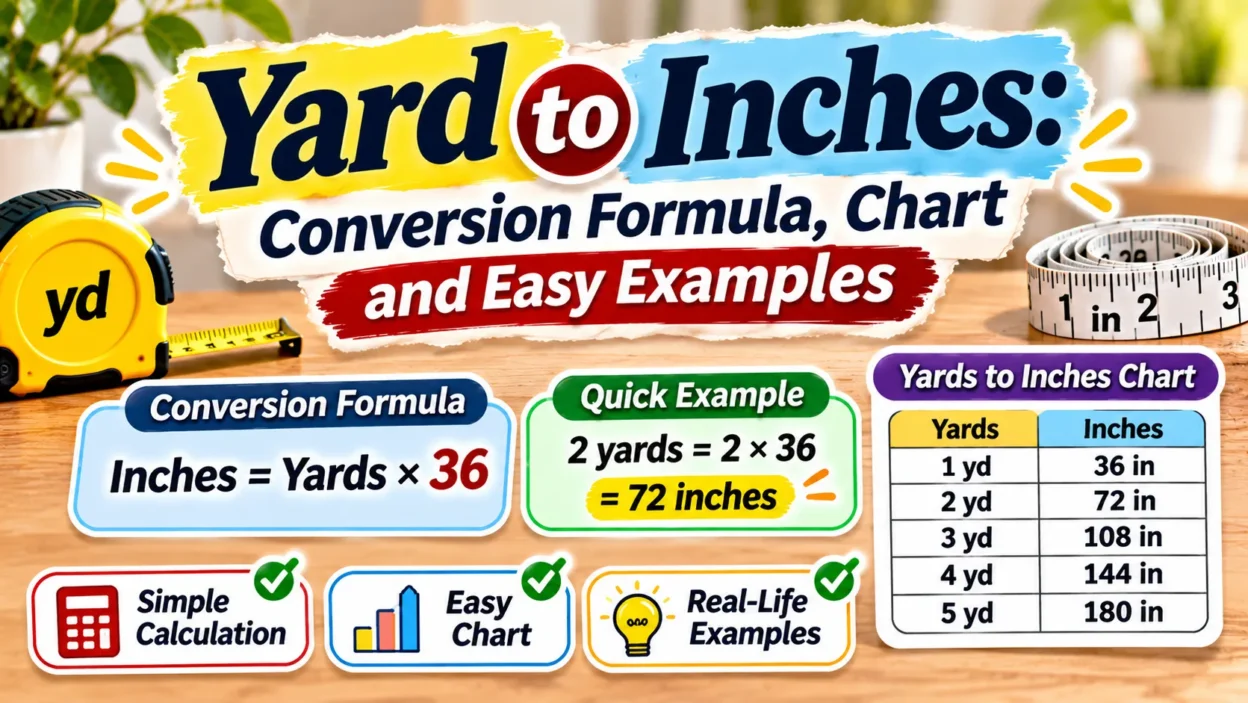
So, how many inches are in a yard? One yard equals exactly 36 inches. This means you can convert any yard measurement into inches by multiplying the number of yards by 36.
For example, 2 yards equal 72 inches, while 5 yards equal 180 inches. Once you learn this simple conversion, you can calculate almost any measurement in seconds.
In this guide, you will discover the exact yard-to-inch formula, explore a conversion chart, learn practical examples, and understand how to avoid common measurement mistakes.
How Many Inches Are in a Yard? 📏
There are 36 inches in 1 yard. This is an exact conversion, not an estimate. The relationship remains the same whether you measure fabric, furniture, flooring, sports fields, or other objects.
Here are some basic conversions:
- 1 yard = 36 inches
- 2 yards = 72 inches
- 3 yards = 108 inches
- 4 yards = 144 inches
- 5 yards = 180 inches
- 10 yards = 360 inches
The yard is commonly used in the United States for measuring longer distances and materials. Inches are more useful for smaller dimensions that require greater detail.
For example, a fabric store may sell material by the yard, while a sewing pattern may provide measurements in inches. Converting between these units helps you understand exactly how much material you need.
What Is the Formula to Convert Yards to Inches? 🧮
You can convert yards into inches by multiplying the number of yards by 36. This formula works because every yard contains exactly 36 inches.
Yards to Inches Formula:
[
\text{Inches} = \text{Yards} \times 36
]
For example, suppose you want to convert 4 yards into inches.
Step 1: Start with the measurement.
4 yards
Step 2: Multiply the measurement by 36.
4 × 36 = 144
Step 3: Write the result with the correct unit.
4 yards = 144 inches
You can apply this formula to whole numbers, fractions, and decimal measurements.
Quick Calculation Examples
| Yards | Calculation | Inches |
|---|---|---|
| 0.5 yd | 0.5 × 36 | 18 in |
| 1 yd | 1 × 36 | 36 in |
| 1.5 yd | 1.5 × 36 | 54 in |
| 2 yd | 2 × 36 | 72 in |
| 2.5 yd | 2.5 × 36 | 90 in |
| 3 yd | 3 × 36 | 108 in |
| 5 yd | 5 × 36 | 180 in |
| 10 yd | 10 × 36 | 360 in |
Yards to Inches Conversion Chart 📊
A conversion chart helps you find the inch equivalent without repeating the calculation. Use this table for quick measurements, school assignments, fabric projects, and home improvement tasks.
| Yards (yd) | Inches (in) |
|---|---|
| 0.25 yd | 9 in |
| 0.5 yd | 18 in |
| 0.75 yd | 27 in |
| 1 yd | 36 in |
| 1.25 yd | 45 in |
| 1.5 yd | 54 in |
| 1.75 yd | 63 in |
| 2 yd | 72 in |
| 2.5 yd | 90 in |
| 3 yd | 108 in |
| 3.5 yd | 126 in |
| 4 yd | 144 in |
| 4.5 yd | 162 in |
| 5 yd | 180 in |
| 6 yd | 216 in |
| 7 yd | 252 in |
| 8 yd | 288 in |
| 9 yd | 324 in |
| 10 yd | 360 in |
| 15 yd | 540 in |
| 20 yd | 720 in |
| 25 yd | 900 in |
| 50 yd | 1,800 in |
| 100 yd | 3,600 in |
Each value follows the same rule: multiply the yard measurement by 36.
How to Convert Fractional Yards to Inches 🔢
Not every measurement uses a whole number. Fabric, craft materials, and sewing supplies often come in fractions of a yard. Fortunately, you can convert fractional yards using the same multiplication formula.
For example, half a yard equals 18 inches because 0.5 × 36 = 18.
Here are several common fractional conversions:
Half a Yard to Inches
Half a yard represents 0.5 of a full yard.
[
0.5 \times 36 = 18
]
Therefore, ½ yard = 18 inches.
Quarter Yard to Inches
A quarter yard represents 0.25 of a full yard.
[
0.25 \times 36 = 9
]
Therefore, ¼ yard = 9 inches.
Three-Quarter Yard to Inches
Three-quarters of a yard represents 0.75 of a full yard.
[
0.75 \times 36 = 27
]
Therefore, ¾ yard = 27 inches.
One and a Half Yards to Inches
Convert 1½ yards into its decimal form, which is 1.5.
[
1.5 \times 36 = 54
]
Therefore, 1½ yards = 54 inches.
Two and a Half Yards to Inches
Convert 2½ yards into 2.5 and multiply by 36.
[
2.5 \times 36 = 90
]
Therefore, 2½ yards = 90 inches.
These conversions are particularly helpful when buying fabric, cutting materials, or following measurements in craft instructions.
How to Convert Inches Back to Yards? 🔄
Sometimes you may have a measurement in inches but need to express it in yards. You can reverse the original formula by dividing the number of inches by 36.
Inches to Yards Formula:
[
\text{Yards} = \text{Inches} \div 36
]
For example, suppose you have 108 inches and want to convert that measurement into yards.
[
108 \div 36 = 3
]
Therefore, 108 inches = 3 yards.
Here are a few additional examples:
| Inches | Calculation | Yards |
|---|---|---|
| 18 in | 18 ÷ 36 | 0.5 yd |
| 36 in | 36 ÷ 36 | 1 yd |
| 54 in | 54 ÷ 36 | 1.5 yd |
| 72 in | 72 ÷ 36 | 2 yd |
| 90 in | 90 ÷ 36 | 2.5 yd |
| 108 in | 108 ÷ 36 | 3 yd |
| 144 in | 144 ÷ 36 | 4 yd |
| 180 in | 180 ÷ 36 | 5 yd |
Remember the difference between the two formulas:
- Yards to inches: Multiply by 36.
- Inches to yards: Divide by 36.
How Long Is a Yard Compared to Inches? 📐
A yard measures 36 inches, which makes it three times as long as a foot. Since one foot contains 12 inches, three feet equal one yard.
The relationship between these measurements is:
- 1 yard = 3 feet
- 1 foot = 12 inches
- 1 yard = 36 inches
You can use this relationship to understand longer measurements without memorizing additional conversion values.
For example, imagine a piece of rope measuring 2 yards. You can first convert 2 yards into 6 feet and then multiply 6 by 12 to get 72 inches.
Both methods produce the same answer.
What Does a Yard Look Like in Everyday Life? 🏠
It can be difficult to picture 36 inches without a familiar reference. Everyday objects and common measurements can help you understand how long a yard actually is.
Here are some practical comparisons:
1. A Standard Yardstick
A yardstick is designed to measure exactly one yard. Its length is 36 inches, making it one of the easiest tools for visualizing this measurement.
You can use a yardstick for measuring fabric, furniture, flooring, and other household materials.
2. Three Standard Rulers
A typical school ruler measures 12 inches. Place three standard 12-inch rulers end to end, and their combined length will equal 36 inches, or one yard.
This comparison makes the relationship between inches and yards easy to remember.
3. Three Feet of Fabric
If you purchase one yard of fabric, you receive a length of 36 inches. However, the width depends on the fabric type and manufacturer.
For sewing projects, always check both the length and width before purchasing material.
4. A Short Section of Rope
A rope measuring one yard has a length of 36 inches. If you cut a 3-yard section, it will measure 108 inches.
This comparison is useful for gardening, outdoor projects, and household repairs.
5. A Measuring Tape
Many measuring tapes display inches, feet, and sometimes yards. When the tape reaches the 36-inch mark, you have measured exactly one yard.
A measuring tape is especially useful when checking longer objects or distances.
Where Are Yard-to-Inch Conversions Used? 🛠️
Yard-to-inch conversions are useful in many everyday activities. Although the calculation is simple, using the correct unit can help you avoid purchasing mistakes and measurement errors.
Fabric and Sewing
Fabric stores commonly sell material by the yard. However, sewing patterns may provide measurements in inches.
For example, if a project requires 2 yards of fabric, you can convert that amount into 72 inches. This helps when planning fabric cuts and checking available material.
Remember that fabric also has a width measurement, so the total amount of fabric depends on both dimensions.
Construction and Home Improvement
Builders and DIY enthusiasts sometimes use yards for longer measurements and inches for smaller details.
For example, a 4-yard material length equals 144 inches. Converting this measurement helps when comparing product dimensions or following project instructions.
Always double-check measurements before cutting or installing materials.
Landscaping and Gardening
Gardeners may use yards when estimating the length of fencing, hoses, or landscaping materials. Inches can provide more precise measurements when cutting or positioning smaller sections.
For instance, a 5-yard garden hose section measures 180 inches.
Sports and Outdoor Activities
Yards are common in sports measurements, particularly American football. A football field uses yard markings to show distance.
Converting these distances into inches can help with educational activities and measurement exercises, although sports rules generally use yards.
Crafts and DIY Projects
Craft projects often involve ribbons, ropes, decorative materials, and other supplies sold by the yard.
If you need 1.5 yards of ribbon, you can calculate 54 inches. This makes it easier to measure and cut the required length.
Common Mistakes When Converting Yards to Inches ⚠️
Although the conversion formula is straightforward, small mistakes can lead to incorrect measurements. Keep these points in mind when working with yards and inches.
1. Using 12 Instead of 36
One yard contains 36 inches, not 12 inches. Twelve inches equal one foot, so multiplying yards by 12 gives the wrong result.
2. Dividing Instead of Multiplying
When converting yards into inches, multiply by 36. Division works when you convert inches back into yards.
3. Confusing Yards with Feet
A yard contains three feet. If you need to convert yards into feet, multiply by 3. If you need inches, multiply by 36.
4. Ignoring Fractions
Measurements such as ½ yard and ¾ yard are common in fabric and craft projects. Convert fractions into decimals or multiply the fraction directly by 36.
5. Forgetting the Unit
Always include the correct unit after your answer. Writing 72 without identifying inches or yards can create confusion, especially in construction and technical work.
Frequently Asked Questions About Yards to Inches ❓
How many inches are in 1 yard?
There are exactly 36 inches in 1 yard. This is a standard conversion used throughout the US customary measurement system.
How many inches are in 2 yards?
Two yards equal 72 inches. Multiply 2 by 36 to get the result.
How many inches are in 3 yards?
Three yards equal 108 inches because 3 × 36 = 108.
How many inches are in 5 yards?
Five yards equal 180 inches. Simply multiply 5 by 36.
How many inches are in half a yard?
Half a yard equals 18 inches. You can calculate this by multiplying 0.5 by 36.
How many inches are in a quarter yard?
A quarter yard equals 9 inches because 0.25 × 36 = 9.
Is 36 inches equal to 1 yard?
Yes. One yard and 36 inches represent exactly the same length.
How many feet are in a yard?
One yard contains exactly 3 feet. Since each foot contains 12 inches, 3 × 12 equals 36 inches.
How do I convert yards to inches quickly?
Multiply the number of yards by 36. For example, 7 yards × 36 = 252 inches.
Is a yard longer than a meter?
No. One yard equals 0.9144 meters, while one meter equals approximately 1.094 yards. Therefore, a meter is slightly longer than a yard.
Conclusion
Converting yards to inches is easy once you remember one important number: 36. Every yard contains exactly 36 inches, so multiply the number of yards by 36 to find the equivalent measurement.
For example, 1 yard equals 36 inches, 2 yards equal 72 inches, and 5 yards equal 180 inches. You can also reverse the calculation by dividing inches by 36 to find yards.
Whether you are measuring fabric, planning a DIY project, checking construction materials, or completing a school assignment, this simple formula will help you work with measurements accurately.

Colton Mercer is a writer and contributor at TechMeasurez, covering measurements, dimensions, size guides, conversions, comparisons, and practical online tools. His work focuses on turning everyday measurement questions into clear, easy-to-follow information. Through TechMeasurez, Colton aims to make useful facts, guides, and digital resources simple for everyone to understand.