Have you ever wondered how long 40 feet is in real life? This measurement is commonly used for buildings, swimming pools, large rooms, vehicles, and outdoor spaces. However, imagining a distance of 40 feet can be difficult without comparing it with something familiar.
40 feet equals 480 inches, 13.33 yards, or approximately 12.19 meters. It is about the length of four midsize cars parked bumper to bumper, depending on their sizes. In this guide, you will discover how long this distance is, compare it with everyday objects, learn easy conversions, and find practical ways to visualize 40 feet.
📏 How Long Is 40 Feet in Meters and Other Units?
Forty feet is a substantial length that can span a large indoor space or a considerable portion of a yard. Converting it into other units makes it easier to understand, especially if you usually use the metric system.
Here are the main conversions:
| Measurement Unit | Equivalent to 40 Feet |
|---|---|
| Feet | 40 ft |
| Inches | 480 in |
| Yards | 13.33 yd |
| Meters | 12.192 m |
| Centimeters | 1,219.2 cm |
| Millimeters | 12,192 mm |
| Kilometers | 0.012192 km |
| Miles | Approximately 0.0076 mi |
The easiest conversion to remember is that 40 feet is approximately 12.2 meters. It is also 13 feet 4 inches longer than 26 feet 8 inches? A simpler way to visualize it is to imagine a straight line measuring 40 feet from one endpoint to the other.
👀 What Does 40 Feet Look Like in Real Life?
Forty feet is longer than many ordinary living rooms and considerably longer than a typical passenger car. It is a useful reference when estimating the length of a driveway, planning a garden, or understanding the dimensions of a large structure.
Imagine standing at one end of a straight line and looking toward a point 40 feet away. The distance is approximately 12.2 meters, which is long enough to cross a large room or span a good portion of an outdoor area.
You can visualize this length using cars, buses, room dimensions, and sports equipment. These comparisons help you estimate the distance, although actual object sizes vary.
🚗 1. About Four Midsize Cars Parked End to End
Many midsize cars are approximately 14 to 16 feet long. Four vehicles in that range would measure roughly 56 to 64 feet when parked directly end to end.
That means 40 feet is generally shorter than a row of four midsize cars. A better comparison is approximately two and a half to just under three such cars, depending on their lengths.
Picture a few cars lined up in a straight row. This gives you a practical sense of how much space 40 feet occupies. If you are estimating a driveway or garage, check the actual vehicle lengths and allow room for movement.
🚌 2. Around the Length of a Large Bus Section
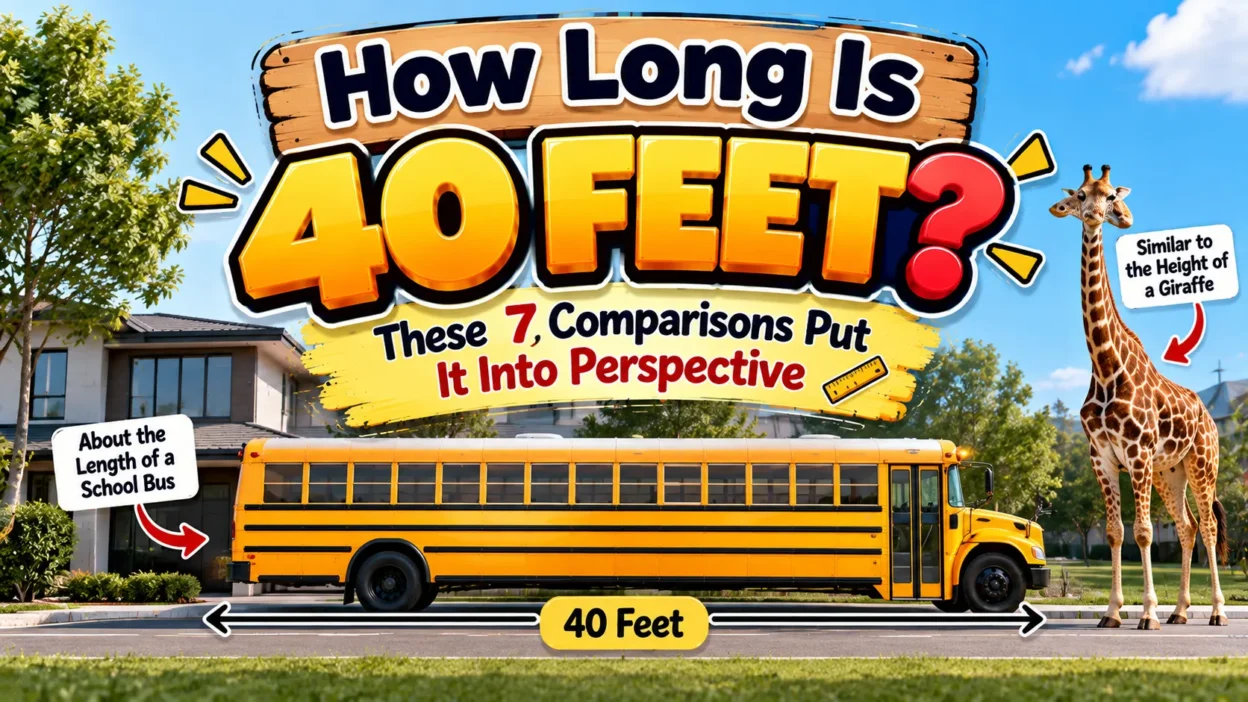
Bus lengths vary considerably by type. Some smaller buses measure around 20 to 30 feet, while larger transit buses may be approximately 40 feet long.
A 40-foot transit bus therefore provides a particularly useful real-world comparison. Imagine the full length of a large city bus, from the front bumper to the rear.
This comparison can help you picture the distance without needing a measuring tool. However, not every bus measures 40 feet, so use the vehicle’s published specifications if you need an exact length.
🏠 3. Longer Than Many Living Rooms
Living rooms come in many sizes, but some are around 12 to 20 feet long. Forty feet is substantially longer than many residential living rooms.
Imagine extending a measuring line from one end of a typical living room and continuing well beyond the opposite wall. Depending on the room’s layout, 40 feet might span a large open-plan area or cover several connected spaces.
This comparison is helpful when planning flooring, lighting, furniture layouts, or interior renovations. Measure the actual room before ordering materials, because its shape and width also affect the amount needed.
🏊 4. About Half the Length of a 25-Yard Pool
A 25-yard swimming pool measures 75 feet long. Forty feet is slightly more than half of that distance.
If you imagine standing at one end of a 25-yard pool, the halfway point would be 37.5 feet away. A distance of 40 feet would extend a little beyond that midpoint.
This is a useful comparison because pool lengths are often clearly defined. It can help you understand how 40 feet compares with a familiar recreational space.
🌳 5. A Long Stretch Across a Backyard
Forty feet can cover a significant section of a backyard, garden, or outdoor recreational area. It may be enough to measure a garden path, a long planting bed, or part of a lawn.
Imagine marking a straight line across your yard that measures 40 feet. You could use this distance to plan where to place garden features, outdoor seating, or decorative elements.
If you are planning an outdoor project, measure the width as well as the length. A 40-foot line describes only one dimension and does not tell you the total area of the space.
🧱 6. Four Sections of 10 Feet Each
Another simple way to visualize 40 feet is to divide it into four equal sections.
Each section measures 10 feet, so combining four sections gives you the full distance:
10 feet + 10 feet + 10 feet + 10 feet = 40 feet
If you have a tape measure, you can mark each 10-foot section along the ground. This creates a clear visual reference and is often more reliable than estimating the distance using furniture or vehicles.
🏀 7. About Four Times a 10-Foot Basketball Hoop Height
A regulation basketball hoop is 10 feet above the playing surface. Four times that height equals 40 feet.
Imagine four basketball hoop heights stacked vertically. The combined height would be 40 feet, although this is a vertical comparison rather than a horizontal length.
This example helps you understand the scale of the measurement. It is particularly useful when visualizing tall structures, trees, or building features from the ground.
📊 How Does 40 Feet Compare With Other Lengths?
Comparing 40 feet with shorter and longer measurements helps you estimate distances and understand how much space an object may occupy.
| Length | Equivalent in Meters | Comparison |
|---|---|---|
| 10 feet | 3.05 m | One-quarter of 40 feet |
| 15 feet | 4.57 m | 25 feet shorter |
| 20 feet | 6.10 m | Half as long |
| 30 feet | 9.14 m | 10 feet shorter |
| 40 feet | 12.19 m | Full length |
| 50 feet | 15.24 m | 10 feet longer |
| 60 feet | 18.29 m | 1.5 times as long |
| 80 feet | 24.38 m | Twice as long |
| 100 feet | 30.48 m | 2.5 times as long |
This comparison shows that 40 feet is a useful reference for larger spaces. It is twice as long as 20 feet and half as long as 80 feet.
🔢 How to Convert 40 Feet to Meters
Meters are widely used in countries that follow the metric system. Converting feet to meters makes it easier to compare building dimensions, distances, and product specifications.
One foot equals exactly 0.3048 meters. Multiply 40 by this conversion factor:
40 × 0.3048 = 12.192 meters
Therefore, 40 feet equals exactly 12.192 meters, or approximately 12.19 meters.
For everyday estimates, rounding the result to 12.2 meters is usually sufficient. If you are working on a construction project, use the required level of precision and confirm the actual dimensions with a measuring tool.
📐 How to Convert 40 Feet to Inches
Inches are useful for smaller measurements and detailed product dimensions. Since one foot contains 12 inches, converting 40 feet is straightforward.
Multiply the number of feet by 12:
40 × 12 = 480 inches
Therefore, 40 feet equals exactly 480 inches.
This conversion can be useful when comparing measurements in technical plans or calculating lengths using an inch-based measuring tape. For longer distances, however, feet or meters are generally easier to visualize.
🧮 How to Convert 40 Feet to Yards
Yards are another unit of length used in sports, landscaping, and outdoor measurements. One yard equals three feet.
To convert 40 feet into yards, divide the measurement by three:
40 ÷ 3 = 13.333… yards
Therefore, 40 feet is approximately 13.33 yards, or 13 yards and 1 foot.
This conversion is particularly helpful when reading sports field dimensions or comparing lengths stated in yards rather than feet.
🏡 Where Is a 40-Foot Length Useful?
A distance of 40 feet can be useful in many practical situations, particularly when measuring large spaces or planning outdoor projects.
Common applications include:
- Driveways: Estimate the length of a parking area or access route.
- Gardening: Plan a long planting bed, path, or lawn section.
- Construction: Understand the dimensions of a wall, room, or structural component.
- Vehicle storage: Compare available space with the length of a bus or other large vehicle.
- Sports: Visualize distances used in training and recreational areas.
- Home improvement: Estimate the length of materials, trim, or outdoor lighting.
- Event planning: Plan the spacing of seating, decorations, or equipment.
Before buying materials or starting construction, measure the actual space and allow for any necessary gaps, overlaps, or installation requirements.
📏 How Can You Measure 40 Feet Without a Long Tape Measure?
If you do not have a measuring tape that extends to 40 feet, you can measure the distance in smaller sections. These methods can help with rough estimates, although they may not be precise enough for construction or other technical work.
Use a shorter tape measure: Measure 10 feet, mark the endpoint, and repeat four times in a straight line.
Use a measuring wheel: A measuring wheel can be rolled along the ground to estimate longer distances. Check its accuracy and follow the manufacturer’s instructions.
Estimate using walking steps: A person’s step length varies, but a step may cover around 2 to 2.5 feet for some adults. Forty feet might take approximately 16 to 20 steps, depending on stride length.
Use a laser distance meter: Some laser measuring devices can measure longer distances accurately when used within their specified range and conditions.
For accurate results, use a suitable tape measure, measuring wheel, or laser distance meter. Estimates based on walking steps or familiar objects should only be used for visualization.
⚠️ Common Mistakes When Visualizing 40 Feet
Longer measurements can be difficult to estimate accurately. A few common mistakes can lead to incorrect calculations or poor planning.
- Confusing feet with meters: Forty feet is approximately 12.19 meters, not 40 meters.
- Assuming all buses are the same length: Vehicle dimensions vary by model and type.
- Mixing length with area: Feet measure length, while square feet measure area.
- Relying only on walking steps: Stride length differs from person to person.
- Ignoring available clearance: A space may need extra room for vehicles, doors, or equipment.
- Rounding too early: Use precise conversions when accuracy matters.
The best way to avoid these errors is to write down the measurement and unit clearly, then verify the distance using an appropriate measuring tool.
❓ Frequently Asked Questions About 40 Feet
How long is 40 feet in meters?
Forty feet equals exactly 12.192 meters, which is approximately 12.19 meters.
How many inches are in 40 feet?
There are exactly 480 inches in 40 feet because each foot contains 12 inches.
Is 40 feet a long distance?
Forty feet is a substantial length for a room or residential outdoor space, but it is relatively short compared with many walking or driving distances.
How many yards are in 40 feet?
Forty feet equals approximately 13.33 yards, or 13 yards and 1 foot.
Is 40 feet longer than a bus?
It depends on the bus. Some large transit buses are around 40 feet long, while smaller buses are shorter and some specialized vehicles differ in size.
How many steps does it take to walk 40 feet?
It may take roughly 16 to 20 steps for some adults, depending on their stride length. This is only an estimate and should not be used for precise measurements.
How can I visualize 40 feet at home?
Imagine four sections of 10 feet placed end to end. You can also compare the distance with a large transit bus, which may be close to 40 feet long.
How many meters is 40 feet and 40 inches?
Forty feet and 40 inches is a different measurement from 40 feet alone. Since 40 inches equals 3 feet 4 inches, the combined length is 43 feet 4 inches, or approximately 13.21 meters.
✅ Conclusion
Forty feet equals 480 inches, approximately 13.33 yards, or 12.19 meters. It is a substantial length that can help you visualize large rooms, outdoor spaces, and long structures.
To picture this distance, imagine four 10-foot sections placed end to end or a large transit bus that measures around 40 feet. These comparisons provide a useful starting point for understanding the measurement.
For accurate planning, use a measuring tape, measuring wheel, or laser distance meter. Real-life comparisons help you estimate length, but measuring the actual space is the most reliable way to confirm its dimensions.

Colton Mercer is a writer and contributor at TechMeasurez, covering measurements, dimensions, size guides, conversions, comparisons, and practical online tools. His work focuses on turning everyday measurement questions into clear, easy-to-follow information. Through TechMeasurez, Colton aims to make useful facts, guides, and digital resources simple for everyone to understand.