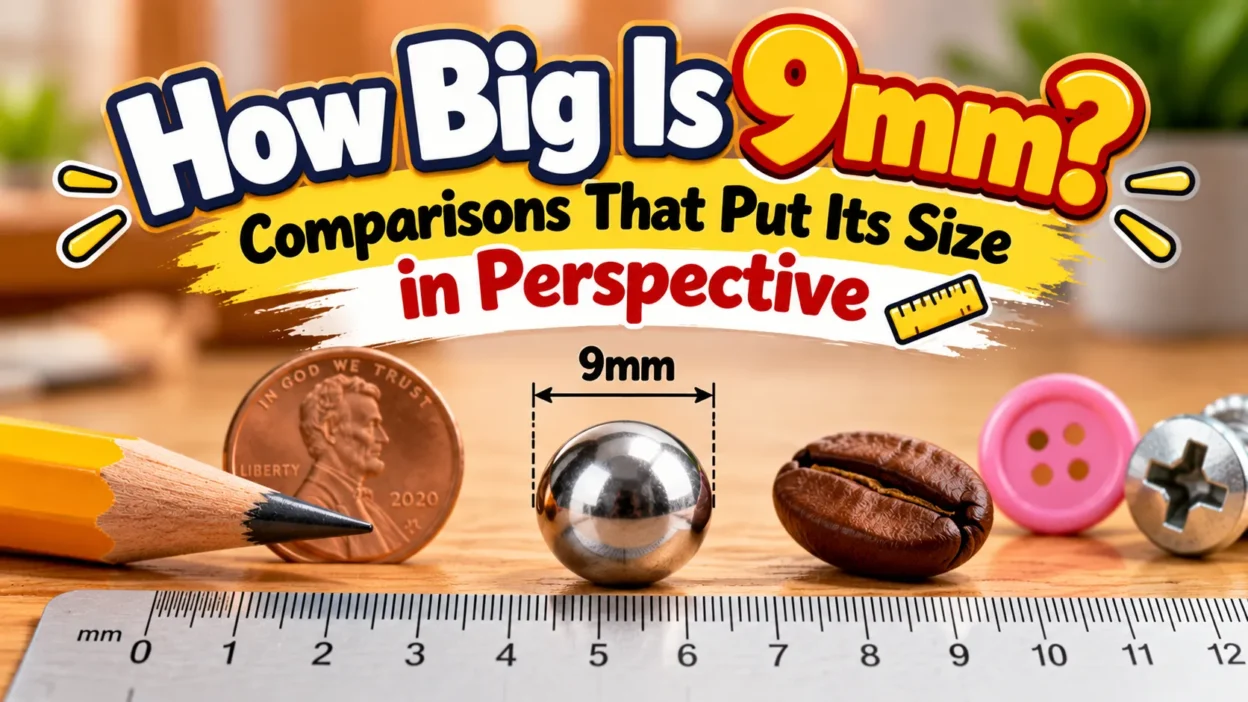
Have you ever wondered how big 9mm really is? This tiny measurement appears in everyday objects, jewelry, small buttons, and many other items. Although 9 millimeters may sound difficult to picture, comparing it with familiar objects makes the size much easier to understand.
9mm equals 0.9 centimeters, approximately 0.35 inches, or 0.009 meters. It is slightly smaller than 1 centimeter and about the width of a standard pencil eraser, depending on the pencil.
In this guide, you’ll discover 15 everyday comparisons that help you visualize 9mm, learn how to measure this small distance, and understand how it compares with other common measurements.
📏 How Big Is 9mm in Inches and Centimeters?
Nine millimeters is a small measurement, just 1 millimeter short of a full centimeter. Since 10 millimeters equal 1 centimeter, converting 9mm is straightforward.
Here are the most useful conversions:
- Centimeters: 0.9 cm
- Inches: Approximately 0.354 inches
- Meters: 0.009 m
- Micrometers: 9,000 micrometers
- Fraction of an inch: Slightly more than 1/3 inch
To visualize the size, imagine a line that is just a little shorter than 1 centimeter on a metric ruler. That distance represents 9mm.
It is also useful to compare 9mm with a standard inch. One inch equals 25.4 millimeters, so 9mm is a little over one-third of an inch.
Because this measurement is so small, even a difference of 1 or 2 millimeters can be noticeable. If accuracy matters for a craft project, jewelry purchase, or repair, use a ruler with millimeter markings or a digital caliper.
✏️ 1. The Width of a Pencil Eraser
A pencil eraser can help you visualize a measurement close to 9mm, depending on the pencil’s design. Some narrow pencil erasers are around this width, while others are noticeably wider.
The measurement refers to the eraser’s width across its surface, not its length or thickness. A rectangular eraser, for example, can have several different dimensions.
If you have a pencil nearby, look at the eraser on its end. Its width may give you a rough idea of how large 9mm is.
However, pencil erasers are not standardized to one exact size. For an accurate comparison, measure the eraser across its widest point with a ruler.
🪙 2. A Small Button
Some small clothing buttons measure approximately 9mm across. Buttons are manufactured in many sizes, so this is a possible comparison rather than a universal measurement.
A button with a diameter of 9mm is just under 1 centimeter wide. It is small enough to be used on certain shirts, children’s clothing, cuffs, or decorative garments.
To picture this size, imagine a small button resting on your fingertip. Its width would be slightly less than the distance represented by 1 centimeter on a metric ruler.
Button size is often expressed in millimeters or in specialized sizing systems. If you are buying replacement buttons, check the diameter carefully because even a small difference can affect how the button fits through a buttonhole.
💍 3. A Small Jewelry Bead
Some jewelry beads measure close to 9mm in diameter. Beads of this size can appear in bracelets, necklaces, earrings, and handmade accessories.
A spherical bead measuring 9mm across is 0.9 centimeters wide. The distance is measured straight through the center from one side to the other.
Beads come in a variety of shapes and sizes. A round bead, a flat disc, and an oval bead may all have different dimensions, even when a product listing includes a 9mm measurement.
If you are making jewelry, the bead diameter can affect the appearance and spacing of the finished design. A bracelet made with 9mm beads, for example, will generally look different from one made with 4mm beads.
Use the manufacturer’s listed dimensions when buying beads online, especially if you need them to match existing jewelry.
🔘 4. The Diameter of a Small Coin-Like Token
Some small game tokens, decorative discs, or craft pieces measure approximately 9mm across. These tiny circular objects can provide a useful visual reference.
The diameter is the straight-line distance from one edge of the disc to the opposite edge through its center.
However, ordinary coins vary widely in size, and many are considerably larger than 9mm. Do not assume that a particular coin measures this amount without checking its official dimensions.
If you have a small token or decorative disc, place it beside a metric ruler and compare its width with the 9mm mark.
This comparison is useful for crafts and small components, but a measured object is more reliable than guessing based on its appearance.
📐 5. Nine Millimeter Marks on a Metric Ruler
A metric ruler is one of the most accurate ways to understand how big 9mm is. Find the centimeter markings and look at the smaller millimeter divisions between them.
There are 10 millimeters between each centimeter mark. The ninth small division after the zero point represents 9mm.
On a typical ruler, this point sits just before the 1-centimeter mark. The gap between the 9mm mark and the 10mm mark is only 1 millimeter.
This comparison is especially useful because it shows the measurement exactly rather than relying on an approximate household object.
If you need to measure a small item, line up one edge with the zero mark and identify where the opposite edge falls. Make sure you read the scale at eye level to reduce visual errors.
📱 6. A Small Portion of a Smartphone’s Thickness
Some smartphone bodies are around 7–9mm thick, depending on the model. This means that the thickness of certain phones can be close to 9mm.
The thickness is measured from the phone’s front surface to its back surface. It is not the screen’s diagonal size or the length of the device.
Modern phones vary in thickness, and camera bumps can extend farther than the main body. A phone listed as 8mm thick may have a thicker camera area.
If you own a phone that is approximately 9mm thick, its side profile can help you picture the measurement. Check the manufacturer’s specifications to confirm the exact thickness.
This is a useful comparison because many people use smartphones daily, but it should be treated as model-dependent rather than a universal phone measurement.
🔩 7. A Small Metal Washer
Some small metal washers have an outer diameter or inner opening close to 9mm. Washers are used with screws and bolts to distribute pressure or help secure mechanical connections.
It is important to distinguish between a washer’s inner diameter, outer diameter, and thickness. A washer described as having a 9mm opening may be much wider across its outside edge.
For example, a washer with a 9mm inner diameter could have an outer diameter several millimeters larger.
If you are choosing a washer for a repair, check the required dimensions carefully. A small measurement difference can affect whether it fits around a bolt or sits properly against the surface.
Washers can help you visualize small measurements, but the exact size depends on the hardware specification.
🧵 8. A Small Sewing Snap Fastener
Some small snap fasteners used in clothing and craft projects measure close to 9mm across. These fasteners consist of interlocking components that hold fabric together.
The measurement generally refers to the diameter of the snap, although products may list other dimensions as well.
A 9mm snap is less than 1 centimeter wide, making it a small component for lightweight garments, accessories, and sewing projects.
Snap fasteners are available in different sizes and materials, so not every fastener will match this measurement. Check the packaging or product specifications before buying replacements.
If you have one at home, place it on a ruler to see how its diameter compares with the 9mm mark.
🧷 9. A Small Craft Pinhead
Some small craft pins have heads that are around 9mm wide, though many are smaller or larger. The pinhead is the rounded or flat section at the top of the pin.
To visualize the measurement, imagine a pinhead measuring slightly less than 1 centimeter across.
This comparison can be helpful when sewing, arranging decorations, or working on small craft projects. However, pinheads vary considerably in shape and size.
If you need an exact measurement, use a ruler with millimeter markings or a magnifying measuring tool. Avoid handling sharp pins carelessly, especially when measuring tiny components.
🧊 10. A Small Plastic Bead or Spacer
Some plastic beads and spacers used in crafts measure approximately 9mm across. These small components can be found in jewelry kits, decorative projects, and children’s craft supplies.
A round spacer measuring 9mm across has a diameter of 0.9 centimeters. Its hole, if it has one, will usually be smaller than the full outer diameter.
Beads and spacers are sold in many different dimensions, so check whether the listed measurement refers to the outside diameter, length, or hole size.
This comparison is useful for anyone working with small craft materials. If several components must fit together, precise measurements can help you select the correct size.
🧴 11. The Width of a Small Bottle Cap Feature
Certain small bottle caps and packaging components include ridges, tabs, or circular features that measure close to 9mm. However, the overall cap is often much wider.
This example refers only to a specific small feature, not the complete bottle cap.
Packaging dimensions vary according to the bottle’s purpose, closure type, and manufacturer. A cap designed for a small container may have a different size from one used on a household cleaning product.
If you are measuring packaging for a craft or storage project, identify the exact feature you want to measure. This prevents confusion between the width of a small ridge and the diameter of the entire cap.
🪵 12. A Thin Strip of Material
A strip of wood, plastic, cardboard, or foam can be cut to a width of exactly 9mm. This makes it a useful reference for craft work and small DIY projects.
Imagine a narrow strip lying flat on a table. If the strip measures 9mm across, it will be slightly narrower than a 1-centimeter strip.
Unlike natural objects, a manufactured strip can be measured or cut to a specified size. This makes it a more dependable comparison when precision matters.
Remember that width, thickness, and length are different dimensions. A strip might be 9mm wide, 2mm thick, and 20cm long.
If you need a 9mm strip for a project, mark the material carefully and use an appropriate measuring and cutting tool.
🧿 13. A Small Decorative Gem or Cabochon
Some small decorative gems, glass stones, and cabochons are sold in sizes close to 9mm. These items are used in jewelry, clothing decorations, crafts, and other creative projects.
The size usually refers to the width or diameter of the decorative piece. For an oval gem, the length and width may be different.
A round decorative stone measuring 9mm across is just under 1 centimeter wide. Its thickness is a separate measurement and may be considerably smaller.
If you are purchasing decorative stones, check whether the product listing provides the diameter, length, width, or thickness.
This comparison helps visualize the size of a small embellishment, but decorative pieces are not standardized, so the exact dimensions depend on the product.
🔋 14. A Small Electronic Component
Certain small electronic components, connectors, and plastic housings have dimensions close to 9mm. The measurement may refer to their width, height, or diameter.
Electronic components are designed to fit specific devices and circuit layouts, so even small dimensional differences can matter.
For example, a component might be 9mm wide but only 4mm tall. Another may have a 9mm diameter while being longer in its other dimension.
If you are working with electronics, use the manufacturer’s technical drawing or specification sheet rather than estimating the component’s size by sight.
This example is particularly useful for understanding why millimeter measurements are important in engineering, electronics, and precision manufacturing.
🧩 15. A Small Piece of a Construction or Craft Set
Some small construction pieces, decorative tiles, and craft components have an individual dimension close to 9mm. These objects can provide a visual reference when working with miniature models or detailed designs.
However, there is no universal craft piece that always measures 9mm. Different brands and sets use different dimensions.
If you have a small component, place it next to a metric ruler and compare its length or width with the 9mm mark.
This can help you understand how small the measurement is when assembling miniatures, making jewelry, or working on detailed craft projects.
For precise work, always measure the component directly instead of relying on a general estimate.
📊 Quick Comparison: Things That May Measure Around 9mm
The following table summarizes the examples and identifies the dimension that may be close to 9mm.
| Object | Dimension to check |
|---|---|
| Pencil eraser | Width |
| Small button | Diameter |
| Jewelry bead | Diameter |
| Coin-like token | Diameter |
| Metric ruler | Distance from 0 to 9mm |
| Smartphone | Body thickness |
| Metal washer | Inner or outer diameter |
| Sewing snap fastener | Diameter |
| Craft pinhead | Head width |
| Plastic bead or spacer | Outer diameter |
| Bottle cap feature | Width of a specific feature |
| Thin material strip | Width or thickness |
| Decorative gem | Diameter or width |
| Electronic component | Width, height, or diameter |
| Craft component | One specified dimension |
Most examples in this list are approximate because the size depends on the particular product. For the most reliable visual reference, use a metric ruler and locate the 9mm mark just before 1 centimeter.
🧮 How to Measure 9mm Without a Caliper
Measuring 9mm can be challenging because it is less than 1 centimeter. Fortunately, a standard metric ruler can provide a useful reference.
Method 1: Use a ruler with millimeter markings. Find the 1 cm mark, which equals 10mm. The ninth small division after zero represents 9mm.
Method 2: Compare it with 1 centimeter. Nine millimeters is exactly 1mm shorter than 1cm. This is helpful for estimating the size, although visual estimation is not precise enough for every task.
Method 3: Use a digital caliper. If you need to measure a small component accurately, a digital caliper can provide a more precise reading than a basic ruler.
Method 4: Convert to inches. Nine millimeters equals approximately 0.354 inches. This can help if your measuring tool uses an inch scale.
Avoid measuring tiny objects by eye if the dimensions affect fit, safety, or functionality. Even a small error can matter when working with jewelry components, fasteners, and electronic parts.
🔍 Why Does 9mm Look Different on Different Objects?
Nine millimeters is a fixed distance, but its appearance changes depending on the shape and dimension being measured.
A bead may measure 9mm across, while a smartphone may be close to 9mm thick. These measurements describe different dimensions even though the numerical value is the same.
The object’s color, shape, and surrounding space can also affect how large it appears. A dark object against a light background may look different from the same object against a similarly colored surface.
For accurate comparisons, identify whether you are measuring length, width, height, thickness, or diameter. Then use a ruler or caliper to check the exact dimension.
❓ Frequently Asked Questions About 9mm
Here are quick answers to common questions about the size of 9 millimeters.
How many inches is 9mm?
Nine millimeters equals approximately 0.354 inches. It is a little more than one-third of an inch.
Is 9mm smaller than 1 centimeter?
Yes. One centimeter equals 10 millimeters, so 9mm is exactly 1mm smaller than 1cm.
How many centimeters is 9mm?
Nine millimeters equals 0.9 centimeters. Divide the millimeter measurement by 10 to convert it to centimeters.
What household object is about 9mm wide?
Some pencil erasers, small buttons, and jewelry beads may measure close to 9mm. Their exact dimensions depend on the item, so measure them if accuracy matters.
Is 9mm the same as 0.9 cm?
Yes. Nine millimeters and 0.9 centimeters represent exactly the same length.
How can I visualize 9mm without a ruler?
Imagine a distance that is just 1mm shorter than a centimeter. For a more reliable comparison, use a metric ruler and count the small divisions before the 1cm mark.
Is 9mm a large measurement?
No. Nine millimeters is a small measurement, measuring less than 1 centimeter and approximately 0.35 inches. It is commonly useful for describing small objects and components.
✅ Final Thoughts on How Big 9mm Is
Nine millimeters is a small but useful measurement that equals 0.9 centimeters or approximately 0.354 inches. It is just 1 millimeter shorter than a full centimeter, making it easy to visualize on a metric ruler.
Small buttons, jewelry beads, pencil erasers, and certain electronic components can help you picture the size, although their actual dimensions vary.
For an accurate measurement, locate the 9mm mark on a metric ruler or use a digital caliper when greater precision is necessary. This simple approach is more dependable than estimating the size of an object by sight.

Colton Mercer is a writer and contributor at TechMeasurez, covering measurements, dimensions, size guides, conversions, comparisons, and practical online tools. His work focuses on turning everyday measurement questions into clear, easy-to-follow information. Through TechMeasurez, Colton aims to make useful facts, guides, and digital resources simple for everyone to understand.