Converting 30 centimeters to inches is simple once you understand the relationship between the metric and imperial measurement systems. Whether you are measuring a box, checking the dimensions of a household item, working on a school assignment, or comparing product sizes, knowing the correct conversion helps you get accurate results.
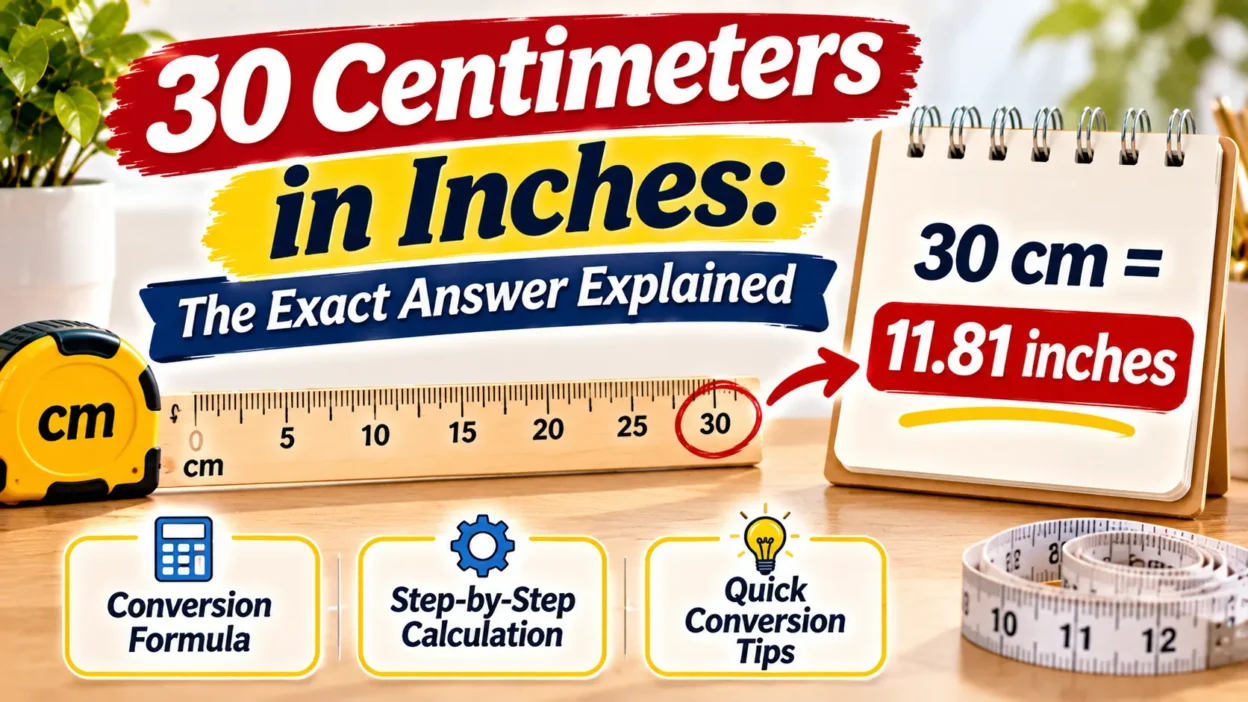
So, how many inches are in 30 centimeters? The answer is 11.81 inches when rounded to two decimal places. The exact result is approximately 11.811 inches.
In this guide, you will learn how to convert 30 cm to inches using a simple formula, understand the calculation step by step, explore a helpful conversion chart, and compare this measurement with familiar everyday objects. You will also find answers to common questions about centimeters and inches.
How Many Inches Is 30 Centimeters? 📏
30 centimeters equals approximately 11.81 inches. This conversion uses the internationally accepted relationship between inches and centimeters: one inch equals exactly 2.54 centimeters.
Here is the conversion at a glance:
- Centimeters: 30 cm
- Inches: 11.811 inches
- Rounded to two decimal places: 11.81 inches
- Rounded to one decimal place: 11.8 inches
- Rounded to the nearest whole inch: 12 inches
The result may look slightly different depending on how many decimal places you use. For most everyday measurements, 11.81 inches provides sufficient accuracy.
How to Convert 30 cm to Inches 🧮
You can convert centimeters into inches by dividing the centimeter measurement by 2.54. This method works because an inch contains exactly 2.54 centimeters.
The conversion formula is:
Inches = Centimeters ÷ 2.54
Now, substitute 30 for the centimeter value:
30 ÷ 2.54 = 11.8110236…
Therefore:
30 cm = 11.81 inches
You can use this formula whenever you need to convert another centimeter measurement into inches. Simply enter the number of centimeters and divide it by 2.54.
Step-by-Step Calculation
Follow these three simple steps to understand the conversion:
- Start with the measurement: You have 30 centimeters.
- Apply the conversion formula: Divide 30 by 2.54.
- Calculate the result: The answer is approximately 11.811 inches.
For quick reference, you can round the final answer to 11.81 inches.
Why Do You Divide Centimeters by 2.54? 🔍
The number 2.54 comes from the internationally standardized relationship between the two measurement units. One inch equals exactly 2.54 centimeters, so you must divide centimeters by 2.54 to determine the equivalent number of inches.
For example, imagine you have a ruler marked in centimeters but need to record a measurement in inches. Dividing the centimeter value by 2.54 gives you the corresponding inch measurement.
You can also convert inches into centimeters by reversing the calculation:
Centimeters = Inches × 2.54
Both formulas work for any measurement. Remember this simple rule:
- Centimeters to inches: Divide by 2.54.
- Inches to centimeters: Multiply by 2.54.
Understanding the difference helps prevent calculation mistakes when switching between metric and imperial measurements.
30 cm to Inches Conversion Chart 📊
A conversion chart makes it easier to compare 30 centimeters with nearby measurements. You can use the following table when working with clothing sizes, furniture dimensions, crafts, school projects, or household measurements.
| Centimeters (cm) | Inches (in) |
|---|---|
| 1 cm | 0.39 in |
| 5 cm | 1.97 in |
| 10 cm | 3.94 in |
| 15 cm | 5.91 in |
| 20 cm | 7.87 in |
| 25 cm | 9.84 in |
| 30 cm | 11.81 in |
| 35 cm | 13.78 in |
| 40 cm | 15.75 in |
| 45 cm | 17.72 in |
| 50 cm | 19.69 in |
| 60 cm | 23.62 in |
| 70 cm | 27.56 in |
| 80 cm | 31.50 in |
| 90 cm | 35.43 in |
| 100 cm | 39.37 in |
The chart uses values rounded to two decimal places. If you need a highly precise result for technical work, keep additional decimal places during your calculation and round only the final answer.
What Does 30 Centimeters Look Like? 🏠
Numbers can be difficult to visualize without a familiar reference. Fortunately, 30 centimeters is close to one foot because 12 inches equals 30.48 centimeters.
This means 30 cm is just slightly shorter than a standard 12-inch measurement. You can picture it as a little less than one foot.
Here are some everyday comparisons that can help you understand the size:
1. A Standard 12-Inch Ruler
A standard 12-inch ruler measures 30.48 centimeters. Therefore, a 30 cm measurement is only 0.48 cm shorter than the ruler.
This comparison offers one of the easiest ways to visualize the measurement. If you have a standard ruler nearby, 30 centimeters reaches almost its entire length.
2. A Large Dinner Plate
Some large dinner plates measure approximately 28–30 cm across. A plate with a diameter of 30 cm has a width of about 11.81 inches.
Plate sizes vary by manufacturer and style, so this example provides a general comparison rather than an exact measurement for every dinner plate.
3. A Short Desktop Keyboard
Some compact keyboards measure close to 30 cm in width. However, keyboard dimensions depend on the number of keys, layout, and design.
A compact keyboard can help you picture the approximate length of this measurement.
4. A Small Storage Box
A storage box measuring 30 cm along one side has a length of approximately 11.81 inches. You may find similar dimensions in organizers, packaging boxes, and household storage containers.
Always check the product specifications because manufacturers may list length, width, and height separately.
Is 30 cm the Same as 12 Inches? 📐
Not exactly. Although 30 centimeters is very close to 12 inches, the two measurements are slightly different.
Here is the comparison:
- 30 cm: 11.811 inches
- 12 inches: 30.48 centimeters
- Difference: 0.48 centimeters, or approximately 0.19 inches
Therefore, 12 inches is slightly longer than 30 centimeters.
People often treat these measurements as nearly equal when estimating everyday sizes. However, you should use the exact conversion when precision matters, particularly in construction, manufacturing, sewing, and technical projects.
Convert 30 Centimeters into Other Units 🔄
You may sometimes need to express 30 centimeters in units other than inches. Converting this measurement into millimeters, meters, or feet can make it easier to work with different measurement systems.
Here are the equivalent measurements:
| Measurement Unit | Equivalent Value |
|---|---|
| Inches | 11.811 in |
| Feet | 0.9843 ft |
| Millimeters | 300 mm |
| Meters | 0.30 m |
| Yards | 0.3281 yd |
30 cm to Millimeters
One centimeter contains 10 millimeters. Multiply 30 by 10:
30 × 10 = 300 mm
Therefore, 30 cm equals 300 millimeters.
30 cm to Meters
One meter contains 100 centimeters. Divide 30 by 100:
30 ÷ 100 = 0.30 m
Therefore, 30 cm equals 0.30 meters.
30 cm to Feet
One foot contains 12 inches. Since 30 cm equals approximately 11.811 inches, divide that value by 12:
11.811 ÷ 12 = 0.9843 feet
Therefore, 30 cm equals approximately 0.9843 feet.
This measurement is slightly shorter than one full foot.
When Do You Need to Convert 30 cm to Inches? 🛠️
Centimeter-to-inch conversions are useful in many everyday situations. Different countries and industries use different measurement systems, so you may need to convert a metric measurement before buying, building, measuring, or comparing something.
Here are several common examples:
Shopping Online
International shopping websites sometimes display product dimensions in centimeters. If you normally use inches, converting the measurements helps you understand the actual size before placing an order.
For example, a product listed as 30 cm wide measures approximately 11.81 inches across.
Measuring Furniture
Furniture manufacturers may use centimeters when listing table, shelf, cabinet, and storage dimensions. Converting those measurements into inches helps you compare products and check whether an item will fit in your available space.
Sewing and Clothing
Sewing patterns and clothing measurements often use both centimeters and inches. If a pattern gives a 30 cm measurement, you can convert it to 11.81 inches before marking or cutting the fabric.
For accurate sewing, avoid rounding too early because even small differences can affect the final fit.
School and Homework
Students frequently encounter metric-to-imperial conversion questions in mathematics and science lessons. Learning the 2.54 conversion factor makes these problems easier to solve.
For example, if a worksheet asks you to convert 30 cm into inches, divide 30 by 2.54 to get approximately 11.81 inches.
DIY and Home Improvement
Home improvement projects may involve measurements from products, tools, or instructions that use different units. Converting centimeters into inches helps you follow specifications and compare dimensions more accurately.
For cutting materials or installing fixtures, use the appropriate level of precision rather than relying on an approximate whole-number measurement.
Common Mistakes When Converting Centimeters to Inches ⚠️
The conversion process is straightforward, but a few common mistakes can produce incorrect results.
1. Multiplying Instead of Dividing
When converting centimeters into inches, divide by 2.54. Multiplying by 2.54 converts inches into centimeters, so using the wrong operation changes the result.
2. Using the Wrong Conversion Factor
Some people use 2.5 instead of 2.54 for quick estimates. Although this may provide a rough answer, it does not give the exact conversion.
For 30 cm, dividing by 2.5 gives 12 inches instead of approximately 11.81 inches.
3. Rounding Too Early
Avoid rounding intermediate calculations if you need an accurate result. Keep the full calculator value and round only the final answer.
4. Confusing Centimeters with Millimeters
A centimeter equals 10 millimeters. Therefore, 30 cm equals 300 mm, not 30 mm.
Checking the unit before calculating can prevent this type of mistake.
Frequently Asked Questions About 30 cm to Inches ❓
Is 30 cm exactly 11.81 inches?
No. The more precise result is approximately 11.8110236 inches. The value 11.81 inches is rounded to two decimal places.
Is 30 centimeters bigger than 1 foot?
No. One foot equals 12 inches or 30.48 centimeters. Therefore, 30 centimeters is slightly shorter than one foot.
How many inches are in 30 cm without rounding?
The decimal conversion is 11.811023622047244 inches, with the decimal continuing. For most everyday purposes, 11.811 inches is sufficiently precise.
What is 30 cm in feet and inches?
30 centimeters equals approximately 0 feet and 11.81 inches. It is just under one foot.
How do I convert 30 cm to inches on a calculator?
Enter 30, press the division button, and enter 2.54. The calculator will display approximately 11.8110236.
What is half of 30 cm in inches?
Half of 30 cm is 15 cm. Divide 15 by 2.54 to get approximately 5.91 inches.
How many millimeters are in 30 centimeters?
There are 300 millimeters in 30 centimeters because every centimeter contains 10 millimeters.
Why do some websites show 30 cm as 12 inches?
Some websites round 11.81 inches to the nearest whole number. This produces 12 inches, which works for rough estimates but is not the exact conversion.
Conclusion
Converting 30 centimeters to inches requires just one simple calculation. Divide 30 by 2.54, and you get approximately 11.81 inches.
You can remember that 30 cm is slightly shorter than one foot, which measures 12 inches or 30.48 cm. This comparison makes the measurement easier to visualize when shopping, measuring household items, completing schoolwork, or handling DIY projects.
Keep the conversion formula handy, and you can quickly convert any centimeter measurement into inches whenever you need an accurate result.

Colton Mercer is a writer and contributor at TechMeasurez, covering measurements, dimensions, size guides, conversions, comparisons, and practical online tools. His work focuses on turning everyday measurement questions into clear, easy-to-follow information. Through TechMeasurez, Colton aims to make useful facts, guides, and digital resources simple for everyone to understand.