
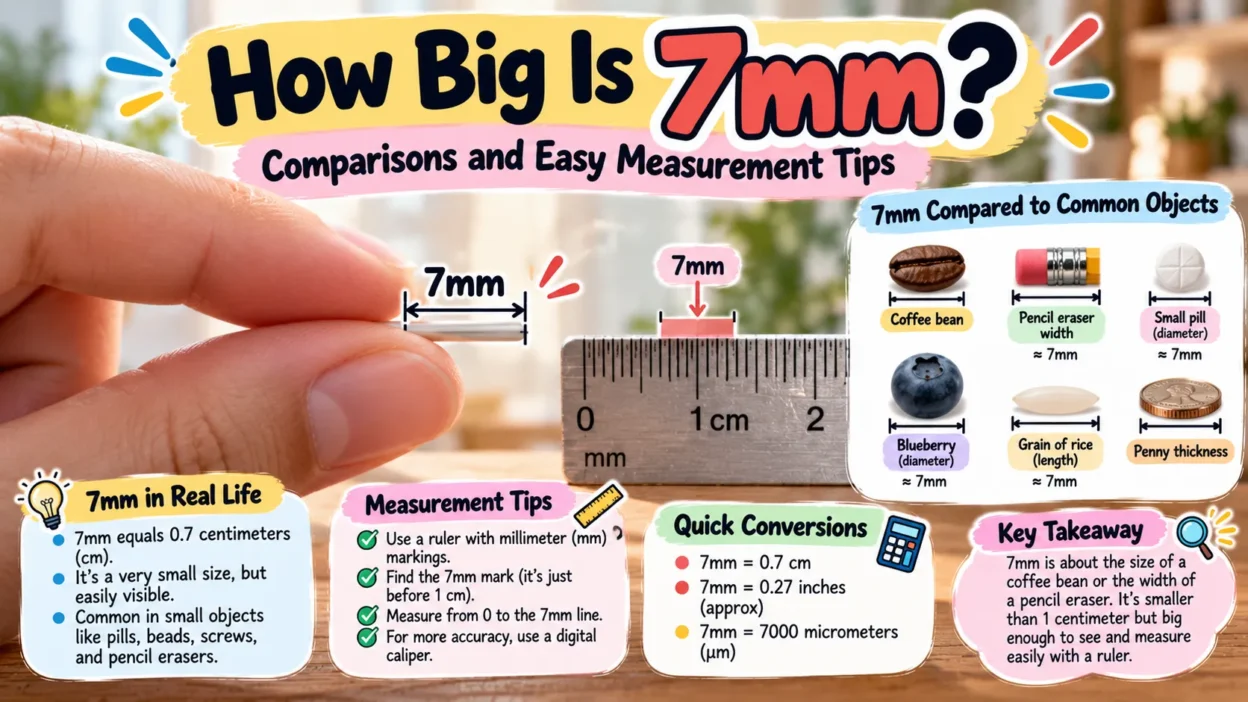
Seven millimeters is a small measurement, but it appears in more everyday objects than you might expect. You may encounter it when checking the size of jewelry beads, measuring small hardware, choosing craft supplies, or comparing the dimensions of a product.
If you’re used to inches rather than millimeters, it can be difficult to picture how much space 7mm actually covers. The good news is that a few simple comparisons can help you understand its size without memorizing complicated measurements.
7mm equals 0.7 centimeters, 0.007 meters, or approximately 0.276 inches. It is slightly longer than one-quarter of an inch and still smaller than a full centimeter.
In this guide, you’ll learn how to visualize 7mm, convert it into other units, estimate it using a ruler, and understand where this measurement appears in everyday life.
📏 What Does 7mm Look Like?
The easiest way to picture 7mm is to look at a metric ruler. Most metric rulers mark centimeters with longer lines and divide each centimeter into 10 smaller millimeter divisions.
If you begin at the zero mark and count seven of the small divisions, you reach 7mm. Because a centimeter contains 10 millimeters, 7mm covers seven-tenths of a centimeter.
Here are the basic conversions:
- 7 millimeters = 0.7 centimeters
- 7 millimeters = 0.007 meters
- 7 millimeters = approximately 0.276 inches
- 7 millimeters = approximately 0.028 feet
- 7 millimeters is slightly longer than ¼ inch
The difference between 7mm and 1 centimeter is 3mm. That means 7mm covers most, but not all, of the distance between two centimeter markings on a ruler.
If you are more familiar with inches, imagine a quarter-inch mark. One-quarter inch equals 6.35mm, so 7mm is just 0.65mm longer. This is a very small difference, making a quarter inch a useful mental reference.
📐 Is 7mm Smaller Than a Centimeter?
Yes, 7mm is smaller than a centimeter.
One centimeter contains exactly 10 millimeters. Therefore, 7mm is 3mm short of a full centimeter and equals 0.7cm.
You can visualize this by looking at the space between two centimeter markings on a ruler. The entire space represents 10mm. Seven millimeters covers seven of those small divisions, leaving three divisions remaining.
This comparison is useful because centimeters are often easier to understand when estimating everyday objects. If you know that a small item measures 1cm across, a 7mm object will be slightly narrower.
For example, a round object measuring 10mm in diameter would be 3mm wider than one measuring 7mm. That difference may seem small, but it can matter when choosing jewelry components, matching replacement parts, or fitting small pieces together.
💍 How Big Is a 7mm Jewelry Bead?
A round jewelry bead measuring 7mm across provides a useful real-world example of this size. Beads of this diameter are used in bracelets, necklaces, earrings, and other decorative accessories.
Imagine placing a small round bead on the tip of your finger. Its diameter would be less than one centimeter, but it would still be large enough to see clearly.
A 7mm bead is larger than a 5mm bead but smaller than a 10mm bead. If you place the three sizes side by side, the differences become easier to recognize.
The stated size usually refers to the bead’s outside diameter, not the hole through its center. A bead may therefore have a 7mm outer diameter and a much smaller opening for threading.
This comparison is especially helpful when shopping online for jewelry supplies. Product photographs can make beads look larger or smaller depending on the camera angle, so checking the stated measurement is more reliable than judging from an image alone.
🔩 How Does 7mm Compare to a Small Screw?
Seven millimeters is a useful size to understand when working with small screws, fittings, and other hardware.
A screw shaft measuring 7mm across would have a diameter of 0.7cm. However, the size of the screw head may be wider than the shaft, and its threaded section may have dimensions that differ slightly from the nominal measurement.
Metric screw sizes often use an M designation. For example, an M6 screw has a nominal thread diameter of 6mm, while an M8 screw has a nominal thread diameter of 8mm. A 7mm measurement falls between those two nominal diameters.
This does not mean that a screw measuring 7mm across should automatically be classified as an M7 screw. Screw identification depends on its thread specifications and other dimensions, not simply on a rough visual estimate.
If you’re assembling furniture or replacing a fastener, check the manufacturer’s specifications. Choosing the wrong screw or fitting can damage a component or prevent it from fitting securely.
✏️ Is 7mm Close to the Width of a Pencil Eraser?
A pencil eraser can provide a rough visual reference for a small measurement, although many erasers are wider than 7mm.
The eraser on a standard wooden pencil may be several millimeters wide, depending on the pencil’s design. Looking at its flat end can help you understand the scale of a few millimeters, but it won’t necessarily show an exact 7mm distance.
A better approach is to measure the eraser with a ruler and compare its actual width with the seven-millimeter mark.
For example, if an eraser measures 8mm across, it is just 1mm wider than the measurement you’re trying to picture. If it measures 6mm, it is 1mm narrower.
This illustrates why measuring an object is more reliable than assuming that all pencils or erasers have standard dimensions. Use the comparison to develop a mental picture, not as a substitute for a ruler.
💅 How Does 7mm Compare to a Fingernail?
Your fingernails can help you visualize small distances because they’re familiar and easy to see. However, fingernail sizes vary from person to person and from one finger to another.
A width of 7mm may cover a small section of a narrow fingernail, while it would cover a smaller proportion of a wider nail.
Imagine drawing a straight line across your fingernail that measures 7mm. The line would be less than one centimeter long, making it a useful illustration of the size.
This comparison can help you estimate the dimensions of small decorative objects, tiny gaps, or compact components when a ruler isn’t immediately available.
However, don’t use your fingernail as an exact measurement. Differences in hand size, nail shape, and nail growth make it an unreliable measuring reference. If precision matters, check the measurement with a ruler or caliper.
🔘 How Big Is 7mm Compared to a Button?
Buttons come in many shapes and sizes, from tiny buttons on shirts to larger buttons on coats and jackets. A 7mm measurement may represent the diameter of a very small button or a particular detail on a larger one.
To understand the scale, imagine a button that measures 14mm across. A 7mm distance would equal exactly half of its diameter.
This is a helpful way to compare measurements because doubling 7mm gives you 14mm, or 1.4cm.
Keep in mind that button measurements are not standardized across all clothing. Some small buttons are only a few millimeters wide, while others are much larger.
If you’re sewing or replacing a button, measure the existing button rather than relying on its appearance. The diameter, thickness, and distance between buttonholes may all matter, depending on the project.
🪙 Can Coins Help You Visualize 7mm?
Coins are useful for understanding small dimensions, but their diameters and thicknesses vary by currency and denomination.
The face of a coin is usually much wider than 7mm. However, the thickness of a single coin or the combined thickness of several coins may provide a useful reference.
For example, if a coin measures 1.5mm thick, four identical coins stacked together would have a combined thickness of approximately 6mm. That stack would be close to 7mm, although still 1mm shorter.
The example depends on the actual thickness of the coins. Not all coins measure 1.5mm, so you should not assume that four coins from every currency will create the same stack height.
This comparison demonstrates how small measurements accumulate. A single thin layer may be difficult to judge, but stacking several layers can make the overall thickness easier to see.
🖊️ How Does 7mm Compare to a Pen Tip?
The tip of a fine pen is much narrower than 7mm. For example, a pen described as having a 0.7mm tip has a nominal tip size that is one-tenth of 7mm.
This means that 10 lengths of 0.7mm placed side by side would total 7mm, assuming there are no gaps or overlaps.
This is a mathematical comparison rather than a practical way to measure a distance. The visible width of a pen line can differ from the stated tip size because of ink flow, pressure, and paper texture.
Still, the comparison helps explain the scale. A 7mm measurement is small, but it is substantially wider than the nominal tip size of a fine writing pen.
This can be useful when thinking about drawing details, small printed lines, craft designs, or other tasks that involve fine measurements.
📱 How Big Is 7mm Compared to a Smartphone?
A smartphone is much larger than a 7mm object, which makes it a helpful reference for understanding the difference between millimeters and centimeters.
Suppose a phone measures 70mm across. A 7mm strip would be exactly one-tenth of that width.
You can picture a narrow strip along one edge of the phone that covers only a small portion of its overall width. This provides a simple way to understand how compact the measurement is.
The same comparison may help when estimating a narrow gap, a small scratch, or the width of a tiny accessory. However, a phone’s width depends on its model, so the 70mm example is illustrative rather than universal.
If you’re buying a case, connector, or other accessory, check the actual product dimensions instead of relying on the general size of a smartphone.
📊 How Big Is 7mm in Different Units?
The table below shows the most useful conversions for seven millimeters.
| Measurement unit | Equivalent |
|---|---|
| Millimeters | 7mm |
| Centimeters | 0.7cm |
| Meters | 0.007m |
| Inches | Approximately 0.276in |
| Feet | Approximately 0.023ft |
| Quarter inch | 6.35mm |
The easiest conversion to remember is 7mm = 0.7cm. If you work with inches, remember that 7mm is slightly longer than a quarter inch.
🔍 How Can You Measure 7mm Accurately?
You don’t need an expensive tool to measure 7mm for ordinary tasks. A standard metric ruler is often enough.
Use a metric ruler. Place the starting edge of the object at the zero mark, then check where the opposite edge falls. Count seven small divisions to identify 7mm.
Use a digital caliper. If you’re measuring a screw, bead, small component, or narrow opening, a digital caliper can provide a more precise reading than visual estimation. Make sure you’re measuring the correct dimension, such as diameter, width, or thickness.
Compare it with a quarter inch. A quarter inch equals 6.35mm. This gives you a close mental reference, although the difference may matter for precision work.
Check the manufacturer’s measurements. If you’re buying hardware or craft supplies, use the listed dimensions to confirm whether the item is 7mm. Photographs can be misleading because objects may be enlarged or reduced on a screen.
For important fitting or construction tasks, use the appropriate measuring tool instead of relying on everyday objects.
❓ Frequently Asked Questions
Is 7mm considered small?
Yes. Seven millimeters is less than one centimeter and measures approximately 0.276 inches. It is a small measurement commonly used for jewelry, hardware, decorative details, and compact components.
Is 7mm the same as a quarter inch?
No. A quarter inch equals 6.35mm, while 7mm equals approximately 0.276 inches. Therefore, 7mm is 0.65mm longer than a quarter inch.
How many centimeters are in 7mm?
Seven millimeters equals 0.7 centimeters. To convert millimeters into centimeters, divide the number of millimeters by 10.
Is 7mm bigger than 1cm?
No. One centimeter equals 10mm, so 7mm is 3mm smaller than 1cm.
How can I visualize 7mm without a ruler?
You can imagine a distance slightly longer than a quarter inch. You can also compare the measurement with a small jewelry bead or count seven millimeter divisions on a metric ruler when one is available. These references help you estimate the size, but a ruler is more reliable for exact measurements.
🎯 Final Thoughts: Understanding the Size of 7mm
Seven millimeters is a small measurement equal to 0.7 centimeters or approximately 0.276 inches. It is slightly longer than a quarter inch and 3mm shorter than a full centimeter.
This size can help you understand the dimensions of jewelry beads, small hardware, buttons, and other compact objects. It is also useful when comparing product specifications or working on craft projects that require accurate measurements.
The easiest way to remember 7mm is to picture a distance just a little longer than ¼ inch. When you need precision, use a metric ruler or digital caliper rather than relying on the size of a fingernail, eraser, or other object that may vary.

Colton Mercer is a writer and contributor at TechMeasurez, covering measurements, dimensions, size guides, conversions, comparisons, and practical online tools. His work focuses on turning everyday measurement questions into clear, easy-to-follow information. Through TechMeasurez, Colton aims to make useful facts, guides, and digital resources simple for everyone to understand.


