
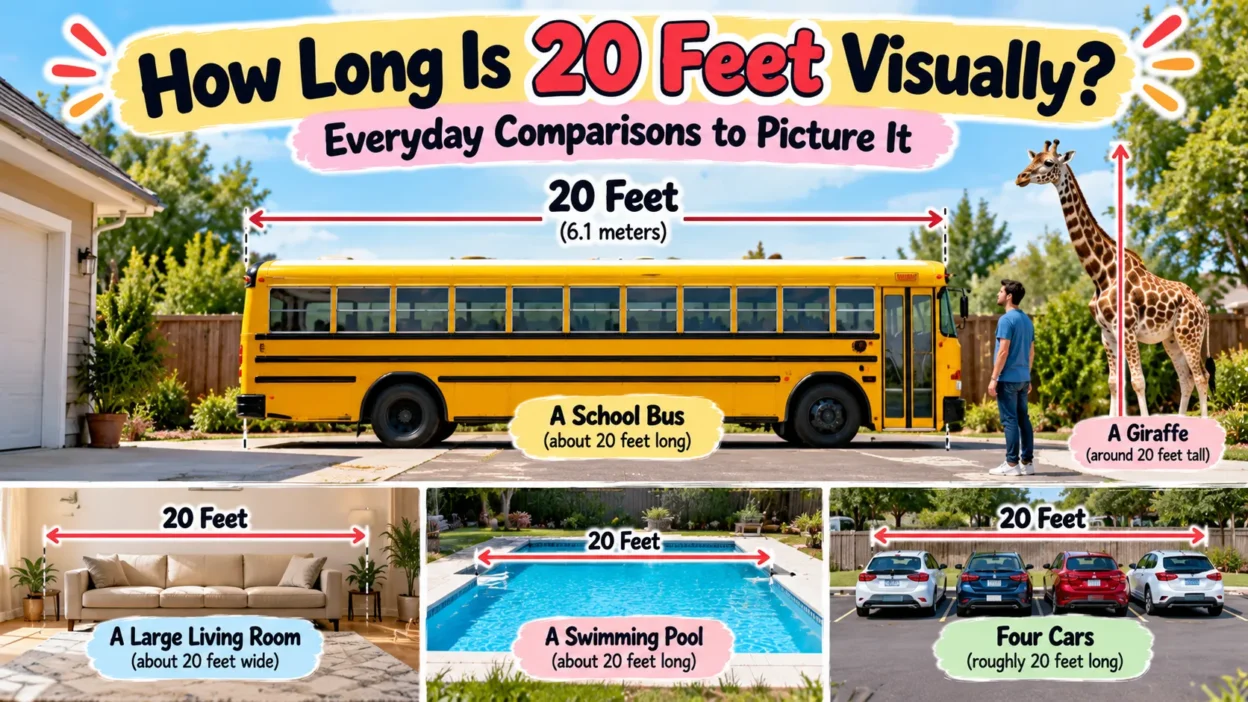
Have you ever wondered how long 20 feet really is? It can be difficult to imagine a measurement without seeing it in person. Whether you are measuring a room, planning a fence, checking furniture dimensions, or simply curious about everyday measurements, visual comparisons make it much easier to understand.
20 feet is equal to 240 inches, 6.096 meters, or approximately 6.1 meters. That is roughly the length of a large SUV and about two-thirds the length of a standard school bus.
To help you picture this distance, let’s compare 20 feet with familiar objects, spaces, and everyday situations.
📏 How Long Is 20 Feet in Inches and Meters?
Before comparing this length with real-world objects, it helps to understand the basic conversions. Twenty feet is a substantial distance, especially when you visualize it across a room or driveway.
Here are the most useful conversions:
- 20 feet = 240 inches
- 20 feet = 6.096 meters
- 20 feet = 609.6 centimeters
- 20 feet = 6,096 millimeters
- 20 feet = 6.67 yards
For a quick mental picture, imagine a straight line stretching a little over six meters from one end to the other. If you use a standard 12-inch ruler, you would need 20 rulers placed end to end to make one 20-foot line.
This measurement is useful when estimating room dimensions, outdoor spaces, vehicle lengths, and construction projects.
🚙 1. About the Length of a Large SUV
A large SUV is one of the easiest objects to use when picturing a distance of 20 feet. Many full-size SUVs measure approximately 16 to 18 feet long, although the exact dimensions depend on the model.
Imagine a large SUV parked in your driveway. Now picture a little extra space extending beyond its front or rear bumper. That gives you a useful sense of how much distance 20 feet covers.
For example, a full-size SUV measuring 17 feet would occupy most of a 20-foot line, leaving approximately 3 feet remaining.
Keep in mind that not every SUV is this large. Compact SUVs can be considerably shorter, so this comparison works best with a full-size model.
Visual takeaway: Think of one large SUV plus a few extra feet. Together, that is close to 20 feet.
🚌 2. Around Two-Thirds of a School Bus
A standard school bus can be roughly 25 to 35 feet long, depending on its size and design. A 20-foot distance is therefore shorter than a full-size school bus.
Imagine a school bus that measures 30 feet from bumper to bumper. Twenty feet would cover two-thirds of its length.
This comparison is especially helpful because most people have seen a school bus and can recognize how much space it occupies on the road.
If you picture the bus divided into three equal sections, two of those sections would represent approximately 20 feet on a 30-foot bus.
Actual school buses vary in length, so this is a visual estimate rather than an exact match.
Visual takeaway: Picture two-thirds of a long school bus to understand how far 20 feet stretches.
🏠 3. The Width of a Small Living Room
Many small living rooms measure around 10 to 15 feet across, while larger spaces may be 20 feet wide or more. A room that is 20 feet wide can feel quite spacious, especially when it has an open layout.
Imagine standing against one wall and looking toward the opposite wall. If the room measures 20 feet across, the distance between the two walls is exactly the length you are trying to visualize.
You could also imagine placing four 5-foot sofas end to end across the room. The combined length would equal 20 feet, although that does not mean four sofas would necessarily fit comfortably in the space.
This comparison is useful when arranging furniture, planning renovations, or estimating the dimensions of an open living area.
Visual takeaway: A 20-foot span can cover the width of a generously sized living room.
🛏️ 4. More Than Three King-Size Beds
A standard US king-size mattress measures approximately 80 inches long, or 6 feet 8 inches. This makes it a convenient reference for understanding a longer distance.
Twenty feet equals 240 inches. Divide that by the 80-inch length of a king mattress, and you get exactly three mattress lengths.
Imagine placing three king mattresses end to end, with no gaps between them. Their combined length would equal 20 feet.
This comparison works particularly well because mattresses have familiar, standardized dimensions. However, the measurement refers to the mattress itself, not the larger bed frame, headboard, or surrounding furniture.
Visual takeaway: Three standard king-size mattresses placed end to end measure 20 feet.
🚪 5. Four Standard Interior Doors Placed Side by Side in Height
A typical interior door in the United States is about 80 inches tall, which is 6 feet 8 inches.
Four door heights add up to 320 inches, or 26 feet 8 inches, so four doors would be longer than 20 feet. But three standard door heights equal 20 feet exactly.
Picture three ordinary interior doors standing upright, one directly above another. Their combined height would give you a vertical reference for a 20-foot distance.
This is a helpful comparison if you have trouble imagining a measurement horizontally. You can picture the distance rising above the floor rather than stretching across it.
Door heights can vary, especially for custom homes and commercial buildings, so use 80 inches as a typical reference.
Visual takeaway: Stack three standard 80-inch door heights mentally, and you have a 20-foot vertical distance.
🚗 6. Roughly Three Average Cars Parked End to End
Most passenger cars measure approximately 14 to 16 feet long, although small cars may be shorter and large vehicles may be longer.
Three average cars parked end to end would usually extend well beyond 20 feet. However, one car measuring 15 feet plus another 5 feet of open space gives you a practical visual reference.
For a more exact comparison, imagine a car that is 15 feet long and add another 5 feet beyond its bumper. The complete distance would be 20 feet.
This can help when estimating driveway space or judging the length of a parking area. Remember that a 20-foot parking space may not comfortably accommodate every vehicle, especially when clearance is needed at both ends.
Visual takeaway: Picture a typical car and then imagine another 5 feet of space extending beyond it.
🏀 7. About Two-Thirds of a Basketball Court’s Width
A regulation NBA basketball court is 50 feet wide and 94 feet long. A 20-foot measurement is 40% of the court’s width, not two-thirds.
Imagine standing along one sideline and looking toward the opposite sideline. The full width is 50 feet, so a 20-foot line would cover slightly less than half that distance.
You can also divide the width into five equal sections. Each section would measure 10 feet, meaning two sections would represent 20 feet.
This is a useful comparison for sports fans or anyone familiar with basketball courts. It also demonstrates that 20 feet is a meaningful distance even in a large indoor sports facility.
Visual takeaway: Across a 50-foot-wide basketball court, 20 feet covers two-fifths of the total width.
🏡 8. A Large Section of a Backyard
A 20-foot line is long enough to span a significant part of many residential backyards. It can help you estimate the distance between a patio and a fence, the length of a garden bed, or the space available for an outdoor seating area.
Imagine walking from your back door toward the fence. After approximately six meters, you would have covered 20 feet.
For another perspective, picture four equal 5-foot sections marked along the ground. Walking across all four sections would take you 20 feet from your starting point.
The comparison will feel different depending on the size of your property. In a compact yard, 20 feet may seem substantial; in a large garden, it may look relatively short.
Visual takeaway: Twenty feet is a little over six meters of backyard space.
🏊 9. Two-Thirds of a 30-Foot Swimming Pool
Some residential swimming pools are around 30 feet long, although pools come in many different dimensions. In a 30-foot pool, a 20-foot distance would cover two-thirds of its length.
Imagine looking along the pool from one end. Divide its length into three equal sections. Each section would be 10 feet long, so two sections would equal 20 feet.
This comparison can help you visualize the measurement because a swimming pool creates a clear, straight line. It is also useful when thinking about pool layouts, decking, or the distance between outdoor features.
Not all pools are 30 feet long, and this example should not be treated as a standard pool measurement.
Visual takeaway: Twenty feet covers two-thirds of a pool that measures 30 feet from end to end.
🪜 10. Four Times the Length of a 5-Foot Ladder
A 5-foot ladder provides a straightforward way to break a larger measurement into smaller parts. Four lengths of 5 feet equal exactly 20 feet.
Imagine laying four 5-foot ladders in a straight line, end to end. The combined distance would be 20 feet.
You could use the same idea with a tape measure. Mark the ground at 5 feet, 10 feet, 15 feet, and finally 20 feet. These markers make the total distance easier to understand without needing to picture the entire length at once.
This is a conceptual comparison only. Ladders are not designed to be joined together or used in an unsafe configuration, and their actual lengths vary.
Visual takeaway: Four 5-foot sections create one 20-foot line.
🌳 11. A Distance Similar to the Height of a Small Tree
Some small ornamental trees and young trees reach heights of approximately 15 to 20 feet. That makes a 20-foot vertical measurement easy to picture outdoors.
Imagine a tree that stands 20 feet tall from the ground to its highest point. Its height would match the same measurement stretched horizontally along the ground.
The tree’s canopy may spread much wider or narrower than its height, depending on the species. A young maple, ornamental pear, or other small tree may provide a rough reference, but tree dimensions vary considerably.
This comparison is particularly useful if you are estimating landscaping dimensions, planning a garden, or judging the height of a tree near your home.
Visual takeaway: Picture a small tree reaching approximately 20 feet from the ground to its top.
📐 How to Measure 20 Feet Without a Measuring Tape
If you need to estimate 20 feet in real life, you do not always need a long tape measure. A few simple methods can help you get close.
Use your walking steps
An average adult’s walking step is often around 2 to 2.5 feet, depending on stride length. At that rate, 20 feet is roughly 8 to 10 steps.
This is only an estimate. Shorter strides will require more steps, while longer strides will require fewer.
Mark five-foot sections
If you have a short tape measure, measure five feet at a time and mark each point. Four five-foot sections will add up to 20 feet.
Use a standard measuring tape
A 25-foot tape measure can cover the full distance in one measurement. Keep it straight and measure from the same starting point to avoid adding extra length accidentally.
Measure with a phone app
Some smartphones offer augmented-reality measuring tools. These can help estimate longer distances, but their accuracy depends on the device, lighting, surfaces, and calibration. For construction or other precision work, use a proper measuring tool.
🔄 How Does 20 Feet Compare With Other Measurements?
The table below shows how 20 feet relates to several familiar lengths.
| Measurement | Length in feet | Comparison with 20 feet |
|---|---|---|
| 5 feet | 5 ft | One-quarter as long |
| 10 feet | 10 ft | Half as long |
| 15 feet | 15 ft | Three-quarters as long |
| 20 feet | 20 ft | The full distance |
| 25 feet | 25 ft | 5 feet longer |
| 30 feet | 30 ft | 10 feet longer |
| 40 feet | 40 ft | Twice as long |
These comparisons can be useful when estimating distances for home projects, furniture placement, garden layouts, or outdoor installations.
❓ Frequently Asked Questions About 20 Feet
Is 20 feet considered long?
Twenty feet is a substantial length for many everyday purposes. It can span a large room, cover much of a driveway, or stretch across a significant section of a backyard. Whether it feels long depends on the space you are measuring.
How many meters is 20 feet?
Twenty feet equals 6.096 meters, which is usually rounded to 6.1 meters for everyday use.
How many inches are in 20 feet?
There are 12 inches in one foot. Therefore, 20 multiplied by 12 equals 240 inches.
What common object is 20 feet long?
There is no single everyday object that is always exactly 20 feet long. A large SUV may approach this length, while a 30-foot school bus or swimming pool provides a useful way to visualize a 20-foot portion.
Can I estimate 20 feet by walking?
Yes. If your walking step measures about 2 to 2.5 feet, you may cover 20 feet in approximately 8 to 10 steps. Your actual stride length will affect the result.
Is 20 feet the same as 6 meters?
Not exactly. Six meters equals approximately 19.69 feet, so 20 feet is about 0.31 feet longer than 6 meters. For quick estimates, the two measurements are close.
How big is a 20-foot space?
A 20-foot space stretches 240 inches, or about 6.1 meters, in one direction. Its overall size depends on the second dimension. For example, a space measuring 20 feet by 10 feet has an area of 200 square feet.
🎯 Final Thoughts: Picture 20 Feet With Everyday Objects
Twenty feet may sound abstract until you compare it with familiar things. It equals 240 inches, approximately 6.1 meters, and the length of three standard king-size mattresses placed end to end.
You can also picture two-thirds of a 30-foot swimming pool, four 5-foot sections, or a distance stretching across part of a backyard.
The easiest approach is to choose an object you know well, imagine its length, and compare it with the full 20-foot distance. For rough estimates, these visual comparisons work well. For construction, installation, or safety-related measurements, confirm the distance with a reliable measuring tool.

Colton Mercer is a writer and contributor at TechMeasurez, covering measurements, dimensions, size guides, conversions, comparisons, and practical online tools. His work focuses on turning everyday measurement questions into clear, easy-to-follow information. Through TechMeasurez, Colton aims to make useful facts, guides, and digital resources simple for everyone to understand.


