Six inches is a measurement that appears in many everyday situations, from checking the size of a household item to choosing a picture frame, measuring a small package, or working on a DIY project. However, if you don’t regularly use a ruler, it can be difficult to imagine exactly how long 6 inches looks.
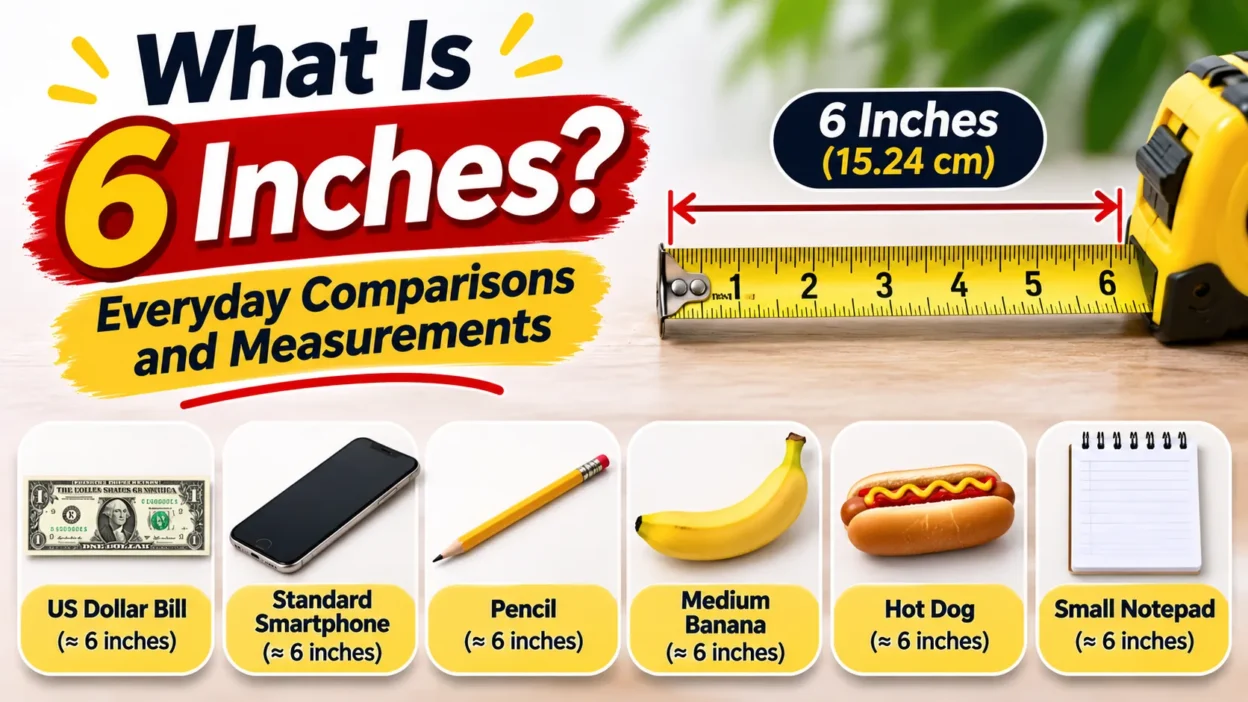
Six inches equals 15.24 centimeters, 152.4 millimeters, or half a foot. It is also equal to 0.5 feet, making it a convenient measurement to understand when comparing inches with larger units.
You can visualize this length by looking at a standard ruler, comparing it with your hand, or measuring familiar household objects. The important thing is to understand whether you’re measuring an object’s length, width, height, or diameter because each describes a different dimension.
In this guide, we’ll break down what 6 inches means, how it compares with everyday objects, how to convert it into other units, and how to estimate it when a measuring tool isn’t available.
📏 What Does 6 Inches Actually Mean?
An inch is a standard unit of length used in the United States and several other countries. Six inches simply means six individual inch-long sections placed end to end.
If you look at a standard 12-inch ruler, the 6-inch mark sits exactly halfway between the beginning and the end. This makes it one of the easiest measurements to recognize.
Here are the basic conversions:
- 6 inches = 15.24 centimeters
- 6 inches = 152.4 millimeters
- 6 inches = 0.5 feet
- 6 inches = 0.167 yards
- 6 inches = 0.1524 meters
If you use the metric system, remember that 6 inches is slightly more than 15 centimeters. If you prefer feet, it is exactly half a foot.
This measurement is useful for estimating small objects, stationery, accessories, and household items. It can also help you understand product dimensions when shopping online, especially when a listing provides measurements in inches rather than centimeters.
✋ How Does 6 Inches Compare to Your Hand?
Your hand is one of the most convenient references for visualizing a 6-inch measurement. For many adults, the distance from the wrist crease to the tip of the middle finger is longer than 6 inches, although hand sizes vary.
Imagine placing a 6-inch ruler beside your open hand. Depending on your hand length, the ruler may reach from the wrist crease toward the middle of your fingers without extending all the way to the middle fingertip.
For example, if your hand measures 7.5 inches from the wrist crease to the tip of your middle finger, a 6-inch object would cover 80% of its length.
However, if your hand measures exactly 6 inches, the ruler would match its full length.
Your palm alone is usually shorter than your complete hand because it does not include the fingers. Therefore, a 6-inch object may extend beyond the palm and toward the fingertips.
For the most useful comparison, measure your own hand once and remember the result. This gives you a personal reference for estimating 6 inches in everyday situations.
📄 How Does 6 Inches Compare to a Standard Sheet of Paper?
A standard US letter-size sheet of paper measures 8.5 inches wide and 11 inches long. This makes it a familiar reference for understanding the size of 6 inches.
Six inches is 2.5 inches shorter than the paper’s width and 5 inches shorter than its length.
Imagine drawing a straight line from one edge of a standard sheet of paper. A 6-inch line would cover most of the shorter side but leave 2.5 inches remaining.
This comparison is especially helpful when estimating the dimensions of notebooks, printed materials, photographs, and small craft projects.
If you use A4 paper instead, its dimensions are approximately 8.27 by 11.69 inches. Six inches is still shorter than either side.
Paper is a useful visual reference, but remember that different paper sizes exist. Always check the actual dimensions if you’re preparing a design or document that needs to fit a particular space.
📱 Is 6 Inches Similar to a Smartphone?
A smartphone can provide a useful comparison, but you need to distinguish between screen size and the physical dimensions of the device.
Many smartphones are marketed with screen sizes around 6 inches. However, manufacturers usually measure screen size diagonally, from one corner of the display to the opposite corner.
This does not mean the phone is exactly 6 inches long or wide.
For example, a smartphone with a 6-inch display may have a body measuring approximately 6 inches or slightly more in height, depending on its design and screen proportions. Its width will generally be much smaller.
This comparison is helpful when visualizing a 6-inch diagonal screen, but it should not be used to estimate the exact length of every smartphone.
If you’re buying a phone case, stand, or carrying pouch, check the actual height, width, and thickness listed by the manufacturer.
🥪 How Does 6 Inches Compare to a Sandwich?
A 6-inch sandwich is another familiar example of this measurement. Some sandwich shops sell sandwiches in lengths around 6 inches, making them an easy reference for understanding a short linear distance.
Imagine a sandwich placed on a table with its two ends visible. The distance from one end of the bread to the other would be approximately 6 inches if it matches that advertised size.
This is equal to 15.24 centimeters, which is slightly longer than 15 centimeters.
The comparison is useful because sandwiches have a clear beginning and ending point. You can picture the full length without needing to think about complicated shapes or dimensions.
However, sandwich sizes can vary by restaurant, bread style, and preparation. An advertised size may not always match the exact finished length, so treat it as a visual example rather than a universal standard.
📚 How Does 6 Inches Compare to a Small Book?
Many small books, journals, and pocket notebooks have one side measuring around 6 inches. This makes them useful objects for understanding the measurement.
For example, a compact notebook measuring 6 inches in height would be 15.24 centimeters tall. You could place it beside a ruler to see how closely its dimensions match the target length.
However, not every paperback or notebook has this size. Some books are shorter, while larger editions may measure 8 inches, 9 inches, or more.
This comparison is particularly useful when choosing storage boxes, organizing a bookshelf, or checking whether a book will fit inside a bag.
Always measure the book’s height and width separately. A book measuring 6 inches tall may have a width of only 4 inches, so the two dimensions should not be confused.
🍽️ How Does 6 Inches Compare to a Small Plate?
A small side plate may measure approximately 6 inches across, although plate sizes vary depending on their purpose and design.
If a plate has a 6-inch diameter, the measurement runs straight across its center from one edge to the opposite edge.
This is different from the circumference, which measures the distance around the outside of the plate.
For example, a circular plate with a 6-inch diameter has a circumference of approximately 18.85 inches.
This comparison is useful when organizing kitchen cabinets, choosing small serving dishes, or estimating the dimensions of decorative plates.
Remember that many standard dinner plates are considerably larger than 6 inches. Small dessert plates and side plates are more appropriate references for this measurement.
📦 What Does a 6-Inch Box Look Like?
A 6-inch box is a convenient example because its dimensions can be described in several ways.
A cube measuring 6 inches on each side would have a length, width, and height of 6 inches. Each side would equal 15.24 centimeters.
However, a rectangular box could have different dimensions. For example, it might measure 6 inches long, 4 inches wide, and 3 inches tall.
In that situation, only the length would be 6 inches.
This distinction matters when shopping for storage containers, gift boxes, and shipping supplies. A product listing may display three dimensions, such as length × width × height.
If you’re trying to fit an item inside a box, check the internal measurements rather than relying only on the outside dimensions. The walls of the box reduce the available space.
🛠️ How Can You Measure 6 Inches Without a Ruler?
If you don’t have a ruler nearby, you can estimate 6 inches using familiar objects. These methods are useful for quick comparisons, although they are not as accurate as a proper measuring tool.
Use a 12-inch ruler if available. Six inches is exactly half its length. Simply identify the midpoint between the zero and 12-inch markings.
Use your hand as a reference. If you know the length of your hand from the wrist crease to the middle fingertip, you can compare it with 6 inches. Remember that hand dimensions vary.
Use a standard sheet of paper. Six inches is shorter than the 8.5-inch width of US letter-size paper. You can use this difference to make a rough estimate.
Use a metric ruler. Measure 15.24 centimeters to get the exact equivalent of 6 inches.
Use a measuring tape. This is the best option when measuring furniture, cutting materials, or checking whether something fits into a specific space.
For accurate work, avoid depending on visual guesses. Even a small measurement error can cause problems when fitting parts together or cutting materials.
📊 How Much Is 6 Inches in Different Units?
The following table shows how 6 inches converts into commonly used measurement units.
| Measurement unit | Equivalent |
|---|---|
| Inches | 6 in |
| Centimeters | 15.24 cm |
| Millimeters | 152.4 mm |
| Feet | 0.5 ft |
| Yards | 0.167 yd |
| Meters | 0.1524 m |
The easiest conversion to remember is 6 inches = 15.24 centimeters.
If you frequently switch between the imperial and metric systems, remember that one inch equals 2.54 centimeters. Multiplying the number of inches by 2.54 gives you the centimeter measurement.
📐 Why Is Understanding 6 Inches Useful?
Knowing what 6 inches looks like can help with more than simple measurements. It can make everyday decisions easier, especially when shopping, organizing your home, or completing small projects.
When purchasing products online, dimensions are often listed in inches. Understanding the size helps you decide whether an item will fit inside a drawer, bag, cupboard, or storage container.
For home improvement projects, 6 inches may represent the depth of a small shelf, the width of a decorative panel, or the spacing between two objects. Accurate measurement is important because small differences can affect the final result.
In crafts and school projects, this measurement can help you cut paper, arrange decorative materials, or create designs with consistent spacing.
It is also useful when comparing objects. Once you recognize the length of 6 inches, you can estimate whether another item is shorter, longer, or approximately the same size.
❓ Frequently Asked Questions
Is 6 inches considered long?
Six inches is a moderate length for a small household object but relatively short compared with furniture or large equipment. It equals 15.24 centimeters and half a foot.
Is 6 inches half a foot?
Yes. One foot contains 12 inches, so 6 inches is exactly half a foot.
How many centimeters are in 6 inches?
Six inches equals exactly 15.24 centimeters. You can calculate this by multiplying 6 by 2.54.
Is 6 inches longer than a hand?
It depends on the person’s hand size. For many adults, the full hand from the wrist crease to the middle fingertip is longer than 6 inches, but some people may have shorter hands.
Is 6 inches the same as 15 centimeters?
Not exactly. Six inches equals 15.24 centimeters, which is 0.24 centimeters longer than 15 centimeters. The difference is small, but it matters when accuracy is important.
How can I visualize 6 inches quickly?
Think of half a standard 12-inch ruler, a 15.24-centimeter line, or a length shorter than the width of standard US letter-size paper. These references make the measurement easier to imagine.
🎯 Final Thoughts: Understanding the Size of 6 Inches
Six inches equals 15.24 centimeters, 152.4 millimeters, or exactly half a foot. It is a practical measurement that appears in everyday objects, small packages, accessories, books, and household projects.
You can visualize it by looking at the midpoint of a 12-inch ruler, comparing it with your hand, or measuring a line across a familiar object. A standard sheet of US letter-size paper also provides a useful reference because 6 inches is shorter than its 8.5-inch width.
The most important thing is to compare the correct dimensions. An object’s height, width, length, and diameter are not interchangeable. When accuracy matters, use a ruler or measuring tape rather than relying entirely on visual estimates.

Colton Mercer is a writer and contributor at TechMeasurez, covering measurements, dimensions, size guides, conversions, comparisons, and practical online tools. His work focuses on turning everyday measurement questions into clear, easy-to-follow information. Through TechMeasurez, Colton aims to make useful facts, guides, and digital resources simple for everyone to understand.