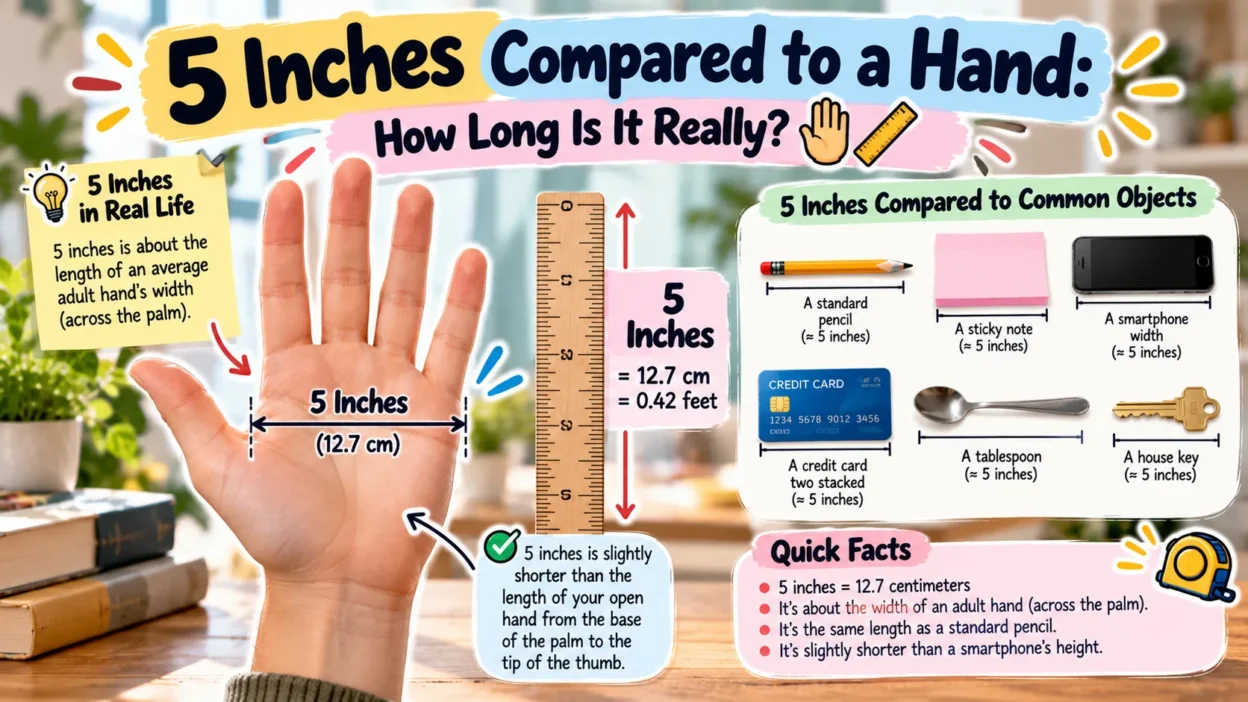
Have you ever wondered how long 5 inches looks when compared with your hand? Whether you’re trying to understand the size of a small object, check a product’s dimensions, measure something without a ruler, or visualize a length you see online, your hand can provide a useful point of reference.
Five inches equals 12.7 centimeters or 127 millimeters. For many adults, this length is shorter than the full hand measured from the wrist crease to the tip of the middle finger. Depending on your hand size, 5 inches may cover most of your palm and extend toward the base or middle of your fingers.
However, not everyone’s hands are the same size. A person’s height, age, and individual proportions can influence hand length, so using your own hand is more reliable than assuming that a standard hand measurement applies to everyone.
In this guide, you’ll learn how 5 inches compares with an adult hand, how it relates to your palm and fingers, and how to measure this length accurately using everyday methods.
📏 How Long Is 5 Inches in Real Life?
Five inches is a relatively short length when compared with larger household objects, but it can be substantial for something small enough to hold in one hand.
To understand the measurement, it helps to convert it into units you may already recognize.
- In inches: 5 inches
- In centimeters: 12.7 cm
- In millimeters: 127 mm
- In feet: Approximately 0.42 feet
- In meters: 0.127 meters
If you’re more familiar with the metric system, imagine a line measuring 12.7 centimeters on a ruler. If you use inches regularly, look at the distance between the zero mark and the 5-inch mark.
This measurement is useful for visualizing small objects such as compact accessories, small tools, and handheld items. When compared with your hand, it becomes easier to understand without needing to imagine the length in isolation.
Keep in mind that 5 inches describes a straight-line distance. For example, the length of an object is measured from one end to the other, not around its surface.
✋ How Does 5 Inches Compare to an Adult Hand?
For many adults, 5 inches is shorter than the full length of their hand, measured from the wrist crease to the tip of the middle finger.
Adult hand length varies considerably. Some people’s hands measure around 7 inches, while others have hands measuring 8 inches or more. These are illustrative examples, not fixed measurements for every adult.
Imagine an adult whose hand measures 7.5 inches from the wrist crease to the tip of the middle finger. A 5-inch line would cover about two-thirds of that distance.
Here’s the calculation:
5 ÷ 7.5 × 100 = approximately 66.7%.
In this example, 5 inches represents about two-thirds of the full hand length, leaving 2.5 inches between the 5-inch mark and the fingertip.
If your hand measures 7 inches, 5 inches would cover about 71% of its length. If your hand measures 8 inches, the same distance would cover 62.5%.
This explains why the comparison can look different from person to person. Rather than relying on a universal hand size, use your own hand as a reference for the most meaningful estimate.
🖐️ Is 5 Inches Longer Than the Palm of Your Hand?
The answer depends on your palm’s actual length.
The palm is the central part of your hand between the wrist crease and the bases of your fingers. It does not include the full length of your fingers, so it is shorter than your complete hand.
For some adults, the palm measures approximately 3.5 to 4.5 inches long, although individual proportions vary. For these people, a 5-inch object may be longer than the palm alone.
Imagine your palm measures 4 inches from the wrist crease to the base of your middle finger. If you place a 5-inch ruler beside it, the ruler would extend about 1 inch beyond the base of your fingers.
That extra length is approximately 2.54 centimeters.
This comparison is useful when estimating whether an object will fit comfortably in your palm. A 5-inch item may extend beyond the central palm area, even though it could still be small enough to hold in one hand.
However, the palm’s width is different from its length. If you’re comparing the width of an object with your palm, you need to measure across your hand rather than from your wrist toward your fingers.
☝️ How Does 5 Inches Compare to Your Fingers?
Your fingers offer another familiar way to understand this measurement, but each finger has a different length.
The middle finger is generally the longest finger on the hand. The index and ring fingers are often slightly shorter, while the little finger is considerably shorter. These differences vary between individuals.
For many adults, a 5-inch length is longer than an individual finger measured from its base to its tip. For example, if your middle finger measures 3.5 inches, a 5-inch object would be 1.5 inches longer.
If your middle finger measures 4 inches, the difference would be 1 inch.
You can use this comparison to estimate the size of a small object when a ruler is unavailable. Place the object beside your finger and compare their lengths.
Nevertheless, fingers are not standardized measuring tools. Their dimensions differ from person to person, and bending your finger can make the comparison less reliable. If you need an accurate result, use a ruler or measuring tape.
🤚 How Does 5 Inches Compare to an Open Hand?
An open hand can help you picture the relationship between 5 inches and the overall size of your hand.
When you spread your fingers, the width of your hand increases, but its length from the wrist crease to the middle fingertip remains approximately the same. This distinction matters because hand width and hand length are two different measurements.
For example, an object measuring 5 inches long might cover much of the central length of your hand without stretching from your wrist all the way to your middle fingertip.
If you place a 5-inch object across your open palm, however, the result depends on how you position it. The object’s length may exceed the width of your palm, especially if you measure across the central area rather than diagonally.
This is why it’s important to compare the same dimensions. Length should be compared with length, and width should be compared with width.
For the clearest visual comparison, place your hand flat on a table and position a ruler alongside it. This allows you to see exactly where 5 inches falls relative to your palm and fingertips.
📱 What Everyday Objects Are Similar to 5 Inches?
Your hand isn’t the only way to visualize this length. Several everyday objects can help you develop a more accurate mental picture of 5 inches.
A compact electronic accessory, small tool, or handheld item may measure approximately 5 inches in one dimension. For example, a short remote control or a compact stationery item may be close to this length, depending on its design.
A smartphone can also provide a reference, but phone dimensions vary considerably. Some compact devices are shorter than 5 inches in height, while many modern smartphones are longer. It’s important to check the device’s actual dimensions rather than assuming all phones have a standard length.
A standard index card or piece of paper can also help if you know its dimensions. For instance, a 5-inch line is noticeably shorter than the long side of a typical US letter-size sheet of paper, which measures 11 inches.
These comparisons help you visualize the measurement in context. However, they should be treated as estimates unless the object’s dimensions are known.
📐 How Can You Measure 5 Inches Using Your Own Hand?
If you want to know exactly how 5 inches compares with your hand, you can measure it yourself in less than a minute.
Step 1: Place your hand on a flat surface.
Open your hand naturally and rest it on a table. Keep your fingers comfortably extended without stretching them unnaturally.
Step 2: Find the wrist crease.
Identify the crease where your hand meets your wrist. This provides a consistent starting point for measuring the full length of your hand.
Step 3: Measure to the middle fingertip.
Use a ruler to measure the straight-line distance from the wrist crease to the tip of your middle finger. Record the measurement in inches or centimeters.
Step 4: Compare your result with 5 inches.
If your hand measures 7.5 inches, for example, then 5 inches represents about two-thirds of its length. If your hand measures 7 inches, the 5-inch distance covers a little over 70% of it.
Step 5: Measure your palm separately.
To determine whether 5 inches is longer than your palm, measure from the wrist crease to the base of your middle finger. Compare that result with 5 inches.
This simple method gives you a personal reference that is much more useful than relying on a general estimate of adult hand size.
📊 Five Inches Compared to Different Hand Measurements
The following table uses example measurements to demonstrate how 5 inches compares with different hand sizes.
| Example measurement | Length | How 5 inches compares |
|---|---|---|
| Shorter adult hand | 7 inches | 5 inches is about 71% of the length |
| Example adult hand | 7.5 inches | 5 inches is about 67% of the length |
| Longer adult hand | 8 inches | 5 inches is 62.5% of the length |
| Example palm length | 4 inches | 5 inches is 1 inch longer |
| Five-inch object | 5 inches | 12.7 centimeters |
These figures are examples to help explain proportions. They are not intended to represent the exact dimensions of every adult’s hand or palm.
The most important takeaway is that 5 inches is often shorter than the complete hand but may be longer than the palm alone.
🔄 How Does 5 Inches Compare in Centimeters?
If you use metric measurements, converting 5 inches to centimeters makes the size easier to understand.
One inch equals exactly 2.54 centimeters. To convert 5 inches, multiply 5 by 2.54.
5 × 2.54 = 12.7 centimeters.
Therefore, 5 inches equals exactly 12.7 centimeters.
This means that a 5-inch object would measure 12.7 centimeters from one end to the other. On a metric ruler, you can locate the 12-centimeter mark and continue another 7 millimeters.
This conversion is especially useful when shopping online because product dimensions may be listed in either inches or centimeters. Checking both units can help prevent confusion when deciding whether an item will fit in your hand, a drawer, a bag, or another space.
🛍️ Why Is Comparing 5 Inches to a Hand Useful?
Understanding the relationship between 5 inches and your hand can help in several everyday situations.
When shopping online, product images can make objects appear larger or smaller than they really are. Comparing a listed 5-inch dimension with your own hand gives you a more realistic idea of its physical size.
When organizing a home, this comparison may help you estimate the dimensions of small accessories, compact containers, or handheld objects. It can also help you decide whether an item is likely to fit in a particular space, although measuring the space itself is still necessary.
For crafts and DIY projects, understanding a 5-inch length can help you estimate material sizes before reaching for a ruler. However, measurements for cutting, drilling, or fitting parts together should always be checked accurately.
The comparison is also useful when learning measurements. Familiar body references can make abstract numbers easier to remember, especially when you regularly switch between inches and centimeters.
⚠️ Can You Reliably Use Your Hand as a Measuring Tool?
Your hand can be useful for rough estimates, but it is not a universal measuring tool.
Hand length, palm length, and finger proportions vary between individuals. Even two people with similar hand lengths may have different palm widths or finger lengths.
If you estimate 5 inches using your hand without measuring it first, your result may be off by a noticeable amount. That might be acceptable when casually estimating an object’s size, but it may cause problems when accuracy matters.
For example, a small difference may affect whether an item fits inside a narrow compartment or whether a component matches the required dimensions.
A better approach is to measure your own hand once and remember the result. You can then use it as a personal reference for quick estimates. For precise work, always use a ruler, measuring tape, or suitable measuring instrument.
❓ Frequently Asked Questions
Is 5 inches small compared to a hand?
For many adults, 5 inches is shorter than the full length of the hand from the wrist crease to the tip of the middle finger. It may cover roughly two-thirds of the hand, depending on its size.
Is 5 inches longer than a palm?
It can be. Some adults have palm lengths shorter than 5 inches, so a 5-inch object may extend beyond the palm toward the fingers. The exact comparison depends on your individual hand dimensions.
How many centimeters is 5 inches?
Five inches equals exactly 12.7 centimeters, or 127 millimeters.
Can I estimate 5 inches using my fingers?
You can use your fingers for a rough comparison, but their lengths vary. Measuring your middle finger with a ruler gives you a more reliable personal reference.
Is 5 inches the same as the full length of a hand?
Not usually for many adults. The full hand, measured from the wrist crease to the tip of the middle finger, is often longer than 5 inches. However, some people’s hands may be shorter, so individual measurements matter.
What is the easiest way to visualize 5 inches?
The easiest method is to look at the 5-inch mark on a ruler and compare it with your own hand. You can also remember that 5 inches equals 12.7 centimeters, which makes the measurement easy to locate on a metric ruler.
🎯 Final Thoughts: Understanding 5 Inches Compared to a Hand
Five inches equals 12.7 centimeters and is shorter than the full length of many adult hands. Depending on your hand size, it may cover approximately two-thirds of the distance from your wrist crease to the tip of your middle finger.
Compared with the palm alone, 5 inches may be longer, extending beyond the base of the fingers. This makes your hand a helpful reference for visualizing small objects, although the exact comparison differs from person to person.
For the best result, measure your own hand and compare it directly with a ruler. Once you know your hand’s dimensions, you’ll have a convenient personal reference for estimating 5 inches in everyday situations.

Colton Mercer is a writer and contributor at TechMeasurez, covering measurements, dimensions, size guides, conversions, comparisons, and practical online tools. His work focuses on turning everyday measurement questions into clear, easy-to-follow information. Through TechMeasurez, Colton aims to make useful facts, guides, and digital resources simple for everyone to understand.