
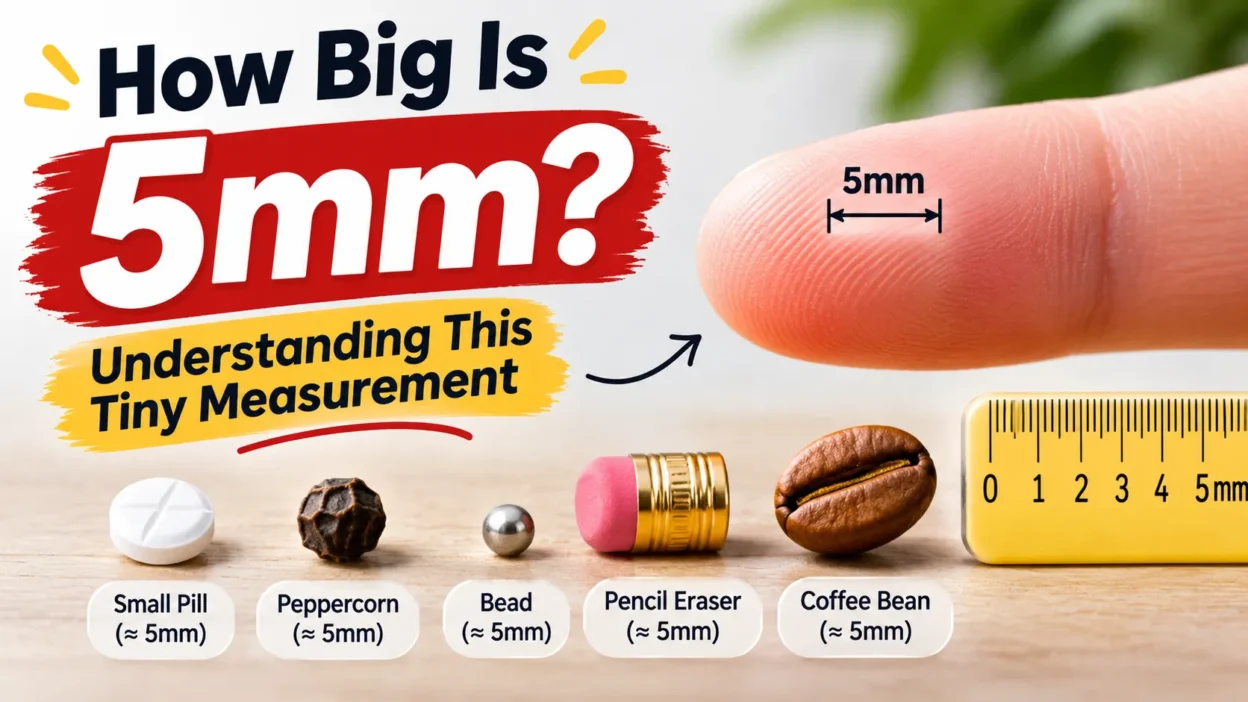
Five millimeters may seem like an extremely small measurement, but it is surprisingly common in everyday life. You might come across 5mm when checking the thickness of a small object, buying jewelry supplies, measuring a screw, choosing craft materials, or comparing product dimensions. The challenge is understanding what this tiny distance actually looks like without holding a ruler.
5mm equals 0.5 centimeters, 0.005 meters, or approximately 0.197 inches. It is slightly smaller than one-fifth of an inch and exactly half the distance between two centimeter marks on a standard metric ruler.
Although 5mm is less than a centimeter, it can make a noticeable difference when measuring small components or checking whether two objects fit together. Understanding its size becomes much easier when you connect the measurement with familiar items and practical examples.
📏 First, Understand Exactly How Big 5mm Is
Before comparing 5mm with everyday objects, it helps to understand where this measurement falls on a ruler.
A centimeter contains 10 millimeters. Therefore, 5mm represents exactly half a centimeter. If you look at the space between the 0cm and 1cm markings on a metric ruler, the halfway point is the 5mm mark.
Here is a quick breakdown:
- 5 millimeters = 0.5 centimeters
- 5 millimeters = 0.005 meters
- 5 millimeters = approximately 0.197 inches
- 5 millimeters = approximately 0.0164 feet
- 5 millimeters = 5,000 micrometers
The easiest way to remember this measurement is to picture half a centimeter on a ruler.
Five millimeters may look tiny beside a large household object, but it can be an important measurement when dealing with jewelry, electronics, small tools, and mechanical components.
🔍 What Does 5mm Look Like on a Ruler?
A metric ruler is probably the simplest way to understand this measurement accurately. Most metric rulers show centimeters as larger numbered markings, with smaller divisions representing individual millimeters.
Find the 0cm marking and move toward the 1cm marking. You will cross nine small divisions before reaching the next centimeter. The fifth division represents 5mm.
This means you don’t need to estimate the measurement visually. You can identify it directly by counting the small markings.
If you use an imperial ruler instead, look for the 5mm equivalent. It is approximately 0.197 inches, which is slightly shorter than 3/16 inch (0.1875 inches) and slightly longer than that fraction.
For everyday understanding, half a centimeter is the easiest reference. For precise work, always read the actual millimeter markings rather than estimating the distance.
✏️ How Does 5mm Compare to a Pencil Tip?
A pencil tip provides an interesting comparison because its pointed end is much narrower than the full width of the pencil.
A sharpened pencil does not have a fixed tip diameter. Its thickness changes as the graphite becomes exposed, and the visible point can be extremely narrow. However, the wooden body of a standard pencil is much wider than 5mm.
Imagine looking at the cross-section of a pencil near its middle. A 5mm measurement would cover a small portion of its width, depending on the pencil’s design.
This comparison helps demonstrate why 5mm is not the same as a tiny writing mark. It is a measurable distance that can be seen clearly on a ruler, even though it remains small compared with ordinary stationery.
If you’re comparing pencil dimensions for a craft or drawing project, measure the actual pencil rather than assuming that every model has the same diameter.
💍 What Does a 5mm Jewelry Bead Look Like?
Five millimeters is a common size to understand when shopping for small jewelry components. Round beads measuring 5mm across are used in bracelets, necklaces, earrings, and decorative accessories.
Imagine a small round bead resting on your fingertip. Its diameter would be half a centimeter, making it compact but still noticeable.
A 5mm bead is smaller than an 8mm bead and considerably smaller than a 10mm bead. When you place these sizes next to each other, the differences become easier to recognize.
The measurement usually refers to the bead’s outside diameter. The opening through which a string or wire passes is measured separately and is generally smaller.
This distinction matters when buying jewelry supplies. A bead may be advertised as 5mm, but its threading hole might measure only a fraction of that size.
If you’re making a bracelet or necklace, checking both the outside diameter and hole size helps you choose the right materials.
🔩 Is 5mm a Common Size for Screws and Small Hardware?
Yes, 5mm is a useful measurement in metric hardware. It is often encountered when working with small screws, bolts, fittings, and mechanical components.
For example, an M5 screw has a nominal thread diameter of 5mm. The letter M identifies a metric screw thread, while the number indicates its nominal diameter.
However, the entire screw does not measure 5mm in every direction. Its head may be wider, and its length is measured separately from its diameter.
This is particularly important when assembling furniture or replacing a damaged fastener. A screw with the wrong diameter may not fit the intended hole or thread.
You should also avoid confusing a 5mm screw with a 5mm drill bit. Although both measurements describe a diameter, the correct drill-bit size depends on the material, hole type, and screw specifications.
When choosing hardware, always follow the manufacturer’s measurements and fitting recommendations.
🪙 How Does 5mm Compare to the Thickness of a Coin?
A single coin is generally much wider than 5mm across its face, but its thickness can be useful for understanding small measurements.
For example, imagine a coin that measures approximately 2mm thick. Stacking two such coins would create a combined thickness of around 4mm, which is close to 5mm.
Adding another millimeter would bring the total to the target measurement.
This is an illustrative comparison because coin thickness varies by currency, denomination, and manufacturing specifications. Not every coin measures 2mm thick.
The important idea is that 5mm is a little more substantial than the thickness of many individual coins, but it is still a small distance.
This comparison is particularly useful when thinking about the thickness of flat objects, thin materials, and small layers.
📱 How Small Is 5mm Compared to a Smartphone?
A smartphone is much larger than 5mm, which makes it a useful reference for understanding the scale of this measurement.
Many smartphones are approximately 70–80mm wide. Compared with a phone measuring 75mm across, a 5mm strip would represent only one-fifteenth of its width.
Imagine a narrow strip running along one edge of your phone. It would occupy a very small part of the device’s overall width.
This comparison can help you understand the size of a narrow gap, a small scratch, or a thin accessory. It is also useful when looking at the dimensions of phone connectors and compact electronic components.
However, smartphone measurements differ between models. Use the manufacturer’s specifications when you need an accurate comparison.
🧵 What Does 5mm Look Like in Sewing and Craft Projects?
Five millimeters is a useful measurement in sewing, knitting, paper crafts, and other creative projects.
For example, a 5mm gap between two stitching lines can create a noticeable difference in the appearance of a finished piece. Similarly, a 5mm border around a paper design may look narrow but still provide visible spacing.
In knitting and crochet, millimeter measurements are commonly used to describe needle and hook sizes. A tool labeled 5mm has a nominal diameter of 5 millimeters, although its overall shape and working dimensions depend on the design.
This measurement also helps when choosing decorative beads, small buttons, ribbon widths, and other craft supplies.
If you’re following a pattern, pay attention to whether the measurement describes thickness, width, diameter, or spacing. These terms refer to different dimensions, even when the numerical value is identical.
🪵 Is 5mm Thick Enough for Wood, Plastic, or Other Materials?
A thickness of 5mm is relatively small for many construction materials, but it can be useful in crafts, model-making, packaging, and lightweight projects.
For example, a wooden craft panel measuring 5mm thick may be suitable for certain decorative projects, depending on its material and intended use.
A plastic sheet with the same thickness may feel different because plastic and wood have different strengths, flexibility, and densities.
This is why thickness alone does not determine whether a material is strong enough. Its composition, dimensions, support, and intended purpose also matter.
When shopping for material, check the listed thickness carefully. A product described as 5mm thick should not be confused with one measuring 5cm, which is ten times thicker.
For DIY projects, use a ruler or caliper to verify the actual thickness if a precise fit is important.
📊 How Does 5mm Compare With Other Small Measurements?
Sometimes the easiest way to understand a measurement is to compare it with nearby sizes.
| Measurement | Equivalent in millimeters |
|---|---|
| 1 millimeter | 1mm |
| 2 millimeters | 2mm |
| 3 millimeters | 3mm |
| 4 millimeters | 4mm |
| 5 millimeters | 5mm |
| 6 millimeters | 6mm |
| 8 millimeters | 8mm |
| 10 millimeters | 1cm |
This table shows that 5mm is exactly halfway between zero and one centimeter.
It also helps explain how small changes can matter. For example, an 8mm object is 3mm wider than a 5mm object. That difference may seem minor, but it can affect whether a small component fits inside a particular opening.
🔄 How Do You Convert 5mm Into Inches?
If you use inches instead of millimeters, converting 5mm is straightforward.
One inch equals 25.4 millimeters. To convert millimeters into inches, divide the millimeter measurement by 25.4.
For 5mm:
5 ÷ 25.4 = 0.19685 inches.
Therefore, 5mm is approximately 0.197 inches.
This is slightly smaller than one-fifth of an inch, which equals 0.2 inches.
You may also see 5mm rounded to approximately 3/16 inch in certain practical conversion charts. However, 3/16 inch equals 4.7625mm, so it is not an exact match.
For everyday estimates, 0.2 inches is a convenient approximation. For engineering, hardware, and precision projects, use the more accurate conversion.
🛠️ How Can You Measure 5mm Without a Digital Caliper?
You don’t need a specialized measuring instrument for every 5mm measurement. A standard metric ruler can be enough for many everyday tasks.
Use a metric ruler: Locate the centimeter markings and count five small millimeter divisions from the zero point.
Use a measuring tape: Some measuring tapes include millimeter markings, allowing you to identify the distance without converting units.
Use a digital caliper: When measuring small components, a digital caliper provides a more precise reading. It is especially helpful for checking diameters and thicknesses.
Check product specifications: If you’re buying a screw, bead, craft tool, or replacement component, the manufacturer’s listed dimensions may provide the information you need.
Avoid relying on visual guesses: Fingernails, pencil tips, and coins vary in size. They can help you imagine a small measurement, but they are not dependable measuring tools.
If the measurement affects whether two parts fit together, use a ruler or caliper instead of estimating.
❓ Frequently Asked Questions About 5mm
Is 5mm considered small?
Yes. Five millimeters is considered a small measurement because it is only half a centimeter. However, it is large enough to measure clearly with an ordinary metric ruler and is commonly used for small hardware, jewelry, and craft materials.
Is 5mm the same as half a centimeter?
Yes. One centimeter contains 10 millimeters, so 5mm is exactly half a centimeter.
Is 5mm close to ¼ inch?
It is slightly smaller. A quarter inch equals 6.35mm, while 5mm equals approximately 0.197 inches. The difference is 1.35mm.
How many millimeters are in 1 centimeter?
One centimeter contains exactly 10 millimeters. Therefore, 5mm represents half of one centimeter.
Is 5mm bigger than 3/16 inch?
Yes, slightly. Three-sixteenths of an inch equals approximately 4.76mm, while 5mm is about 0.24mm larger.
What is 5mm used to measure?
Five millimeters is commonly used for small components, jewelry beads, metric screws, craft materials, needle and hook sizes, and the thickness or diameter of compact objects.
Can I measure 5mm with a regular ruler?
Yes. A metric ruler with millimeter markings can measure 5mm directly. You simply count five small divisions from the zero mark.
🎯 Final Thoughts: Getting a Clear Picture of 5mm
Five millimeters is a small but important measurement that equals half a centimeter or approximately 0.197 inches. It appears in many areas of everyday life, including jewelry, small hardware, sewing, electronics, and craft projects.
The easiest way to visualize it is to find the halfway point between two centimeter markings on a metric ruler. You can also remember that 5mm is slightly smaller than one-fifth of an inch.
Although everyday comparisons help make the measurement easier to understand, they should not replace accurate measuring tools. If you’re choosing a screw, buying a component, or completing a project that requires a precise fit, use a metric ruler or digital caliper to confirm the size.

Colton Mercer is a writer and contributor at TechMeasurez, covering measurements, dimensions, size guides, conversions, comparisons, and practical online tools. His work focuses on turning everyday measurement questions into clear, easy-to-follow information. Through TechMeasurez, Colton aims to make useful facts, guides, and digital resources simple for everyone to understand.