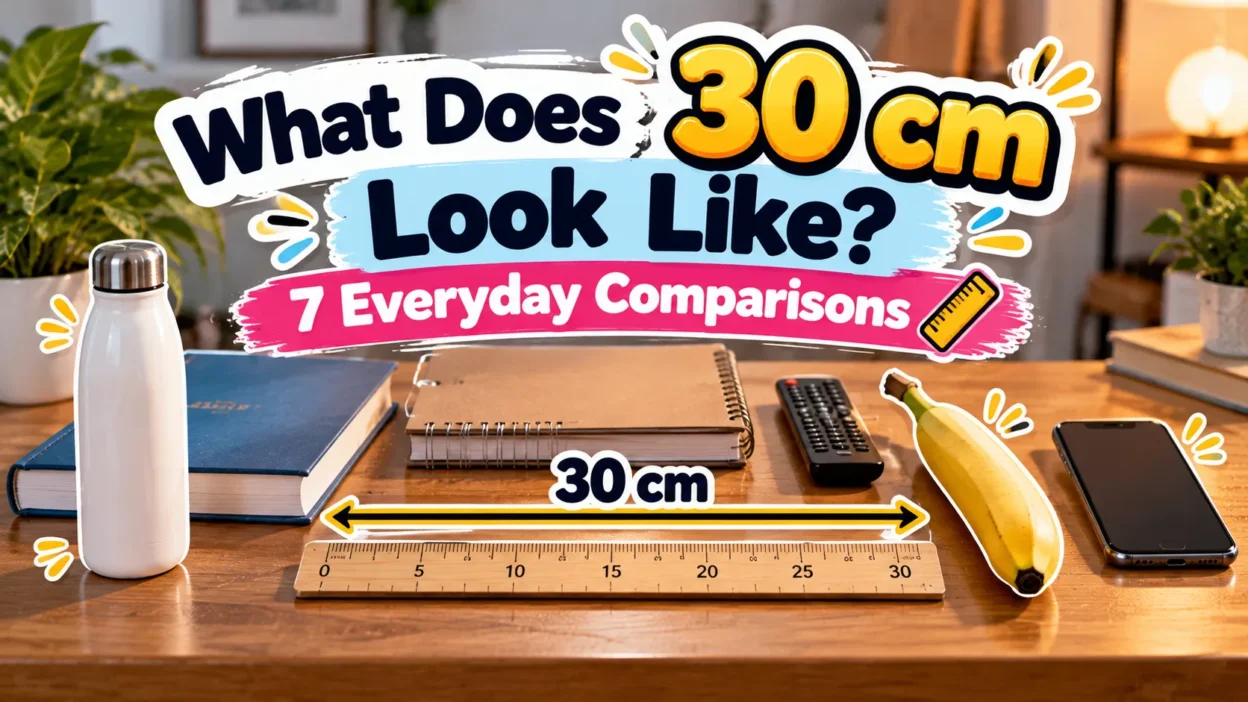
Have you ever wondered what 30 cm looks like in real life? This measurement appears in many everyday objects, from school rulers and kitchen tools to household accessories. If you do not have a measuring tape nearby, comparing 30 centimeters with familiar items can help you understand its actual size.
30 cm equals 11.81 inches, 300 millimeters, or 0.3 meters. It is slightly shorter than a standard 12-inch ruler, making it easy to visualize with common measuring tools.
In this guide, you will discover 15 everyday objects that are approximately 30 cm long or wide. You will also learn how to measure this distance, understand the difference between length and diameter, and find simple comparisons you can use at home, school, or work.
📏 How Long Is 30 cm?
Thirty centimeters is a little less than one foot. Since one foot equals 30.48 centimeters, 30 cm falls short of a foot by just 0.48 cm.
Here are the main conversions:
- In inches: Approximately 11.81 inches
- In feet: Approximately 0.984 feet
- In millimeters: 300 mm
- In meters: 0.3 m
- In yards: Approximately 0.328 yards
One of the easiest ways to picture this length is to imagine a standard 12-inch ruler. A 30 cm line is only about 0.19 inches shorter than the ruler.
You can also picture a straight line measuring 300 millimeters. This is a useful reference for school projects, DIY tasks, cooking, and measuring household items.
Keep in mind that an object’s listed size may refer to its length, width, height, diameter, or screen diagonal. The examples below include approximate comparisons, so check the exact dimensions if precision matters.
📐 1. A Standard 30 cm Ruler
A ruler marked with 30 centimeters is the most direct way to visualize this measurement. Many classroom and office rulers are 30 cm long, although some are shorter or longer.
If you have a metric ruler, place it on a flat surface and look from the zero mark to the 30 cm mark. That distance represents exactly 30 centimeters.
Some rulers display both centimeters and inches. On these rulers, 30 cm corresponds to approximately 11.81 inches, which is just under the 12-inch mark.
This comparison is particularly useful because it gives you a reliable reference for checking the size of other objects. You can use it to measure books, stationery, small household items, and craft materials.
Remember that the ruler’s printed markings may begin slightly inside its physical edge. For the most accurate measurement, align the zero mark with the beginning of the object rather than automatically starting at the ruler’s end.
📄 2. The Long Side of A4 Paper
A standard A4 sheet of paper measures 21 cm wide by 29.7 cm long. Its longer edge is therefore only 0.3 cm shorter than 30 cm.
This makes A4 paper one of the closest common references for visualizing 30 centimeters. Place a sheet on a desk and look along its longer side. It is almost exactly 30 cm long.
A4 paper is widely used for documents, school assignments, office printing, and everyday writing in many countries.
The difference between 29.7 cm and 30 cm is very small. However, if you need an exact measurement for a technical drawing or a craft project, use a ruler rather than treating the paper as exactly 30 cm.
This comparison is especially useful for students and office workers who regularly handle printed documents. It provides an easy way to estimate the measurement without needing a dedicated measuring tool.
🥖 3. A Long Loaf of Bread
Some long loaves of bread measure approximately 30 cm from one end to the other. The exact length depends on the type of bread, baking method, and bakery.
For example, certain baguettes and sandwich loaves may be around 30 cm long, while other varieties are considerably shorter or longer.
To visualize the measurement, imagine placing a long loaf on a kitchen counter. The straight-line distance from one end to the other can provide a useful reference.
However, bread is not a standardized measuring object. Its shape may be curved, tapered, or uneven, making visual estimates less reliable than measuring with a ruler.
If you are comparing bread sizes for a recipe or serving tray, check the actual dimensions of the loaf rather than assuming every long loaf is 30 cm.
🖥️ 4. A 12-Inch Laptop or Tablet Screen
A device advertised as having a 12-inch screen has a display diagonal of 12 inches, which equals 30.48 cm. This is very close to 30 cm.
However, screen size is measured diagonally, not across the device’s length or width. A 12-inch screen does not mean the laptop or tablet is 30 cm long from side to side.
The actual body dimensions depend on the screen’s aspect ratio, bezel size, and device design. Some devices may have a width close to 30 cm, while others are noticeably narrower.
This example is useful when thinking about portable electronics or choosing a protective sleeve. Always check the manufacturer’s listed height and width rather than relying solely on the screen size.
🍳 5. A Large Frying Pan
Some large frying pans have a diameter close to 30 cm. These pans can help you visualize the measurement because their cooking surfaces are broad and easy to compare with a ruler.
A pan advertised as 30 cm generally refers to its approximate diameter across the top, although manufacturers may specify measurements differently.
The diameter is the straight-line distance from one side of the circular pan to the opposite side through its center. It is not the distance around the rim.
A 30 cm frying pan is approximately 11.81 inches across. Its cooking base may be narrower than the top opening, especially if the sides slope outward.
If you have a frying pan at home, measure across its top edge to see whether it is close to 30 cm. This is a useful comparison for kitchen organization, choosing lids, and planning storage space.
🪴 6. A Plant Pot With a 30 cm Diameter
Some medium-sized plant pots have a top diameter of approximately 30 cm. These containers are common in gardens, patios, and indoor plant displays.
If a pot is described as 30 cm wide, the measurement usually refers to the diameter of its top opening. It does not necessarily describe its height or the width of its base.
For example, a tapered pot may measure 30 cm across the top but become narrower toward the bottom. A tall planter may also have a height that differs from its diameter.
To visualize 30 cm, imagine a round pot on a garden bench. The straight-line distance across the opening gives you the approximate measurement.
This comparison is helpful when choosing containers for plants or arranging pots on a shelf. Always check the listed dimensions if the container needs to fit into a specific space.
🧹 7. A Short Broom Handle Section
A section of broom handle or a replacement wooden dowel can be cut to exactly 30 cm. Although complete broom handles are usually much longer, a short section provides a straightforward way to picture the measurement.
Imagine a straight wooden rod lying on a workbench. If it measures from the zero mark to the 30 cm mark on a metric tape, its length is exactly 30 centimeters.
This comparison is useful for DIY projects, woodworking, craft activities, and household repairs.
The important distinction is that a 30 cm section of a handle is not the same as a complete broom. The total length of a broom handle depends on its design and intended use.
If you need a wooden piece of this length, measure carefully before cutting. Account for the saw blade’s width when making a cut so the finished piece reaches the intended length.
🥄 8. A Long Kitchen Utensil
Some kitchen utensils, such as serving spoons, spatulas, and cooking spoons, measure close to 30 cm in total length.
The exact dimensions vary by product. A utensil’s total length includes its handle and working end, while a listed blade or bowl measurement may describe only part of the item.
To compare a utensil with 30 cm, place it flat on a counter and measure from one end to the other.
Long cooking utensils are useful visual references because many people already have them in their kitchens. However, not every spoon or spatula measures 30 cm, so check the actual size if you need a reliable measurement.
📚 9. A Large Book or Textbook
Some large textbooks, reference books, and illustrated books measure close to 30 cm along one edge. Smaller novels and paperbacks are often shorter.
Book dimensions depend on the publisher, format, and intended use. A large textbook may be nearly 30 cm tall, while another book might be 25 cm or less.
To picture the measurement, place a book on a table and measure its longest edge. If that edge is close to 30 cm, it can serve as a helpful comparison.
Books are especially useful references for students because they are commonly found in classrooms and study areas. Still, use the actual measurements rather than assuming all textbooks are the same size.
🥕 10. A Very Long Carrot
Some long carrots can grow to approximately 30 cm, although many carrots sold in grocery stores are considerably shorter.
Their size depends on the variety, soil conditions, growing period, and harvesting stage. A carrot’s length can also be difficult to estimate because its shape tapers toward the tip.
To visualize 30 cm, imagine a long carrot placed beside a metric ruler. Measure from the top of the root to its tip, excluding the leafy greens if you want the root’s length alone.
This example is useful for gardening and food-related comparisons, but it is not a dependable standard because natural produce varies considerably.
🧵 11. A Piece of Fabric Cut to 30 cm
A piece of fabric can be measured or cut to exactly 30 cm, making it a practical reference for sewing, quilting, and craft projects.
For example, a rectangular piece measuring 30 by 20 cm has one side that is exactly 30 cm long. A square measuring 30 by 30 cm has four sides of that length.
Fabric itself does not have a standard 30 cm size. The dimensions depend on the pattern, the project, and the way the material is cut.
For accurate results, lay the fabric flat and smooth out wrinkles without stretching it. Then measure from the starting edge to the 30 cm mark.
This comparison is especially useful for sewing projects because centimeters are commonly used in fabric patterns and craft measurements.
🧰 12. A Long Hand Tool
Some hand tools, including certain files, specialty wrenches, and workshop accessories, measure approximately 30 cm in overall length.
However, the measurement depends on the particular tool. Some product listings describe the entire tool, while others refer to the length of its working section or handle.
If you are using a tool to visualize 30 cm, place it on a flat surface and measure from one end to the other.
A tool that measures 30 cm overall is close to a standard foot-long object, making it a convenient workshop reference. Nevertheless, tools come in many different sizes, so use the manufacturer’s specifications when accuracy matters.
🪵 13. A Short Piece of Wood
A wooden strip measuring 30 cm long is an excellent example of this measurement. Wood can be cut to a precise length, unlike many household items whose dimensions vary.
Imagine a narrow piece of timber lying on a workbench. The distance between its two ends is 30 cm if it measures from the zero mark to the 30 cm mark on a ruler.
This example is useful for DIY projects, woodworking, model building, and home improvements.
Remember that length, width, and thickness are separate measurements. A wooden strip might be 30 cm long, 4 cm wide, and 1 cm thick.
If the finished piece must be exactly 30 cm, measure the cut carefully and account for the material removed by the saw.
🧺 14. A Small Storage Basket
Some small storage baskets and organizers measure around 30 cm across one side. They may be used for storing toys, stationery, bathroom supplies, craft materials, or household accessories.
A basket listed as 30 cm wide may have a different depth and height. For example, it might measure 30 cm wide, 22 cm deep, and 15 cm tall.
These dimensions describe different parts of the container, so it is important to identify which measurement you need.
To visualize the width, imagine measuring across the front edge of a rectangular basket. If the distance is 30 cm, it is approximately 11.81 inches wide.
This comparison is useful when arranging storage on shelves or inside cupboards. Check the outside dimensions, including handles and lids, if the basket must fit into a specific space.
🧴 15. A Large Personal-Care Bottle
Some tall shampoo bottles, lotion containers, and personal-care products measure close to 30 cm in height, although many are shorter.
A bottle’s height is generally measured vertically from its base to its highest point. Depending on the product, that may include a cap or pump dispenser.
The actual height varies with the container’s capacity and design. A wide bottle may be shorter than a slim bottle that holds a similar amount of liquid.
If you have a tall bottle at home, stand it upright on a flat surface and measure its height to check whether it is close to 30 cm.
This is a useful visual comparison for organizing bathroom shelves, packing toiletries, or estimating storage space. For precise fitting, always check the product’s listed dimensions.
📊 Quick Comparison: 15 Objects That Help You Picture 30 cm
The following table summarizes the examples and shows how each relates to the measurement.
| Object | Relationship to 30 cm |
|---|---|
| 30 cm ruler | Exact length |
| A4 paper | Long edge is 29.7 cm |
| Long loaf of bread | Some are around 30 cm |
| 12-inch screen | Diagonal is 30.48 cm |
| Large frying pan | Some have a 30 cm diameter |
| Plant pot | Some have a 30 cm top diameter |
| Broom handle section | Can be cut to exactly 30 cm |
| Kitchen utensil | Some are around 30 cm long |
| Large textbook | Some edges approach 30 cm |
| Long carrot | Some can reach 30 cm |
| Fabric piece | Can be cut to exactly 30 cm |
| Hand tool | Some are around 30 cm long |
| Wooden strip | Can be cut to exactly 30 cm |
| Storage basket | Some are 30 cm wide |
| Personal-care bottle | Some are around 30 cm tall |
The ruler, A4 paper, and a measured piece of wood provide the most dependable comparisons. The other objects can help you visualize the measurement, but their dimensions vary by product or natural size.
🧮 How to Measure 30 cm Without a Measuring Tape
If you do not have a measuring tape, you can use a few familiar references to estimate 30 cm. For an exact measurement, however, a ruler or tape measure is the best option.
Method 1: Use a metric ruler. Measure from the zero mark to the 30 cm mark. Make sure the ruler is aligned with the object.
Method 2: Use A4 paper. The long edge measures 29.7 cm, which is only 3 millimeters shorter than 30 cm.
Method 3: Use a 12-inch ruler. Twelve inches equals 30.48 cm, so it is just 0.48 cm longer than 30 cm.
Method 4: Combine smaller measurements. Measure two sections of 15 cm and place them end to end without a gap or overlap. Together, they equal 30 cm.
Avoid relying on hand spans or shoe lengths for precise measurements because these vary from person to person.
🔍 Why Does 30 cm Look Different on Different Objects?
Thirty centimeters is always the same distance, but the measurement can look different depending on the object’s shape and orientation.
A round frying pan may have a 30 cm diameter, while a bottle may be 30 cm tall. A laptop or tablet may have a screen diagonal close to 30 cm without being 30 cm wide.
Perspective also changes how large an object appears. An item held close to your eyes may seem bigger than the same item viewed from across a room.
For the most accurate comparison, identify whether the measurement refers to length, width, height, diameter, or diagonal. Measuring the correct dimension helps you avoid confusion when buying products, arranging furniture, or completing a DIY project.
❓ Frequently Asked Questions About 30 cm
These answers cover common questions about converting and visualizing 30 centimeters.
How many inches is 30 cm?
Thirty centimeters equals approximately 11.81 inches. It is slightly shorter than a standard 12-inch ruler.
Is 30 cm exactly one foot?
No. One foot equals 30.48 cm, so 30 cm is 0.48 cm shorter than a foot.
What common object is closest to 30 cm?
A standard A4 sheet of paper is very close: its long edge measures 29.7 cm. A 12-inch ruler is another useful reference because it measures 30.48 cm.
Is 30 cm the same as 300 mm?
Yes. One centimeter equals 10 millimeters, so 30 cm equals 300 mm.
How many meters is 30 cm?
Thirty centimeters equals 0.3 meters. Since one meter contains 100 centimeters, divide 30 by 100.
How can I visualize 30 cm at home?
Use a 30 cm ruler, the long edge of A4 paper, or a 12-inch ruler. The paper is 3 millimeters shorter than 30 cm, while the 12-inch ruler is 4.8 millimeters longer.
Is a 30 cm pan 30 cm wide?
A pan advertised as 30 cm usually refers to its approximate diameter across the top. The cooking base may be narrower, and the handle is generally excluded from that measurement.
✅ Final Thoughts on What 30 cm Looks Like
Thirty centimeters is a little less than one foot and equals approximately 11.81 inches. It is easy to visualize by comparing it with a 30 cm ruler, the long edge of A4 paper, or a standard 12-inch ruler.
Other examples include large frying pans, kitchen utensils, storage baskets, and pieces of wood cut to this length. These comparisons are useful for everyday estimating, but their dimensions may vary.
If you need an exact measurement for a craft project, purchase, or home improvement task, use a ruler or measuring tape. That way, you can confirm the length rather than relying on appearance alone.

Colton Mercer is a writer and contributor at TechMeasurez, covering measurements, dimensions, size guides, conversions, comparisons, and practical online tools. His work focuses on turning everyday measurement questions into clear, easy-to-follow information. Through TechMeasurez, Colton aims to make useful facts, guides, and digital resources simple for everyone to understand.