
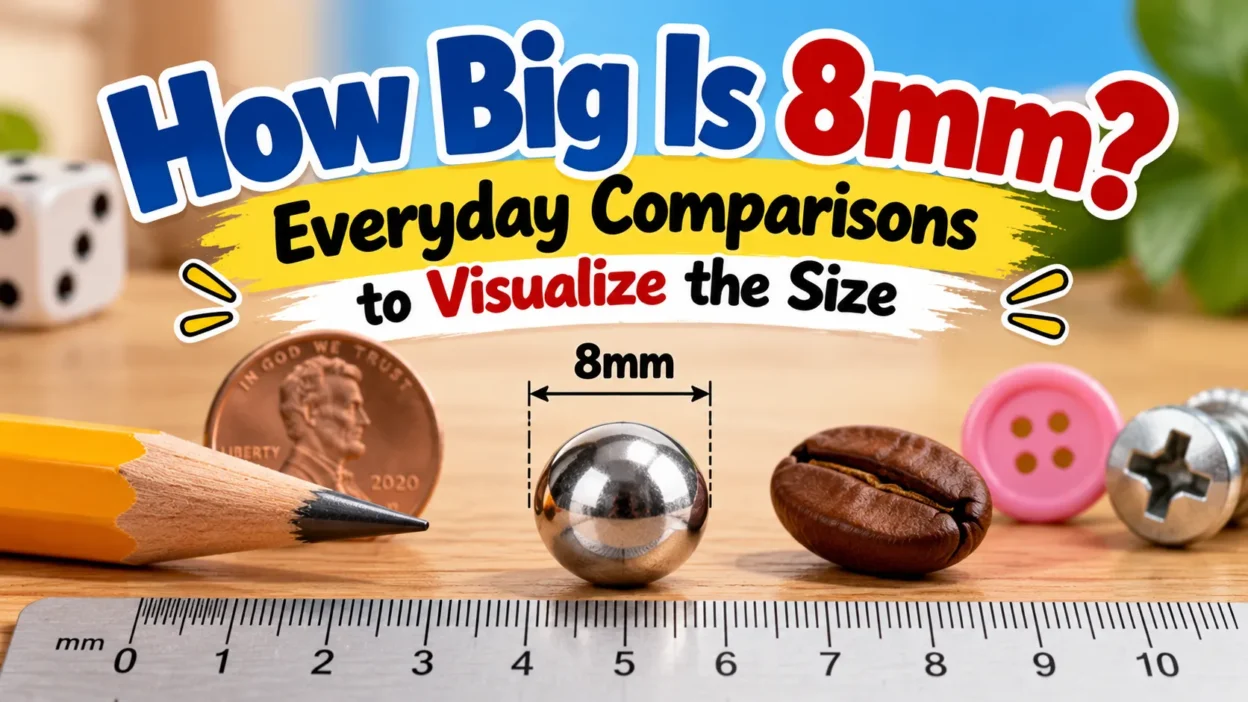
Have you ever wondered how big 8mm really is? Millimeters are small units of measurement, so it can be tricky to picture their size without a ruler or a familiar object for comparison. Whether you’re measuring jewelry, checking a small part, shopping for accessories, or working on a DIY project, understanding this measurement can help.
8mm is equal to 0.8 centimeters, approximately 0.315 inches, or just under one-third of an inch. It is a small measurement, but it is noticeably larger than a few millimeters when you compare it with everyday objects.
In this guide, you’ll discover how big 8mm is in inches and centimeters, what it looks like in real life, and 11 everyday comparisons that make this measurement easier to visualize.
📏 How Big Is 8mm in Inches and Centimeters?
The easiest way to understand 8mm is to convert it into units you’re more familiar with. This measurement is less than one centimeter, making it useful for describing small objects and details.
Here are the basic conversions:
- 8mm = 0.8 centimeters
- 8mm = 0.315 inches
- 8mm ≈ 5/16 of an inch
- 8mm = 8,000 micrometers
- 8mm = 0.008 meters
For a quick mental picture, imagine a line measuring slightly less than one-third of an inch on a ruler.
Although 8mm is shorter than a standard centimeter, it can be easy to see with the naked eye. It is a common scale for small hardware, jewelry dimensions, craft materials, and other everyday objects.
Remember that millimeters can describe length, width, diameter, or thickness. An object measuring 8mm across might have a completely different length or height.
🪙 1. Slightly Wider Than a US Penny’s Thickness
A modern US penny is approximately 1.52mm thick. An 8mm measurement is therefore more than five times the thickness of a single penny.
Imagine looking at the narrow edge of a penny. It appears very thin, while an 8mm object would have a noticeably larger dimension.
For a closer comparison, five pennies stacked together measure approximately 7.6mm thick. That is just a little less than 8mm.
This is a useful way to picture the measurement because pennies are familiar and easy to handle. However, coin stacking is only a visual estimate, not a substitute for a precise measuring tool.
Visual takeaway: Five US pennies stacked together are approximately 7.6mm thick, very close to 8mm.
💳 2. About the Thickness of Ten Credit Cards
A standard plastic payment card is usually around 0.76mm thick. Ten cards stacked directly on top of one another would measure approximately 7.6mm.
That makes a stack of ten cards a useful comparison for visualizing 8mm.
Imagine holding a small stack of bank cards and looking at the edge. The stack would be much thicker than a single card, but it would still be relatively compact.
Card thickness varies by material and design, so this comparison is approximate. Metal payment cards and specialty cards may have different dimensions.
Visual takeaway: Ten standard plastic cards stacked together measure approximately 7.6mm, almost the same as 8mm.
✏️ 3. About the Diameter of a Standard Wooden Pencil
Many standard wooden pencils have a diameter of approximately 7mm, although their dimensions vary by design.
An 8mm measurement is slightly larger than a 7mm pencil’s diameter. The difference is only 1mm, but it can be noticeable when comparing the two side by side.
Imagine looking at the circular end of a typical wooden pencil. Now picture a circle that is a little wider. That gives you a useful mental image of 8mm.
This comparison works best for a typical full-size wooden pencil. Mechanical pencils, jumbo pencils, and specialty drawing pencils may be thinner or thicker.
Visual takeaway: Eight millimeters is slightly wider than the diameter of many standard wooden pencils.
🧵 4. Similar to a Small Craft Bead’s Diameter
Craft beads come in many sizes, and some are sold with an 8mm diameter. These beads are commonly used for bracelets, necklaces, decorative projects, and other handmade accessories.
Imagine a round bead resting on your fingertip. Its diameter would measure 8mm from one side to the other if it were an 8mm bead.
This is one of the most direct ways to visualize the measurement because the size is commonly used in jewelry and craft supplies.
Keep in mind that bead diameter and hole diameter are different measurements. An 8mm bead can have a much smaller hole through its center.
Visual takeaway: Picture a round craft bead measuring 8mm across.
🔩 5. Similar to the Diameter of Some Small Bolts
Hardware is often described using millimeters. An 8mm measurement may refer to the nominal diameter of a bolt, screw, or other component.
For example, an M8 bolt has a nominal thread diameter of 8mm. The actual dimensions of its threads and head depend on the design and applicable standards.
Imagine looking at the threaded shaft of an M8 bolt from the side or measuring across its outer threads with a suitable tool. Its nominal diameter gives you a direct reference for 8mm.
Be careful not to confuse an 8mm bolt diameter with the size of the wrench or socket needed for its head. Those dimensions are not necessarily the same.
Visual takeaway: An M8 bolt has a nominal thread diameter of 8mm.
💍 6. A Common Size for Some Jewelry Details
Jewelry often uses millimeter measurements because small differences can change the appearance of a ring, pendant, bracelet, or earring.
An 8mm gemstone or round pendant, for example, would measure 8mm across its widest point if that is the specified diameter. This is small enough for delicate jewelry while still being visible.
Imagine a round stone sitting in a jewelry setting. Its width would be just under one centimeter.
Remember that jewelry listings may describe different dimensions. An 8mm stone is not necessarily set in an 8mm-wide ring, and an 8mm chain width is not the same as its thickness.
Visual takeaway: An 8mm round gemstone is slightly smaller than a 1-centimeter circle.
🧊 7. Just Under the Width of a One-Centimeter Mark
A centimeter equals 10mm. Therefore, 8mm is 2mm shorter than one centimeter.
Picture a ruler with centimeter markings. The distance between two numbered centimeter lines is 10mm. An 8mm line would cover four-fifths of that distance.
This is one of the simplest ways to understand the measurement without relying on an object that varies in size.
If you have a metric ruler, locate the zero mark and count eight small millimeter divisions. The eighth division represents 8mm.
Visual takeaway: Eight millimeters covers 80% of the distance between two centimeter marks.
🫘 8. Similar to the Size of a Small Bean
Some small beans have widths or lengths close to 8mm, although their sizes depend on the variety and how they are measured.
Imagine a small dry bean resting on a table. Its narrowest or widest dimension may provide a rough comparison with an 8mm measurement.
This example is helpful because beans are familiar household items, but it is not a precise reference. Some beans are considerably larger, while others are smaller.
If you are estimating an object’s size, use this comparison only to build a mental picture. Use a ruler or caliper when exact dimensions matter.
Visual takeaway: A small bean may have one dimension close to 8mm, depending on its variety.
📱 9. Smaller Than the Thickness of Many Smartphones
Most complete smartphones are much thicker than 8mm, although exact dimensions vary by model.
Imagine looking at a phone from the side. Its edge may be around 7–9mm thick on some models, making 8mm a useful reference for understanding the thickness of certain slim devices.
However, phones with protective cases can be significantly thicker. Some newer devices are also thinner or thicker than this range.
For an accurate comparison, check the manufacturer’s specifications for the exact model rather than assuming every phone measures the same.
Visual takeaway: Eight millimeters is comparable to the thickness of some slim smartphones, but device dimensions vary.
🪵 10. Close to the Thickness of a Thin Craft Panel
Some craft boards, plastic sheets, and lightweight panels are sold in thicknesses around 8mm. These materials can be used for small projects, model-making, decorative work, and hobby construction.
Imagine holding a thin panel and examining its exposed edge. The narrow side reveals how thick the material is, even when the panel’s surface is much larger.
This comparison helps show why the same measurement can look different depending on the object. An 8mm panel may seem thin beside a thick board but substantial beside a sheet of paper.
Always check the product specifications because craft materials are available in many thicknesses.
Visual takeaway: A thin board labeled 8mm thick is a direct example of this measurement.
📄 11. Much Thicker Than a Single Sheet of Paper
Ordinary printer paper is approximately 0.1mm thick, although the actual thickness depends on the paper type.
At that approximate thickness, a stack of 80 sheets would measure around 8mm.
Imagine a small pile of paper viewed from the side. Each individual sheet is extremely thin, but many layers combine to create a much more noticeable thickness.
This comparison is especially useful because it demonstrates how small measurements add up. A single sheet is only a fraction of 8mm, but a stack of paper can approach the full measurement.
The number of sheets required will vary with paper weight and thickness.
Visual takeaway: Around 80 sheets of ordinary printer paper can add up to approximately 8mm.
📊 How Does 8mm Compare With Other Small Measurements?
Comparing nearby measurements helps you understand where 8mm sits on the scale.
| Measurement | Inches | Centimeters |
|---|---|---|
| 1mm | 0.039 in | 0.1 cm |
| 3mm | 0.118 in | 0.3 cm |
| 5mm | 0.197 in | 0.5 cm |
| 8mm | 0.315 in | 0.8 cm |
| 10mm | 0.394 in | 1 cm |
| 15mm | 0.591 in | 1.5 cm |
| 20mm | 0.787 in | 2 cm |
As you can see, 8mm is close to one centimeter but still noticeably shorter. It is also more than twice as large as 3mm.
These comparisons are useful when selecting small components, measuring craft supplies, comparing jewelry dimensions, or checking the size of a product before buying it.
🧮 How to Measure 8mm Without Guessing
If you need to check whether something measures 8mm, there are several practical ways to do it.
Use a metric ruler
A ruler with millimeter markings is the simplest option. Start at zero and count eight small divisions along the scale.
Use a digital caliper
A digital caliper is useful when you need a more precise measurement of a small object’s width, thickness, or diameter. Place the jaws against the object without applying excessive pressure.
Compare five pennies
Five modern US pennies stacked together measure approximately 7.6mm. This is a close visual estimate, although coin thickness varies slightly and the method is not suitable for precision work.
Check the product dimensions
If you’re buying hardware, jewelry, craft materials, or electronic accessories, check the listed specifications. Confirm whether 8mm refers to length, width, diameter, or thickness.
❓ Frequently Asked Questions About 8mm
Is 8mm considered big or small?
Eight millimeters is a small measurement because it is less than one centimeter. However, it can be substantial for a small component, bead, or jewelry detail. Whether it seems big or small depends on the object being measured.
Is 8mm the same as 1/4 inch?
No. One-quarter of an inch equals 6.35mm. Eight millimeters is larger by 1.65mm.
How many centimeters is 8mm?
Eight millimeters equals 0.8 centimeters because one centimeter contains 10 millimeters.
How many inches is 8mm?
Eight millimeters equals approximately 0.315 inches, or about 5/16 of an inch.
Is 8mm close to 1 centimeter?
Yes. One centimeter equals 10mm, so 8mm is 2mm shorter. It represents 80% of one centimeter.
What common object is approximately 8mm wide?
Some standard wooden pencils have a diameter close to 7mm, while certain craft beads are available in an exact 8mm diameter. These objects can help you picture the size.
Can I see 8mm without a magnifying glass?
Yes. Eight millimeters is generally large enough to see clearly with the naked eye. A ruler or caliper is still helpful when you need to determine the exact measurement.
🎯 Final Thoughts: Picture 8mm With Everyday Objects
Eight millimeters is a small but noticeable measurement. It equals 0.8 centimeters, approximately 0.315 inches, or about 5/16 of an inch.
The easiest way to picture it is to imagine a line covering four-fifths of the distance between two centimeter marks on a ruler. You can also compare it with an 8mm craft bead, an M8 bolt’s nominal thread diameter, or a stack of five US pennies measuring approximately 7.6mm.
These examples make 8mm easier to understand when you’re shopping, crafting, or estimating object dimensions. If accuracy matters, use a metric ruler or digital caliper rather than relying on visual comparisons.

Colton Mercer is a writer and contributor at TechMeasurez, covering measurements, dimensions, size guides, conversions, comparisons, and practical online tools. His work focuses on turning everyday measurement questions into clear, easy-to-follow information. Through TechMeasurez, Colton aims to make useful facts, guides, and digital resources simple for everyone to understand.