Have you ever wondered how long one inch really is? Whether you are measuring a small object, shopping online, completing a DIY project, or trying to understand product dimensions, knowing the length of an inch can make everyday measurements much easier.
One inch equals exactly 2.54 centimeters (cm), 25.4 millimeters (mm), or 1/12 of a foot. Although an inch is a relatively short measurement, it is commonly used in the United States to describe the dimensions of household items, electronic devices, tools, and accessories.
The easiest way to understand this length is to compare it with familiar objects. A standard ruler, a small button, or a compact everyday accessory can help you picture the measurement, although the exact dimensions of these objects vary.
In this guide, you will learn how long an inch is in different units, what it looks like on a ruler, which everyday objects may measure around one inch, and how to measure this length accurately.
📏 How Long Is 1 Inch in Centimeters?
One inch equals exactly 2.54 centimeters. This is the standard conversion used when switching between the imperial and metric measurement systems.
Centimeters are commonly used in many countries, while inches are frequently used in the United States for everyday measurements and product specifications.
To convert inches into centimeters, multiply the number of inches by 2.54.
For one inch, the calculation is:
1 × 2.54 = 2.54 cm
This means that an object measuring one inch long has a length of 2.54 centimeters. For a quick mental estimate, you can think of an inch as approximately 2.5 cm.
| Measurement unit | Equivalent of 1 inch |
|---|---|
| Inches | 1 inch |
| Centimeters | 2.54 cm |
| Millimeters | 25.4 mm |
| Feet | 0.0833 ft |
| Meters | 0.0254 m |
| Yards | 0.0278 yd |
These conversions are useful when reading international product listings, measuring small components, or following instructions that use different units.
📐 What Does 1 Inch Look Like on a Ruler?
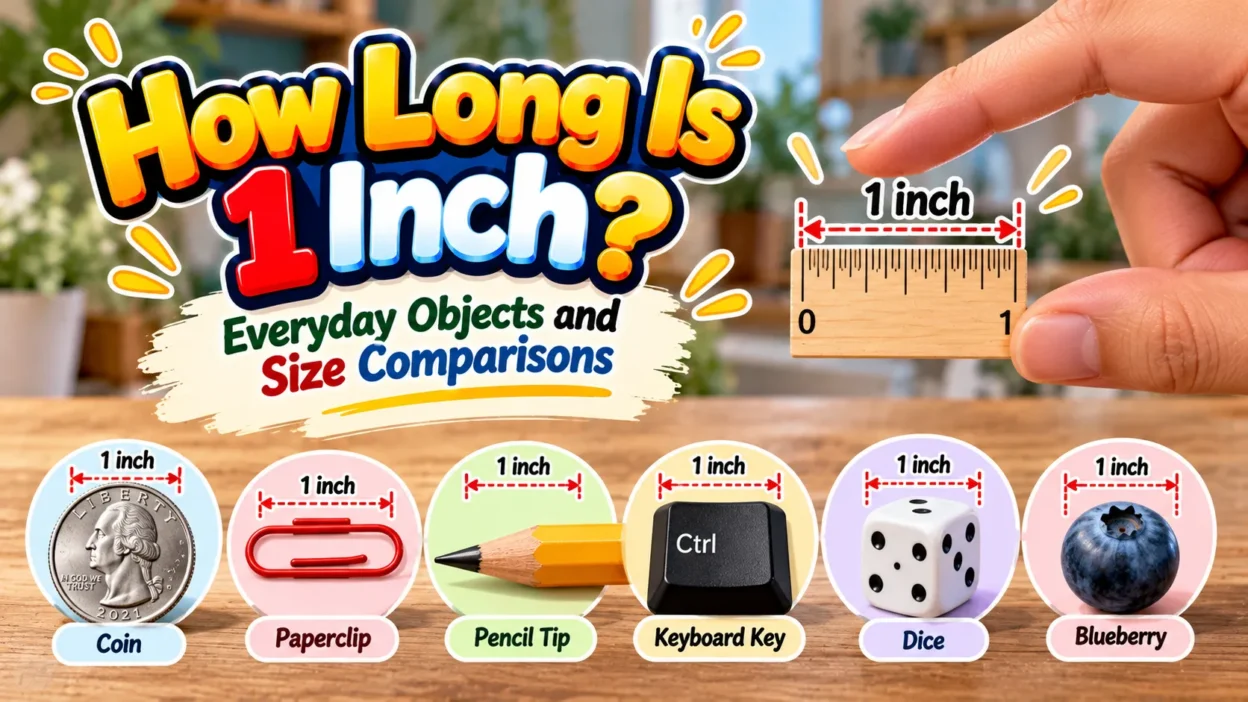
A ruler is one of the easiest tools for visualizing an inch. On a standard ruler marked in inches, the space between the 0-inch and 1-inch marks represents exactly one inch.
The inch is divided into smaller fractions, including halves, quarters, eighths, and sixteenths. These markings help you measure objects more precisely than estimating their lengths by eye.
For example, the halfway mark represents half an inch, while the quarter-inch mark represents one-fourth of an inch.
To measure an object accurately:
- Place one end of the object at the zero mark.
- Align the ruler with the object’s edge.
- Find the 1-inch mark.
- Check whether the opposite end reaches that mark.
- For smaller objects, use the fractional markings to measure more precisely.
Helpful tip: Start at the zero mark rather than the physical edge of the ruler. Some rulers have a small gap or damaged edge that can affect the result.
👀 What Everyday Objects Are About 1 Inch Long?
Familiar objects can help you visualize a short measurement without carrying a ruler everywhere. Several small household items have a dimension that may be close to one inch.
These examples are approximate. The dimensions of real objects vary depending on their design, material, and manufacturer.
1. A Small Button
Some small buttons have a diameter close to one inch, although many clothing buttons are considerably smaller.
A button is a useful reference because its circular shape makes it easy to compare diameters. To check the size, measure straight across the center from one edge to the other.
2. A Small Paper Clip
Some compact paper clips have an overall length close to one inch, depending on their design. Standard paper clips come in different sizes, so not every clip provides an accurate reference.
Measure from the outermost point at one end to the outermost point at the other to determine its total length.
3. A Small Coin
Certain coins have a diameter that approaches one inch, but coin sizes vary by country and denomination.
For example, a US quarter is approximately 0.955 inches in diameter, making it slightly smaller than one inch. It can provide a useful visual comparison, although it is not exactly one inch wide.
4. A Small Bead
Some craft beads measure approximately one inch across. This is particularly useful when working with jewelry, decorative accessories, or handmade crafts.
Beads vary considerably in size, so check their listed diameter before using them as a measurement reference.
5. A Small Craft Button or Embellishment
Some decorative buttons, clothing embellishments, and craft accessories may measure around one inch across.
Their size depends on the design and intended use. Measure the widest point to determine the actual diameter or width.
🏠 Household Objects With a Dimension Close to 1 Inch
Many household objects contain small features that measure approximately one inch, even when the complete item is much larger.
| Object | Possible one-inch dimension | What to measure |
|---|---|---|
| Small button | Diameter | Across the center |
| Compact coin | Diameter | Outer edge to outer edge |
| Craft bead | Diameter | Widest point |
| Small paper clip | Length | End to end |
| Decorative embellishment | Width | Widest section |
| Small screw head | Head diameter | Across the head |
| Small washer | Outer diameter | Across the outside edge |
| Miniature craft piece | Length or width | Longest relevant side |
These examples are visual references rather than guaranteed measurements. If you need an exact one-inch object, verify its dimensions with a ruler or measuring tool.
📦 Products That May Have a One-Inch Dimension
Small measurements are especially important when shopping for accessories, hardware, craft supplies, and replacement components. A difference of even a fraction of an inch can affect whether two pieces fit together.
🧵 1. Sewing and Craft Supplies
Some buttons, beads, decorative pieces, and craft embellishments may have a width or diameter close to one inch.
This measurement can help you select materials for sewing, scrapbooking, jewelry making, and other creative projects.
Check whether the manufacturer lists the diameter, width, or length. These measurements describe different dimensions, particularly for irregularly shaped objects.
🔩 2. Small Hardware Components
Certain washers, fasteners, fittings, and hardware accessories may have a dimension close to one inch.
However, a one-inch hardware specification may refer to the outer diameter, inner diameter, head width, or nominal size. These values are not interchangeable.
Always check the product specifications and compatibility requirements before purchasing replacement components.
💍 3. Jewelry and Decorative Accessories
Some jewelry components, pendants, decorative charms, and accessory pieces may measure around one inch in one dimension.
This can be useful when comparing product listings or planning a handmade design. However, jewelry sizes vary significantly, and the measurement may describe the pendant alone rather than the complete necklace or accessory.
🧰 4. Small Tools and Accessories
Certain small tools and accessories contain parts approximately one inch long or wide. Examples may include compact attachments, tool fittings, and small measuring accessories.
If you need a replacement part, verify its dimensions carefully. A component that looks similar may not fit if its diameter or thickness differs.
📊 How Does 1 Inch Compare With Other Lengths?
Comparing nearby measurements can help you understand the difference between an inch and its fractions or multiples.
| Measurement | Equivalent in centimeters |
|---|---|
| ¼ inch | 0.635 cm |
| ½ inch | 1.27 cm |
| ¾ inch | 1.905 cm |
| 1 inch | 2.54 cm |
| 1½ inches | 3.81 cm |
| 2 inches | 5.08 cm |
| 3 inches | 7.62 cm |
| 4 inches | 10.16 cm |
| 5 inches | 12.70 cm |
| 6 inches | 15.24 cm |
One inch is a relatively small unit, but its fractions can matter when measuring hardware, cutting materials, or fitting small parts together.
For example, half an inch is only 1.27 cm, while two inches equal 5.08 cm.
🧮 How to Convert 1 Inch Into Other Units
Converting an inch into different units is straightforward once you know the standard conversion factors.
Inches to centimeters
Multiply by 2.54.
1 × 2.54 = 2.54 cm
Inches to millimeters
Multiply by 25.4.
1 × 25.4 = 25.4 mm
Inches to feet
Divide by 12.
1 ÷ 12 = 0.0833 feet, approximately.
Inches to meters
Multiply by 0.0254.
1 × 0.0254 = 0.0254 meters
Inches to yards
Divide by 36.
1 ÷ 36 = 0.0278 yards, approximately.
For everyday use, remembering that one inch equals 2.54 centimeters is usually sufficient.
✂️ How to Measure One Inch Without a Ruler
If you do not have a ruler nearby, you can estimate an inch using a known-size object. However, estimates are less reliable than measurements taken with a proper tool.
Use a measuring tape: Locate the one-inch mark and align the beginning of the object with zero.
Use a metric ruler: Measure exactly 2.54 cm. If you only need a rough estimate, approximately 2.5 cm is close.
Use a printable ruler: Print a ruler at 100% scale or actual size. Check its markings against a physical ruler before relying on it.
Compare a known object: A coin or button with verified dimensions can provide a visual reference, but do not assume every coin or button measures exactly one inch.
Use a digital measuring application: Some smartphones offer measuring tools, but accuracy depends on the device and conditions. Confirm important measurements with a physical ruler.
For crafts, hardware, and other projects requiring precision, use a ruler or measuring tape rather than relying on visual estimates.
🛠️ Why Accurate One-Inch Measurements Matter
Accurate small measurements can make a significant difference in everyday projects. When purchasing hardware, selecting craft supplies, or replacing a component, even a small dimensional difference may affect whether the parts fit together.
For sewing and crafting, measurements help you choose buttons, beads, embellishments, and other materials that suit your design. In home repairs, accurate dimensions can help you select compatible fittings and accessories.
When shopping online, read the product specifications carefully. A listing may describe the diameter, thickness, width, or overall length, and these measurements can produce very different results.
Also check the measurement units. One inch equals 25.4 millimeters, not 25.4 centimeters. Confusing these units can lead to significant errors when ordering materials or making something to a particular size.
❓ Frequently Asked Questions About One Inch
How many centimeters is one inch?
One inch equals exactly 2.54 centimeters. For a quick estimate, you can think of it as approximately 2.5 cm.
How many millimeters are in one inch?
One inch equals exactly 25.4 millimeters. To convert inches into millimeters, multiply the inch measurement by 25.4.
What common object is exactly one inch long?
There is no single everyday object that is always exactly one inch long. Some small craft pieces and accessories may have this dimension, but their sizes vary. A ruler provides the most reliable reference.
Is one inch a big measurement?
One inch is a short length compared with most household objects. However, it can be significant when measuring small hardware components, jewelry, craft supplies, and other compact items.
Is one inch the same as 2.5 cm?
Not exactly. One inch equals 2.54 cm, so it is 0.04 cm longer than 2.5 cm. The rounded value is useful for rough estimates.
How can I visualize one inch without a ruler?
You can compare the length with a small object whose dimensions you know, such as a measured coin or craft accessory. This provides only an estimate unless the reference object has been verified.
How many inches are in a foot?
There are exactly 12 inches in one foot. Therefore, one inch represents one-twelfth of a foot.
Is a US quarter one inch wide?
No. A US quarter is approximately 0.955 inches in diameter, making it slightly smaller than one inch. It can serve as a close visual reference, but not an exact one.
✅ Conclusion
One inch equals 2.54 centimeters, 25.4 millimeters, or 1/12 of a foot. Although it is a short length, it is useful for measuring small accessories, hardware components, craft supplies, and household details.
The easiest way to understand this measurement is to use a ruler or compare it with a familiar object whose dimensions have been verified. Remember that approximate visual comparisons are helpful for estimating sizes, but they are not substitutes for accurate measurements.
Whether you are shopping online, completing a DIY project, or measuring a small component, understanding inches and their metric equivalents makes everyday tasks easier.

Colton Mercer is a writer and contributor at TechMeasurez, covering measurements, dimensions, size guides, conversions, comparisons, and practical online tools. His work focuses on turning everyday measurement questions into clear, easy-to-follow information. Through TechMeasurez, Colton aims to make useful facts, guides, and digital resources simple for everyone to understand.