
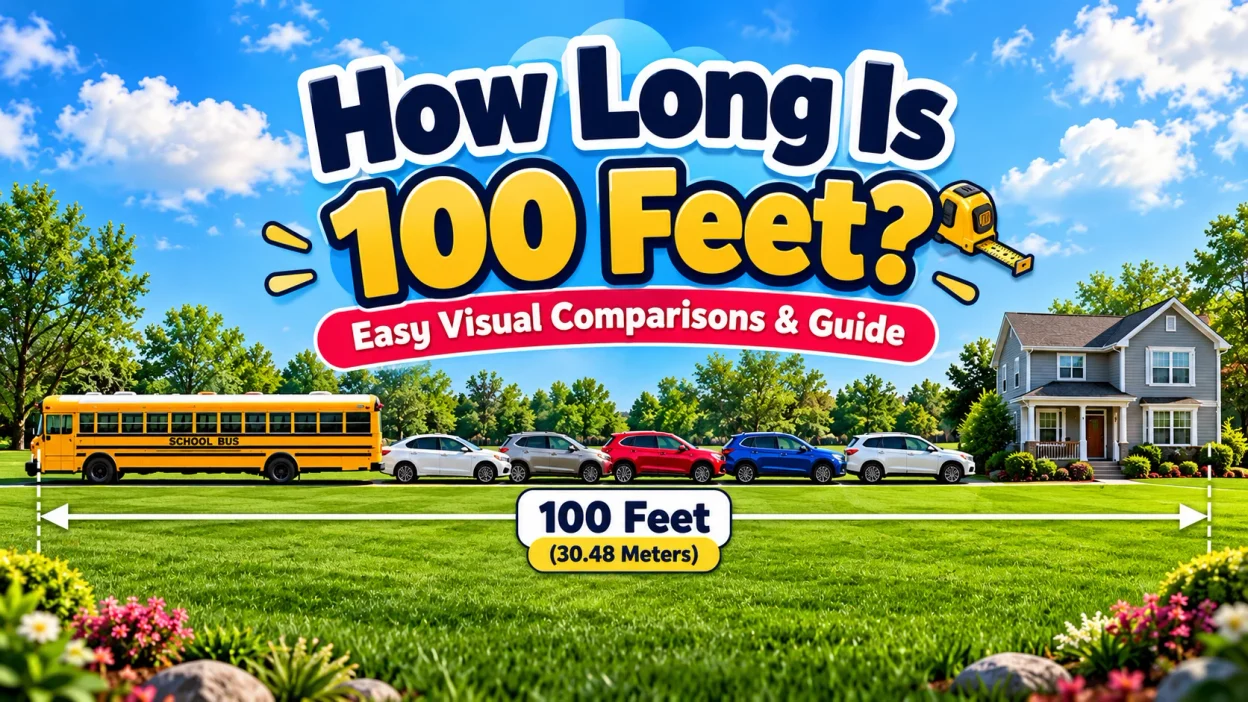
Trying to picture 100 feet without a measuring tool can be surprisingly difficult. You know the number, but knowing what that distance actually looks like in the real world is another matter. Is it about the length of a basketball court? Could you walk it in a few seconds? How many cars would fit across it?
The exact answer is simple: 100 feet equals 30.48 meters, 33⅓ yards, 1,200 inches, or 3,048 centimeters. It is also just over 30 meters, making it a substantial everyday distance without being extremely large.
The easiest way to understand this measurement is through familiar comparisons. A basketball court, several cars, a group of people standing in a line, and part of a football field can all help create a useful mental picture.
Whether you are checking a property dimension, planning a project, comparing distances, or simply trying to understand a measurement you saw online, this guide will help you visualize the size clearly.
📏 What Does 100 Feet Look Like?
A distance of 100 feet is long enough to be difficult to judge accurately at a glance, but it is still a manageable distance for walking.
In metric terms, it measures 30.48 meters. Imagine drawing a straight line across a large lawn or open area. That line would stretch a little more than 30 meters from one end to the other.
Another useful way to picture it is by dividing the distance into smaller sections:
- 25 feet is one-quarter of the total.
- 50 feet is exactly halfway.
- 75 feet is three-quarters of the way.
- 100 feet completes the entire distance.
This makes it easier to estimate large spaces. If you can recognize what 25 or 50 feet looks like, you can mentally build the full distance from those smaller sections.
For many people, approximately 40 ordinary walking steps can also provide a rough visual reference, although stride length varies from person to person.
📐 100 Feet in Different Measurement Units
If you normally use centimeters or meters, converting the distance makes it much easier to understand.
| Measurement | Equivalent |
|---|---|
| Feet | 100 ft |
| Inches | 1,200 in |
| Yards | 33⅓ yd |
| Meters | 30.48 m |
| Centimeters | 3,048 cm |
| Millimeters | 30,480 mm |
| Kilometers | 0.03048 km |
| Miles | 0.01894 mi |
The conversion to meters is particularly useful because meters are commonly used around the world.
Since one foot is exactly 0.3048 meters:
100 × 0.3048 = 30.48 meters
For a quick mental estimate, you can simply remember that this distance is a little more than 30 meters.
The inch conversion is equally straightforward because each foot contains 12 inches:
100 × 12 = 1,200 inches
These conversions make it easier to compare imperial and metric measurements when reading product specifications, property dimensions, construction plans, or other information.
🏀 Is 100 Feet Longer Than a Basketball Court?
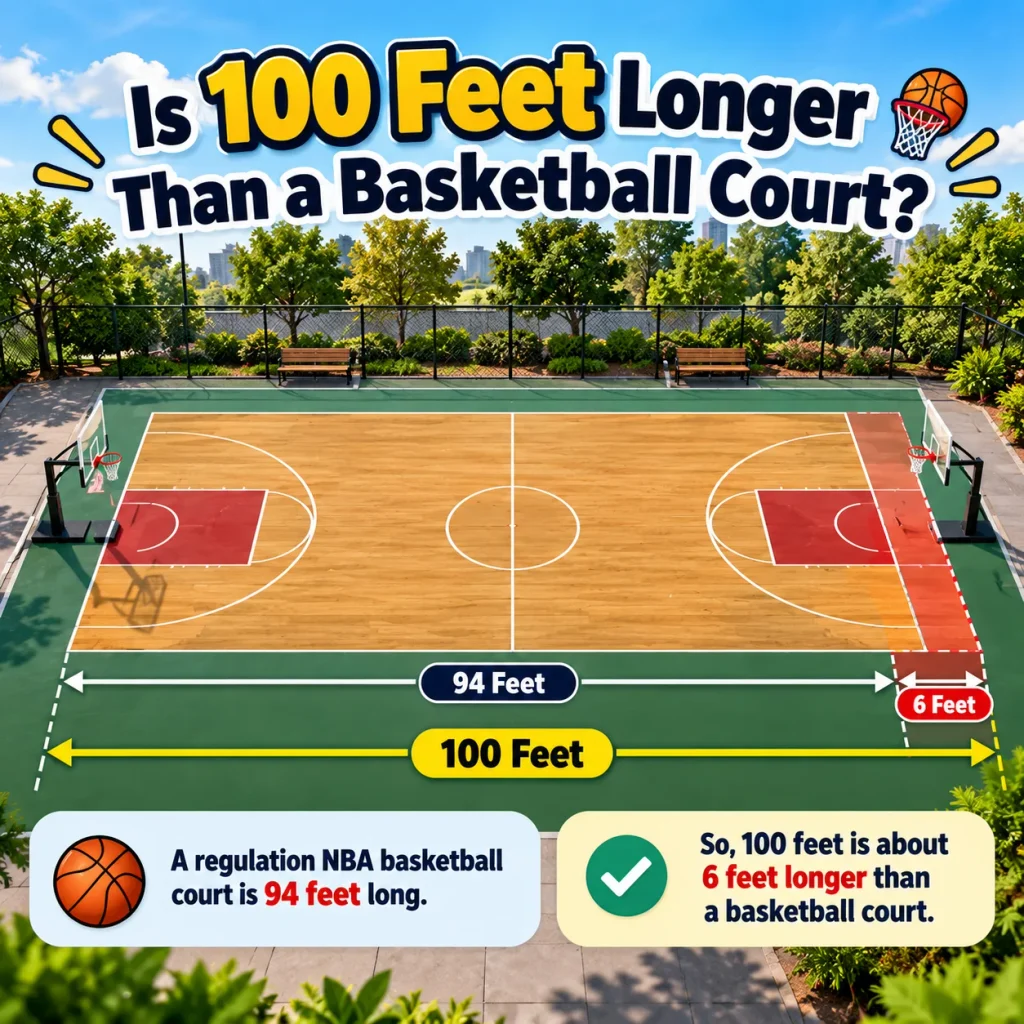
Yes. A regulation NBA basketball court is 94 feet long, so a 100-foot line is about 6 feet longer.
That makes a basketball court one of the easiest ways to visualize this distance.
Imagine standing at one baseline and looking toward the opposite baseline. The court already covers 94 feet from end to end. To reach 100 feet, you would need to continue approximately another six feet beyond the opposite baseline.
So you can remember the comparison like this:
100 feet ≈ one basketball court + 6 feet.
This is a useful reference because a basketball court is a familiar standardized space. It also shows that the distance is not dramatically larger than a full court, even though the number 100 may initially sound quite large.
Image suggestion: Show a basketball court with a measurement line extending six additional feet beyond one baseline.
🏈 How Much of a Football Field Is 100 Feet?
A standard American football field is 360 feet long when both end zones are included. The distance between the two goal lines is 300 feet.
That means a 100-foot section represents exactly one-third of the 300-foot playing area.
This gives you a particularly strong visual reference. Imagine the space between the goal lines divided into three equal sections. One of those sections would measure 100 feet.
The full field is much longer:
| Football Field Section | Length |
|---|---|
| Between goal lines | 300 ft |
| One-third of playing area | 100 ft |
| One end zone | 30 ft |
| Full field including end zones | 360 ft |
This comparison also demonstrates why 100 feet is a substantial distance but not an enormous one. It covers a meaningful portion of a sports field while remaining far shorter than the entire playing surface.
Image suggestion: Divide the football field into three equal sections and highlight one section.
🚗 How Many Cars Would Cover 100 Feet?

Cars provide a convenient everyday comparison because most people have a general idea of how long a car is.
A typical passenger car may be around 14 to 16 feet long, although actual vehicle dimensions vary. If you use 15 feet as a simple reference, six cars would cover approximately 90 feet and seven would reach about 105 feet.
So a practical visual estimate is:
About six to seven average cars placed end to end.
Here is how the math works with a 15-foot reference:
| Number of Cars | Approximate Length |
|---|---|
| 1 | 15 ft |
| 2 | 30 ft |
| 3 | 45 ft |
| 4 | 60 ft |
| 5 | 75 ft |
| 6 | 90 ft |
| 7 | 105 ft |
Of course, a compact car would produce a different result from a large SUV or pickup truck. This is therefore a visualization rather than an exact measuring method.
Image suggestion: Place six full cars and part of a seventh along a straight measurement line.
🚌 How Many School Buses Equal This Distance?
A full-size school bus is often around 35 to 45 feet long, depending on the model.
That means two buses placed end to end could cover approximately 70 to 90 feet. Adding part of another bus would bring the total closer to the 100-foot mark.
Because school buses are not all the same size, it is better to think of this as a rough comparison rather than an exact equation.
| Example | Approximate Length |
|---|---|
| 1 large school bus | 35–45 ft |
| 2 buses | 70–90 ft |
| 2 buses + part of another | Around 100 ft |
This is a useful visual because buses are much longer than ordinary cars. Seeing two large buses lined up gives a strong sense of how substantial a 100-foot space can be.
Image suggestion: Show two buses and part of a third with a 100-foot arrow underneath.
👥 How Many People Would Stretch 100 Feet?
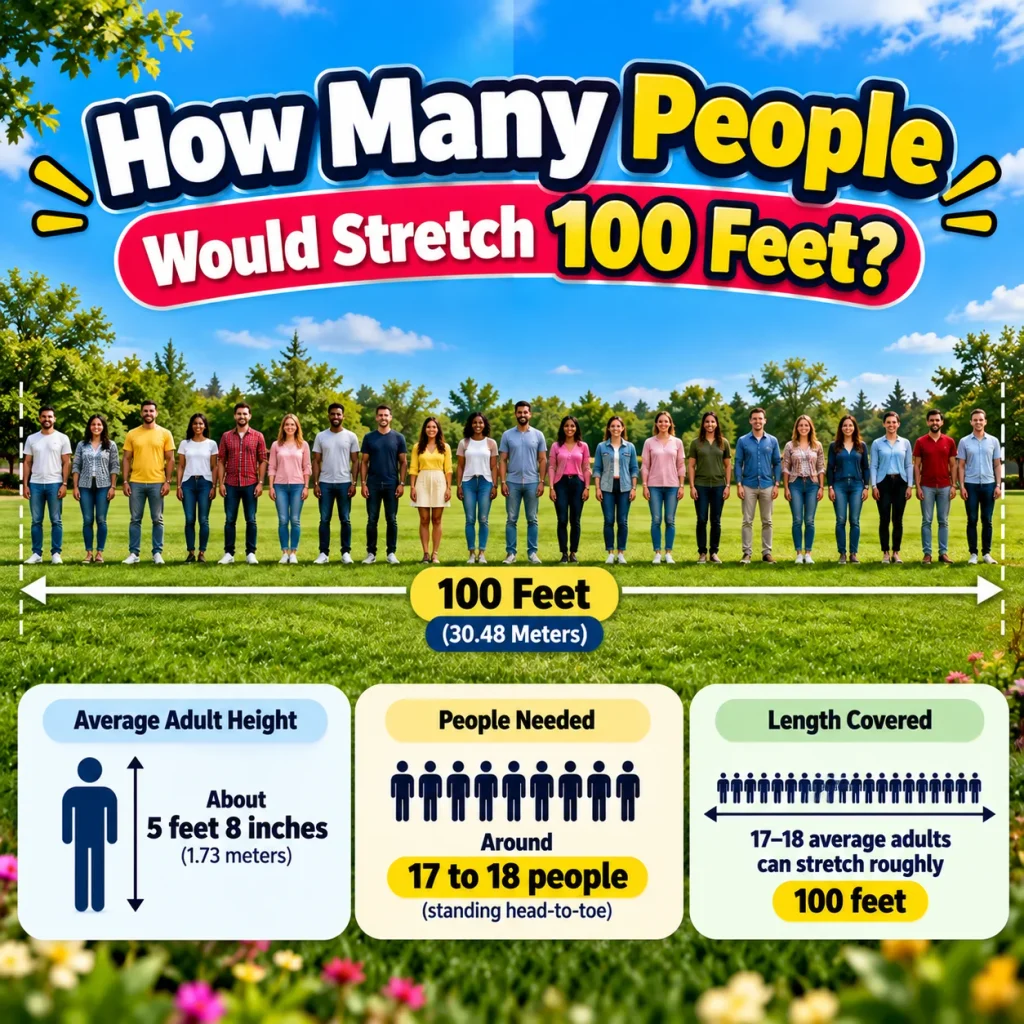
People can also be used as a rough visual scale.
An adult’s height varies significantly, but if you use approximately 5 feet 8 inches as a reference, around 17 to 18 adults standing head-to-toe would create a combined height close to 100 feet.
This does not mean every group of 17 people will equal exactly 100 feet. Taller or shorter individuals change the result.
Still, the comparison helps because most people have a reasonable sense of human height.
Imagine approximately 17 or 18 adults standing in a straight line, with each person’s head-to-foot length placed against the next person’s. The resulting line would be around the same scale as the distance being discussed.
Image suggestion: Create a straight line of people with a measurement arrow underneath.
🐋 Is a Blue Whale About 100 Feet Long?
A very large blue whale can reach around the 100-foot range, making this animal an impressive natural reference for understanding the scale.
Blue whales vary considerably in size, so it would be inaccurate to say that every individual is exactly 100 feet long. Instead, think of a very large blue whale as being roughly comparable to this distance.
Imagine the animal lying straight from its head to its tail. A specimen around this size would occupy an enormous amount of space compared with an ordinary car or person.
This comparison is particularly useful because it transforms an abstract measurement into something visually memorable.
Image suggestion: Show a large blue whale above a straight 100-foot measurement line with a person for scale.
🌳 How Tall Is 100 Feet?
The same measurement can describe height rather than horizontal distance.
A structure that rises 100 feet would stand approximately 30.48 meters above ground level. That is considerably taller than a typical two-story home.
As a rough visual reference, a 100-foot building could be somewhere around 8 to 10 stories tall, depending on the height of each floor.
There is no universal number of stories because commercial buildings, houses, apartments, and other structures have different floor heights.
The important point is that 100 feet vertically represents a significant height. Looking up at a structure of this size can make the distance feel much larger than seeing the same measurement laid out horizontally.
Image suggestion: Place a person and a two-story house beside a 100-foot building for scale.
🌲 What Does a 100-Foot Tree Look Like?
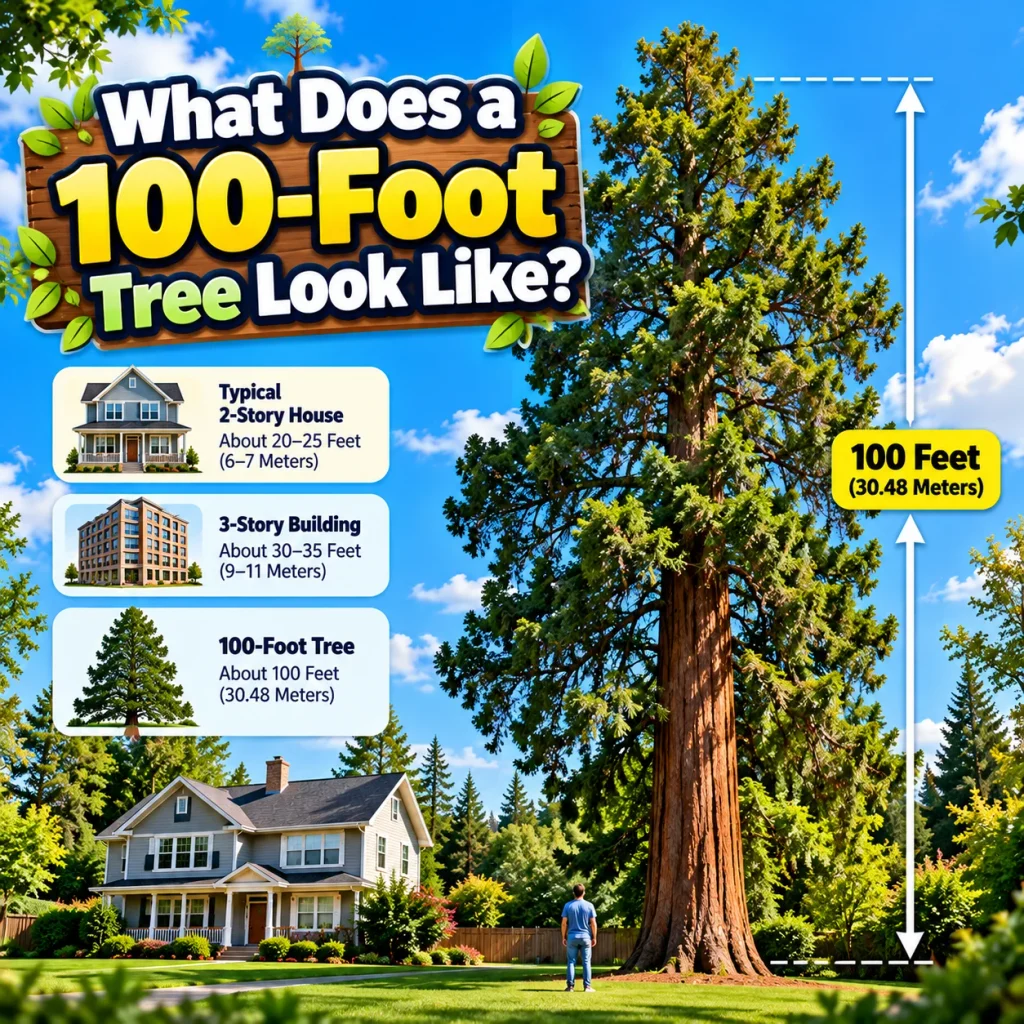
A mature tree reaching approximately 100 feet would be a striking sight.
Tree height depends heavily on species, age, growing conditions, and environment. Some trees remain relatively short while certain mature species can grow well beyond 100 feet.
For visualization, picture a tall tree extending more than 30 meters from the ground to its highest branches.
Standing near the base and looking toward the top gives a useful perspective on the vertical scale. A 100-foot tree would rise far above most residential structures.
This comparison is especially helpful when trying to understand height because trees are familiar natural landmarks.
Image suggestion: Show a tall tree with a person, house, and 100-foot measurement marker.
🚶 How Many Steps Are in 100 Feet?
The number of steps needed to cover a particular distance depends on the person’s stride.
For a rough estimate, about 40 ordinary steps can represent 100 feet for many adults. Someone with a shorter stride may take more steps, while someone with a longer stride may take fewer.
You can make the estimate more personal by finding your own average stride.
Walk naturally across a known distance, count your steps, and calculate your approximate step length. Once you know that number, you can estimate longer distances more accurately.
For example, if your average stride were 2.5 feet:
40 steps × 2.5 feet = 100 feet
Walking is useful for getting a general idea of the distance, but it should not replace a measuring tool when exact accuracy is important.
Image suggestion: Create a walking path showing approximately 40 step markers across the full distance.
📏 How Can You Measure 100 Feet?
The easiest method depends on the tools you have available.
A 100-foot measuring tape is the most straightforward option for a relatively flat area. If you only have a shorter tape, you can divide the distance into repeated sections.
For example:
- A 10-foot tape requires 10 measured sections.
- A 25-foot tape requires 4 sections.
- A 50-foot tape requires 2 sections.
- A measuring wheel can cover the distance continuously.
- A laser distance meter can be useful where appropriate.
For rough estimates, you can also use walking steps or compare the space with objects whose dimensions are already known.
When accuracy matters—such as property boundaries, construction, fencing, or professional work—use a suitable measuring device rather than relying on visual comparisons.
Image suggestion: Show a 25-foot tape being used four times to create a total of 100 feet.
🧰 What Can You Use as a 100-Foot Reference?
You do not always need a 100-foot tape to understand the scale.
Several familiar references can help:
- 🏀 Basketball court: A little shorter than 100 feet.
- 🚗 Passenger cars: Around six to seven average cars.
- 🚌 School buses: Roughly two buses plus part of another.
- 👥 Adults: Around 17–18 average people standing head-to-toe.
- 🏈 Football field: About one-third of the playing field between the goal lines.
- 🐋 Large blue whale: Similar in scale to a very large individual.
- 🌳 Tall tree: Comparable to a large mature tree reaching around 100 feet.
These examples should be treated as visual references, not precision measuring instruments. Real-world objects vary in size.
🌍 100 Feet vs 100 Meters
These two measurements are easy to confuse because they use the same number, but they represent very different distances.
100 feet equals 30.48 meters, whereas 100 meters equals approximately 328.08 feet.
| Distance | Equivalent |
|---|---|
| 100 feet | 30.48 meters |
| 100 meters | 328.08 feet |
| Difference | 228.08 feet |
In other words, 100 meters is more than three times the length of 100 feet.
This distinction matters when reading international specifications, race distances, property information, or technical documents.
If a measurement is given in feet, always check the unit before converting or comparing it with a metric measurement.
Image suggestion: Use two parallel lines to visually compare 100 feet with 100 meters.
📊 100 Feet Compared With Smaller Distances
Breaking a large measurement into smaller portions can make it much easier to understand.
| Distance | Relationship |
|---|---|
| 10 feet | One-tenth |
| 20 feet | One-fifth |
| 25 feet | One-quarter |
| 50 feet | Half |
| 75 feet | Three-quarters |
| 100 feet | Full distance |
| 125 feet | 25% longer |
| 150 feet | 50% longer |
| 200 feet | Twice as long |
| 300 feet | Three times as long |
For example, if you have already seen what 50 feet looks like, simply imagine doubling that space.
Likewise, 25 feet is exactly one-quarter of the total. Four sections of 25 feet placed end to end produce the full distance.
This sectional approach is useful for estimating yards, gardens, sports areas, driveways, fencing projects, and other outdoor spaces.
🏡 Where Might You Encounter a 100-Foot Distance?
You can come across this measurement in many practical situations.
It may appear when discussing:
- 🏠 Property dimensions
- 🌳 Landscaping projects
- 🚧 Construction areas
- 🪵 Fencing requirements
- ⚡ Utility installations
- 🏟️ Sports facilities
- 🛣️ Roads and site layouts
- 🌲 Tree height
- 📦 Commercial spaces
- 🏡 Large residential yards
- 📐 Surveying and land measurement
- 🏗️ Building and renovation projects
For example, if a property requires 100 feet of fencing, knowing that the distance is 30.48 meters gives someone using metric measurements a much clearer idea of the amount of material required.
The context always matters. A 100-foot fence is a horizontal distance, while a 100-foot tree is a vertical height, but both use the same basic unit.
🧠 Why Is This Distance Difficult to Visualize?
People often find larger distances harder to estimate because there are fewer everyday objects that provide a consistent reference.
Most people can easily recognize a foot, a ruler, or the approximate width of a table. Once the distance reaches dozens of feet, perspective becomes more important.
For example, objects farther away appear smaller, which can make a long open area look shorter than it really is.
That is why combining several comparisons can be more effective than relying on a single object.
A basketball court gives you a sports reference. Cars provide an everyday reference. A football field provides a large-scale reference. People provide a human-scale reference.
Together, these examples make the measurement much easier to remember.
⚖️ Is 100 Feet Considered a Long Distance?
Whether 100 feet feels long depends on the situation.
Inside a home, 100 feet would be a very substantial distance. Across a backyard, it could represent a large property dimension. On a football field, however, it represents only about one-third of the playing area.
For walking, it is a short enough distance that most healthy adults can cover it quickly. For construction or fencing, however, 100 feet can represent a meaningful amount of material and planning.
A useful description is that 100 feet is a moderate-to-large everyday distance: much longer than a room, but nowhere near the scale of a kilometer.
In metric terms, remembering 30.48 meters gives you an excellent sense of its overall size.
❓ Frequently Asked Questions
What is 100 feet in meters?
The exact conversion is 30.48 meters.
How many inches are in 100 feet?
There are 1,200 inches because one foot contains 12 inches.
How many yards are in 100 feet?
There are 33⅓ yards in this distance.
How many centimeters are in 100 feet?
The equivalent metric length is 3,048 centimeters.
Is 100 feet longer than a basketball court?
Yes. A regulation NBA court is 94 feet long, so this distance is approximately 6 feet longer.
Is 100 feet one-third of a football field?
It is exactly one-third of the 300-foot distance between the goal lines on a standard American football field.
How many cars fit into 100 feet?
Using a 15-foot passenger car as a rough reference, approximately six to seven cars would span the distance.
How many steps does it take to walk 100 feet?
Around 40 ordinary steps is a reasonable estimate for many adults, but the exact number depends on stride length.
How tall is 100 feet?
It is equal to 30.48 meters of vertical height. As a rough building comparison, it could correspond to approximately 8–10 stories depending on floor height.
How can I estimate the distance without a measuring tape?
You can use a measuring wheel, repeated shorter measurements, known object dimensions, or your own average stride for a rough estimate.
Is 100 feet the same as 100 meters?
No. 100 meters is approximately 328.08 feet, making it much longer.
What is the easiest way to visualize 100 feet?
A basketball court, several cars lined up, or roughly 40 walking steps can provide useful mental references.
📌 Final Takeaway
So, how long is 100 feet in practical terms?
It is exactly 30.48 meters, 33⅓ yards, 1,200 inches, or 3,048 centimeters.
For visualization, think of a distance slightly longer than a regulation basketball court, approximately six to seven average passenger cars, or around one-third of the playing area of an American football field.
You can also picture roughly 40 ordinary walking steps or the approximate length of a very large blue whale.
The best comparison depends on what you are familiar with. If you regularly watch basketball, the court comparison may work best. If you are thinking about a property or driveway, cars or walking steps may be easier to picture.
Ultimately, the most useful number to remember is 30.48 meters. Once you connect that measurement with familiar objects and spaces, a 100-foot distance becomes much easier to understand without needing to physically measure it.

Colton Mercer is a writer and contributor at TechMeasurez, covering measurements, dimensions, size guides, conversions, comparisons, and practical online tools. His work focuses on turning everyday measurement questions into clear, easy-to-follow information. Through TechMeasurez, Colton aims to make useful facts, guides, and digital resources simple for everyone to understand.