Have you ever wondered how long 5 meters is in real life? This measurement may sound simple, but visualizing it can be difficult if you are unfamiliar with the metric system. Whether you are measuring a room, planning a garden, buying furniture, or estimating a distance, understanding five meters can help you picture the size more easily.
Five meters is equal to 500 centimeters, approximately 16.4 feet, or about 16 feet 5 inches. To visualize this length, imagine a straight line stretching across a large living room or five one-meter measuring sticks placed end to end. In this guide, you will discover everyday objects that help explain this distance, useful unit conversions, and simple ways to measure it accurately.
📏 How Long Is 5 Meters in Feet and Inches?
Five meters is a little more than 16 feet long. This conversion is helpful if you usually use feet and inches to measure rooms, furniture, or outdoor spaces.
One meter equals approximately 3.28084 feet. Multiplying this value by five gives 16.4042 feet.
Here are the most useful conversions:
| Unit | Equivalent to 5 Meters |
|---|---|
| Meters | 5 m |
| Feet | 16.4 ft |
| Feet and inches | About 16 ft 5 in |
| Inches | 196.85 in |
| Centimeters | 500 cm |
| Millimeters | 5,000 mm |
| Yards | 5.47 yd |
| Kilometers | 0.005 km |
For everyday use, remembering 5 meters is approximately 16 feet 5 inches is usually enough. If you are working on a construction or home improvement project, use a measuring tape for an accurate result.
🏠 What Does 5 Meters Look Like in Real Life?
A measurement is easier to understand when you compare it with familiar surroundings. Five meters is long enough to cover a substantial part of a room, a garden path, or a small outdoor area.
Imagine standing at one end of a room and walking straight ahead for approximately 16 feet. The distance you cover is close to five meters. Depending on the room’s dimensions, this could take you from one wall to the opposite wall.
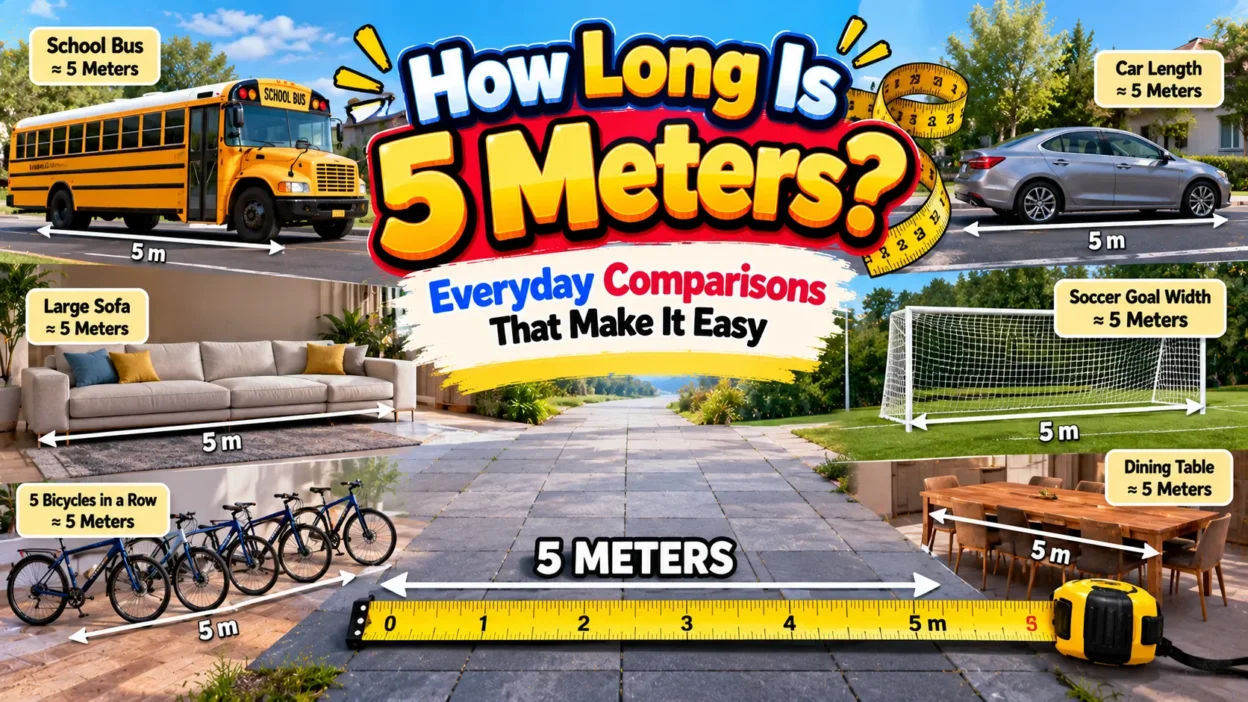
You can also visualize this length using everyday objects, such as furniture, vehicles, and measuring sticks. These examples provide a helpful estimate, although the exact dimensions of each object may differ.
🚗 1. Longer Than Many Compact Cars
Many compact cars measure approximately 3.5 to 4.3 meters in length. This means five meters is longer than many small cars, although some larger vehicles may be close to or exceed this measurement.
Imagine a compact car parked in a driveway. Five meters would cover its length and leave some additional space, depending on the vehicle.
This comparison is helpful when estimating a parking area or thinking about vehicle dimensions. However, if you are checking whether a car will fit inside a garage, always compare the actual vehicle length with the available space.
🛋️ 2. About Two Large Sofas Placed End to End
A typical three-seat sofa may measure around 1.8 to 2.4 meters long. Two large sofas arranged in a straight line could therefore cover approximately 3.6 to 4.8 meters.
Five meters is slightly longer than many such arrangements. Picture two sofas placed end to end, with a little extra space at one end.
This is a useful comparison when planning furniture layouts or estimating the length of a living room wall. Remember that sofa dimensions vary by style, so measure your furniture before arranging or purchasing it.
🚪 3. About Two and a Half Door Heights
A standard interior door is often around 2 meters tall, although door sizes vary. If you imagine two and a half door heights stacked vertically, the total would be approximately five meters.
This example helps you understand the scale of the measurement, especially when visualizing tall walls, ceilings, or vertical structures.
Keep in mind that this is a comparison of height rather than horizontal length. It helps explain the size of five meters, but it should not be used as a substitute for measuring a floor or wall.
🏊 4. Half the Length of a 10-Meter Pool
A 10-meter pool is exactly twice as long as five meters. If you stand at one end of the pool, the halfway point is five meters away.
This is one of the easiest comparisons because the relationship is exact. You do not need to estimate the size of a car or sofa to understand the distance.
The same idea works for any space that measures 10 meters from end to end. Five meters always represents half that length.
🌳 5. A Useful Length for a Garden Path
Five meters is a practical distance for planning a short garden path, measuring a planting row, or arranging outdoor decorations.
For example, you could mark a five-meter line along a garden bed to decide where to place plants. If you leave equal gaps between them, this measurement can help you plan the arrangement before planting.
It can also help when estimating the length of a small walkway or the space needed for an outdoor bench. If you are planning a complete garden area, remember to measure its width as well as its length.
🧵 6. Five One-Meter Measuring Sticks
One of the most accurate ways to visualize this distance is to imagine five measuring sticks, each exactly one meter long.
Place the first stick on the ground, then position the second directly after it. Continue until all five sticks form a straight line.
The total length will be exactly five meters, provided the sticks are aligned without gaps or overlaps. If you have a one-meter ruler or measuring stick at home, you can use the same method to mark the distance yourself.
🏡 7. A Possible Length for a Small Room
Some small rooms may measure around five meters along one wall, while others are shorter or longer. The comparison depends on the building and the room’s purpose.
Imagine measuring from one end of a bedroom or living room to the other. If the distance is five meters, the room is approximately 16.4 feet long.
This can be useful when planning where to place a bed, sofa, desk, or storage unit. However, room dimensions alone do not tell you how much usable space is available. Doors, windows, and existing furniture also affect the layout.
📐 How Long Is 5 Meters Compared With Other Measurements?
Comparing five meters with shorter and longer distances can make the measurement easier to remember. It also helps when you need to estimate a space without calculating every conversion.
| Measurement | Length in Meters | Comparison |
|---|---|---|
| 1 meter | 1 m | One-fifth of 5 meters |
| 2 meters | 2 m | Less than half |
| 2.5 meters | 2.5 m | Exactly half |
| 3 meters | 3 m | Two meters shorter |
| 4 meters | 4 m | One meter shorter |
| 5 meters | 5 m | The full length |
| 10 meters | 10 m | Twice as long |
| 15 meters | 15 m | Three times as long |
| 20 meters | 20 m | Four times as long |
A helpful trick is to divide the distance into smaller sections. Half of five meters is 2.5 meters, and one-fifth is one meter. These simple relationships make mental estimates much easier.
🔢 How to Convert 5 Meters to Feet
Converting meters to feet is useful when reading building plans, measuring rooms, or comparing dimensions listed in different units.
One meter equals approximately 3.28084 feet. To convert five meters, multiply five by this number.
5 × 3.28084 = 16.4042 feet
Therefore, five meters equals approximately 16.4 feet.
To express the decimal part in inches, multiply 0.4042 by 12. This gives approximately 4.85 inches, so the full measurement is about 16 feet 5 inches.
For quick estimates, you can round five meters to 16.4 feet. For precise work, keep additional decimal places until your final calculation.
📏 How to Convert 5 Meters to Inches
Inches are commonly used for smaller measurements, including furniture dimensions, household items, and product specifications.
One meter equals approximately 39.3701 inches. Multiply this figure by five to convert the length.
5 × 39.3701 = 196.8505 inches
Five meters is therefore approximately 196.85 inches, or about 197 inches when rounded to the nearest whole inch.
This conversion can be helpful when comparing a metric measurement with a product listed in inches. Always check whether the product dimensions refer to length, width, or height before making a purchase.
📊 How Many Centimeters and Millimeters Are in 5 Meters?
Centimeters and millimeters are smaller metric units that make it easier to describe detailed measurements.
One meter contains 100 centimeters and 1,000 millimeters. Therefore, five meters can be converted using straightforward multiplication.
- Meters to centimeters: 5 × 100 = 500 cm
- Meters to millimeters: 5 × 1,000 = 5,000 mm
Five meters equals exactly 500 centimeters or 5,000 millimeters.
These conversions are useful when measuring materials, reading product descriptions, or working with detailed plans. If a piece of material is listed as 500 centimeters long, you can immediately recognize that it measures five meters.
🧮 How to Convert 5 Meters to Yards
Yards are another unit of length used for fabric, landscaping, and some sporting measurements.
One meter equals approximately 1.09361 yards. Multiply five by this conversion factor to find the equivalent length.
5 × 1.09361 = 5.46805 yards
Therefore, five meters equals approximately 5.47 yards.
This means five meters is a little less than five and a half yards. If you are buying fabric or other materials, check how the seller measures and cuts the product so you receive the correct amount.
🛠️ Where Is a 5-Meter Length Useful?
Five meters can be useful in everyday tasks because it is long enough to measure furniture arrangements, sections of rooms, and many outdoor spaces.
Here are several situations where this measurement may come in handy:
- Home improvement: Estimate wall lengths or the amount of trim needed.
- Furniture planning: Check the available length for sofas, shelves, or storage units.
- Gardening: Measure planting rows, garden beds, or short pathways.
- Decorating: Plan the placement of lights, decorations, or outdoor features.
- Fabric projects: Understand the length of cloth, rope, or similar materials.
- Room layouts: Estimate the distance between two walls.
- Outdoor planning: Mark a section of a yard or driveway.
For purchases and installation work, allow for extra material where necessary. Cuts, overlaps, fittings, and waste can affect how much you actually need.
📏 How Can You Measure 5 Meters Without a Long Tape Measure?
If you do not have a measuring tape that extends to five meters, you can still estimate the distance using smaller measuring tools. These methods are suitable for basic planning, although they may not be precise enough for technical work.
Use a one-meter ruler: Measure one meter at a time and mark each endpoint. Repeat five times in a straight line.
Use a shorter tape measure: Measure a section, mark the endpoint, and continue from that mark. Keep the tape straight and avoid leaving gaps between sections.
Count your walking steps: An adult’s step may cover around 0.6 to 0.8 meters. Five meters might take roughly seven or eight steps, but stride length varies significantly.
Try a smartphone measuring app: Some phones include tools that estimate distances using the camera. Their accuracy depends on the device and surroundings.
For reliable results, use a properly marked measuring tape or ruler. Estimates are useful for visualization, but exact measurements matter when cutting materials or checking whether something will fit.
⚠️ Common Mistakes When Estimating 5 Meters
A few simple mistakes can make a length seem shorter or longer than it really is. Understanding the difference between units and checking your measurement can help you avoid these problems.
- Confusing meters with feet: Five meters is about 16.4 feet, not five feet.
- Mixing length with area: Meters measure length, while square meters measure area.
- Assuming every vehicle has the same dimensions: Cars differ in length, width, and design.
- Relying entirely on footsteps: Step length changes with a person’s height and walking style.
- Rounding too early: Use precise conversion values if accuracy is important.
- Forgetting installation allowances: Materials may require extra length for cuts, fittings, or waste.
When accuracy matters, measure the actual space and record the unit clearly. This simple habit can prevent confusion when comparing dimensions or purchasing materials.
❓ Frequently Asked Questions
How long is 5 meters in feet?
Five meters equals approximately 16.4 feet, or about 16 feet 5 inches.
How many inches are in 5 meters?
Five meters equals approximately 196.85 inches. Rounded to the nearest whole inch, the length is about 197 inches.
Is 5 meters longer than 15 feet?
Yes. Five meters is approximately 16.4 feet, making it about 1.4 feet longer than 15 feet.
How many centimeters are in 5 meters?
There are exactly 500 centimeters in five meters because one meter equals 100 centimeters.
Is 5 meters a long distance?
Five meters is a moderate length for an indoor space and a relatively short distance for walking. It can cover a substantial part of a room or a small garden area.
Can a car fit within 5 meters?
Many compact cars are shorter than five meters, but vehicle dimensions vary. Check the manufacturer’s stated length if you need to determine whether a vehicle will fit into a garage or parking space.
How many steps does it take to walk 5 meters?
It may take around seven or eight ordinary steps for some adults, but the number depends on stride length. Walking steps provide only a rough estimate.
Is 5 meters the same as 5 square meters?
No. Five meters is a measurement of length. Five square meters is a measurement of area. For example, a rectangular space measuring five meters long and one meter wide has an area of five square meters.
How can I picture 5 meters at home?
Imagine five one-meter measuring sticks placed end to end, or mark the distance with a measuring tape across a clear floor. This gives you a practical visual reference.
✅ Conclusion
Five meters is approximately 16.4 feet, 196.85 inches, or 5.47 yards. In the metric system, it equals exactly 500 centimeters and 5,000 millimeters.
You can picture this distance as a straight line across a large room, a short garden path, or five one-meter measuring sticks placed together. These comparisons make it easier to understand the measurement when planning a space or comparing everyday objects.
For a quick estimate, remember that five meters is about 16 feet 5 inches. If you need an exact measurement for furniture, construction, or home improvement, use a measuring tape to confirm the length.

Colton Mercer is a writer and contributor at TechMeasurez, covering measurements, dimensions, size guides, conversions, comparisons, and practical online tools. His work focuses on turning everyday measurement questions into clear, easy-to-follow information. Through TechMeasurez, Colton aims to make useful facts, guides, and digital resources simple for everyone to understand.