How much liquid can a container hold if its capacity is measured in cubic inches? This is a common question when working with storage containers, engines, water tanks, packaging, and other products that use different measurement systems. Converting cubic inches to liters helps you understand the actual volume without getting confused by unfamiliar units.
Cubic inches are commonly used in the United States to measure three-dimensional space, while liters are part of the metric system and are widely used to describe liquid capacity. Although these units look different, converting between them is straightforward once you know the correct conversion factor.
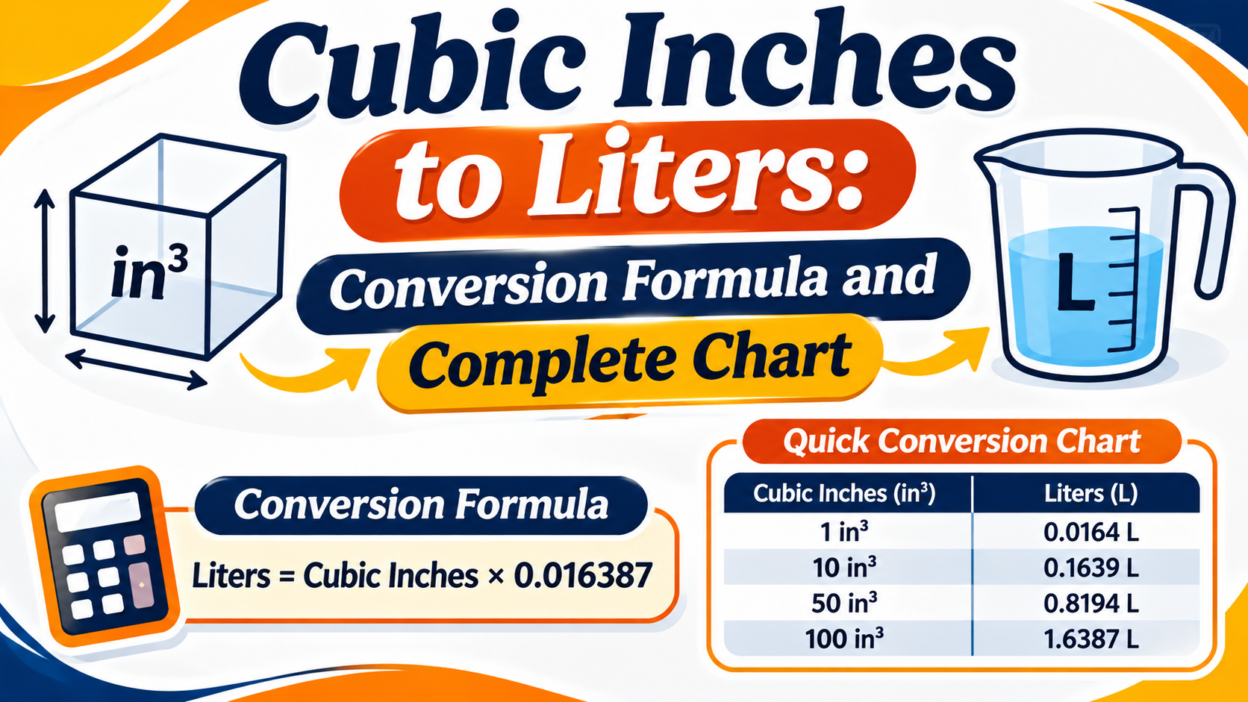
One cubic inch equals exactly 0.016387064 liters. This means you can convert any cubic-inch measurement into liters by multiplying it by 0.016387064.
For example, 100 cubic inches equal approximately 1.6387 liters, while 1,000 cubic inches equal approximately 16.3871 liters.
In this guide, you’ll find the conversion formula, practical examples, detailed conversion tables, reverse calculations, and explanations of where these measurements are useful.
📏 What Is the Conversion from Cubic Inches to Liters?
The standard conversion is:
1 cubic inch = 0.016387064 liters
A cubic inch measures volume, meaning the amount of three-dimensional space occupied by an object or available inside a container. A liter is another unit of volume that is commonly used for liquids, beverages, fuel, and storage capacity.
To understand the relationship, imagine a cube with each side measuring exactly one inch. The space inside that cube is one cubic inch. When converted into the metric system, that volume equals 0.016387064 liters.
Here are some important conversion values:
| Cubic Inches | Liters |
|---|---|
| 1 in³ | 0.016387 L |
| 5 in³ | 0.081935 L |
| 10 in³ | 0.163871 L |
| 25 in³ | 0.409677 L |
| 50 in³ | 0.819353 L |
| 100 in³ | 1.638706 L |
| 500 in³ | 8.193532 L |
| 1,000 in³ | 16.387064 L |
These values make it easier to understand how small cubic-inch measurements compare with liters.
🧮 The Simple Formula for Converting Cubic Inches to Liters
You do not need a complicated mathematical process to convert cubic inches into liters. A single multiplication formula gives you the answer.
Liters = Cubic Inches × 0.016387064
In mathematical form:
[
L = in^3 \times 0.016387064
]
Here:
- (L) represents the volume in liters.
- (in^3) represents the volume in cubic inches.
- 0.016387064 is the conversion factor.
For example, suppose you have a container with a volume of 250 cubic inches.
Insert the value into the formula:
[
250 \times 0.016387064 = 4.096766
]
Therefore:
250 cubic inches = approximately 4.0968 liters.
The formula works for small and large measurements. Simply multiply the number of cubic inches by the conversion factor to calculate the equivalent volume in liters.
📊 Cubic Inches to Liters Conversion Chart
If you frequently work with volume measurements, a conversion chart can save time and reduce calculation errors. Instead of using the formula for every measurement, you can find the closest value in the table.
The following chart covers common cubic-inch measurements and their corresponding liter values.
| Cubic Inches (in³) | Liters (L) |
|---|---|
| 1 | 0.016387 |
| 2 | 0.032774 |
| 3 | 0.049161 |
| 4 | 0.065548 |
| 5 | 0.081935 |
| 10 | 0.163871 |
| 15 | 0.245806 |
| 20 | 0.327741 |
| 25 | 0.409677 |
| 30 | 0.491612 |
| 40 | 0.655483 |
| 50 | 0.819353 |
| 60 | 0.983224 |
| 75 | 1.229030 |
| 100 | 1.638706 |
| 125 | 2.048383 |
| 150 | 2.458060 |
| 175 | 2.867736 |
| 200 | 3.277413 |
| 250 | 4.096766 |
| 300 | 4.916119 |
| 350 | 5.735472 |
| 400 | 6.554826 |
| 450 | 7.374179 |
| 500 | 8.193532 |
| 600 | 9.832238 |
| 700 | 11.470945 |
| 750 | 12.290298 |
| 800 | 13.109651 |
| 900 | 14.748358 |
| 1,000 | 16.387064 |
| 1,200 | 19.664477 |
| 1,500 | 24.580596 |
| 2,000 | 32.774128 |
| 2,500 | 40.967660 |
| 3,000 | 49.161192 |
| 4,000 | 65.548256 |
| 5,000 | 81.935320 |
| 10,000 | 163.870640 |
Values are rounded to six decimal places. Small differences may appear if you use fewer decimal places in your own calculations.
✍️ Step-by-Step Examples of Cubic Inches to Liters
The best way to understand a conversion formula is to see how it works with different measurements. The following examples cover several common values.
Example 1: Convert 10 Cubic Inches to Liters
Suppose you want to convert 10 cubic inches into liters.
Use the formula:
Liters = Cubic Inches × 0.016387064
Substitute the value:
10 × 0.016387064 = 0.16387064
Answer: 10 cubic inches = 0.1639 liters.
Example 2: Convert 50 Cubic Inches to Liters
For a volume of 50 cubic inches:
50 × 0.016387064 = 0.8193532
Answer: 50 cubic inches = 0.8194 liters.
Example 3: Convert 100 Cubic Inches to Liters
A measurement of 100 cubic inches is slightly larger than one and a half liters.
100 × 0.016387064 = 1.6387064
Answer: 100 cubic inches = 1.6387 liters.
Example 4: Convert 250 Cubic Inches to Liters
Multiply 250 by the conversion factor:
250 × 0.016387064 = 4.096766
Answer: 250 cubic inches = 4.0968 liters.
Example 5: Convert 500 Cubic Inches to Liters
For a larger measurement:
500 × 0.016387064 = 8.193532
Answer: 500 cubic inches = 8.1935 liters.
Example 6: Convert 1,000 Cubic Inches to Liters
Now consider a volume of 1,000 cubic inches.
1,000 × 0.016387064 = 16.387064
Answer: 1,000 cubic inches = 16.3871 liters.
These examples demonstrate that the same formula works regardless of the starting measurement.
🔄 How to Convert Liters Back to Cubic Inches
Sometimes, you may have a volume listed in liters but need to express it in cubic inches. In that case, you can reverse the original calculation.
The reverse conversion factor is:
1 liter = approximately 61.0237441 cubic inches.
Use this formula:
Cubic Inches = Liters × 61.0237441
For example, suppose a container has a capacity of 5 liters.
5 × 61.0237441 = 305.1187205
Therefore:
5 liters = approximately 305.12 cubic inches.
Here are some additional reverse conversions:
| Liters | Cubic Inches |
|---|---|
| 0.5 L | 30.5119 in³ |
| 1 L | 61.0237 in³ |
| 1.5 L | 91.5356 in³ |
| 2 L | 122.0475 in³ |
| 3 L | 183.0712 in³ |
| 4 L | 244.0949 in³ |
| 5 L | 305.1187 in³ |
| 8 L | 488.1899 in³ |
| 10 L | 610.2374 in³ |
| 15 L | 915.3562 in³ |
| 20 L | 1,220.4749 in³ |
| 25 L | 1,525.5936 in³ |
| 50 L | 3,051.1872 in³ |
| 100 L | 6,102.3744 in³ |
Remember these two rules:
- Cubic inches to liters: Multiply by 0.016387064.
- Liters to cubic inches: Multiply by approximately 61.0237441.
📐 Understanding Cubic Inches, Cubic Centimeters, and Liters
Cubic inches, cubic centimeters, and liters are all volume units, but they represent different quantities.
Cubic inches are commonly associated with the imperial measurement system. So Cubic centimeters and liters belong to the metric system.
Their relationships are particularly useful when comparing product specifications.
| Volume Unit | Equivalent |
|---|---|
| 1 cubic inch | 16.387064 cm³ |
| 1 cubic inch | 0.016387064 L |
| 10 cubic inches | 163.87064 cm³ |
| 100 cubic inches | 1,638.7064 cm³ |
| 1,000 cubic inches | 16,387.064 cm³ |
| 1 liter | 1,000 cm³ |
| 1 liter | 61.0237441 in³ |
| 1 cubic foot | Approximately 28.3168 L |
One important detail is that a cubic centimeter and a milliliter have the same volume.
1 cm³ = 1 mL
Therefore, one cubic inch also equals approximately 16.387 milliliters.
This relationship is useful when converting small container capacities or measurements for products that list volume in different metric units.
🏭 Where Are Cubic Inches to Liters Conversions Used?
Cubic-inch-to-liter conversions are useful in many practical situations. They are especially important when a product is designed or measured using one unit system but needs to be understood in another.
1. Automotive Engine Displacement
Engine displacement is sometimes measured in cubic inches, particularly in American automotive specifications. Other manufacturers and markets commonly express engine displacement in liters.
For example, an engine with a displacement of 350 cubic inches has an approximate displacement of:
350 × 0.016387064 = 5.7354724 liters.
This is commonly described as a 5.7-liter engine.
2. Storage Containers and Tanks
Containers, tanks, and storage boxes may have their internal volume listed in cubic inches. Converting this value into liters helps people understand how much liquid the container can hold.
For example, a container measuring 500 cubic inches has a volume of approximately 8.19 liters.
3. Product Packaging
International products may use different volume specifications depending on their intended market. Converting cubic inches into liters helps customers compare packaging capacities more easily.
4. Manufacturing and Engineering
Engineers and manufacturers often work with technical drawings and product specifications that include volume measurements. Converting between cubic inches and liters can make communication easier when teams use different measurement systems.
5. Aquariums and Water Storage
Aquarium equipment, water containers, and small tanks may have dimensions listed in inches. Calculating their internal volume and converting it into liters helps when estimating water capacity.
For rectangular containers, calculate the internal volume in cubic inches by multiplying length, width, and height. Then multiply that result by 0.016387064 to obtain liters.
6. Household and DIY Projects
When building boxes, storage units, or other containers, you may calculate volume using inch-based dimensions. Converting the result into liters provides a more familiar capacity measurement for liquids and storage.
Remember that the calculated volume represents the space inside the container only when you use its internal dimensions. Wall thickness and the shape of the container can affect its actual usable capacity.
📦 How to Calculate Container Volume Before Converting to Liters
Sometimes, you are not given a cubic-inch measurement directly. Instead, you may know the length, width, and height of a rectangular container.
You can calculate its volume first and then convert the result into liters.
The formula for a rectangular container is:
Volume = Length × Width × Height
All three dimensions must be measured in inches if you want the result in cubic inches.
For example, imagine a rectangular storage box with these internal dimensions:
- Length: 12 inches
- Width: 10 inches
- Height: 8 inches
First, calculate its cubic-inch volume:
12 × 10 × 8 = 960 cubic inches.
Next, convert that volume into liters:
960 × 0.016387064 = 15.73158144 liters.
Therefore:
A rectangular container measuring 12 × 10 × 8 inches has a theoretical internal volume of approximately 15.73 liters.
This method works for rectangular boxes and tanks. For cylinders, irregular shapes, or containers with curved surfaces, you need the appropriate geometric volume formula before converting the result into liters.
⚠️ Common Mistakes When Converting Cubic Inches to Liters
Even a simple conversion can produce incorrect results if you use the wrong formula or confuse volume measurements with length measurements.
Using the wrong conversion factor
The correct factor is 0.016387064 liters per cubic inch. Do not use the conversion factor for ordinary inches, because length and volume are different types of measurements.
Multiplying by the reverse conversion factor
To convert cubic inches into liters, multiply by 0.016387064. The factor 61.0237441 is used when converting liters into cubic inches.
Confusing cubic inches with square inches
Square inches measure area, while cubic inches measure volume. You cannot convert square inches directly into liters without additional information about depth or height.
Rounding too early
If you round the conversion factor or intermediate calculations too soon, small errors can accumulate. Keep additional decimal places during calculations and round the final answer according to your needs.
Ignoring the container’s internal dimensions
When calculating the capacity of a physical container, external dimensions may give a larger result than the actual usable space. Use internal measurements whenever you want to estimate liquid capacity.
Assuming every container holds its full calculated volume
Theoretical volume and practical capacity are not always identical. A container may need empty space at the top, or its shape may make the usable capacity different from a simple geometric estimate.
❓ Frequently Asked Questions
How many liters are in one cubic inch?
One cubic inch equals exactly 0.016387064 liters. This is the standard conversion factor for changing cubic inches into liters.
What is the formula for cubic inches to liters?
Multiply the number of cubic inches by 0.016387064.
Formula: Liters = Cubic Inches × 0.016387064.
How many cubic inches are in one liter?
One liter equals approximately 61.0237441 cubic inches.
How many liters are 100 cubic inches?
100 cubic inches equal approximately 1.6387 liters.
How many liters are 500 cubic inches?
500 cubic inches equal approximately 8.1935 liters.
How many liters are 1,000 cubic inches?
1,000 cubic inches equal approximately 16.3871 liters.
Is a cubic inch bigger than a liter?
No. One liter is much larger than one cubic inch. A liter contains approximately 61.02 cubic inches.
Are cubic inches and cubic centimeters the same?
No. One cubic inch equals approximately 16.387 cubic centimeters. A cubic centimeter is much smaller than a cubic inch.
How many milliliters are in one cubic inch?
One cubic inch equals approximately 16.387 milliliters because one cubic centimeter is equal to one milliliter.
Why is cubic-inch-to-liter conversion important for engines?
Engine displacement may be listed in cubic inches or liters depending on the manufacturer and market. Converting between the units makes it easier to compare engine sizes.
Can I use the same formula for every cubic-inch measurement?
Yes. Multiply any cubic-inch value by 0.016387064 to obtain liters. The formula works for small and large volumes.
How do I convert liters into cubic inches?
Multiply the number of liters by approximately 61.0237441. For example, 2 liters equal approximately 122.0475 cubic inches.
🎯 Final Answer: Cubic Inches to Liters
Converting cubic inches into liters is simple when you remember the correct relationship:
1 cubic inch = 0.016387064 liters.
Multiply your cubic-inch measurement by 0.016387064 to find its equivalent in liters.
For quick reference:
- 10 cubic inches = 0.1639 liters
- 50 cubic inches = 0.8194 liters
- 100 cubic inches = 1.6387 liters
- 250 cubic inches = 4.0968 liters
- 500 cubic inches = 8.1935 liters
- 1,000 cubic inches = 16.3871 liters
Use the formula and conversion charts in this guide to work with engine displacement, container capacity, manufacturing specifications, and other volume measurements. Once you understand the conversion factor, switching between cubic inches and liters becomes a straightforward calculation.

Colton Mercer is a writer and contributor at TechMeasurez, covering measurements, dimensions, size guides, conversions, comparisons, and practical online tools. His work focuses on turning everyday measurement questions into clear, easy-to-follow information. Through TechMeasurez, Colton aims to make useful facts, guides, and digital resources simple for everyone to understand.